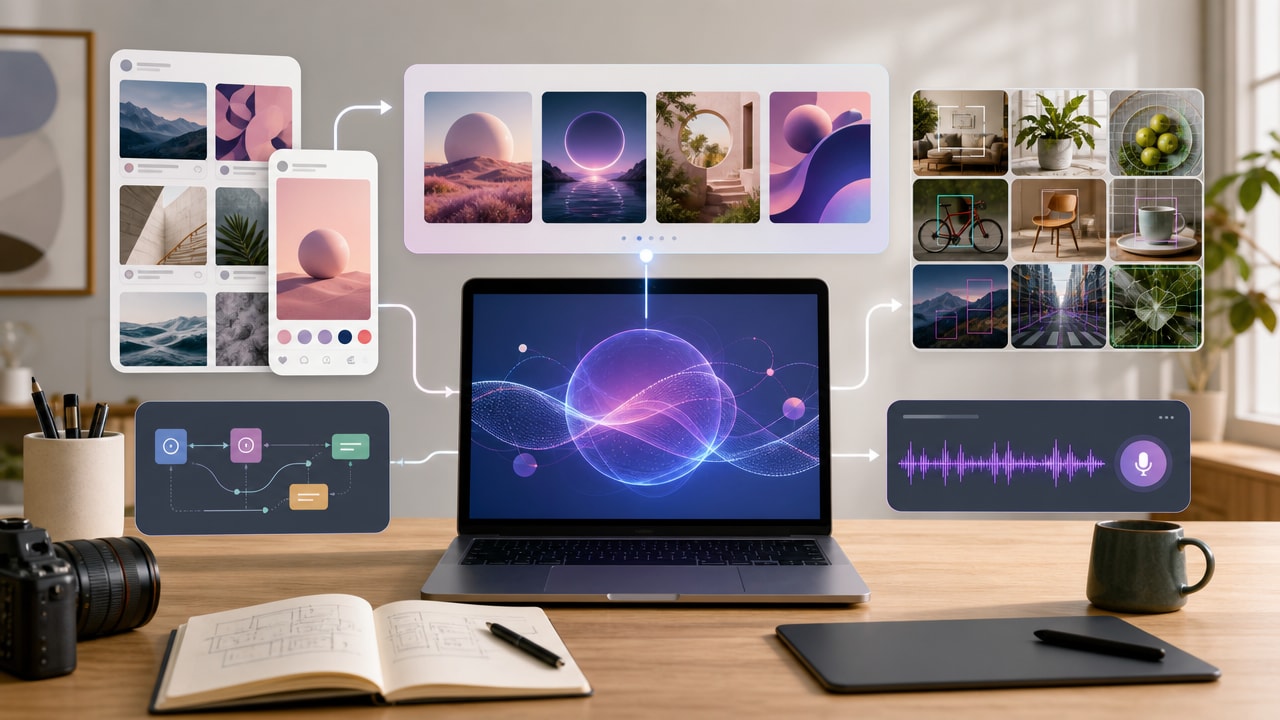
Meta Muse Spark AI creative assistant is a useful keyword to watch because Meta is moving its assistant from simple chat toward multimodal, app-native creation. Meta says Muse Spark now powers Meta AI on the web and app, with rollout across WhatsApp, Instagram, Facebook, Messenger, and AI glasses. For creators, the important point is not that Muse Spark replaces dedicated image or video models. It is that social distribution, visual understanding, shopping context, image generation, and assistant-style planning are becoming part of the same workflow.
What Meta announced
Meta introduced Muse Spark as the first model from Meta Superintelligence Labs and positioned it as the model behind a smarter Meta AI. The official announcement says Muse Spark supports reasoning, multimodal tasks, image generation during voice conversations, visual understanding from camera inputs, and broader rollout inside Meta’s family of apps. That makes it relevant for teams that already create campaign images, short clips, product visuals, and social variations for Instagram, Facebook, and messaging channels.
Independent coverage also frames Muse Spark as a broader rebuild of Meta’s AI stack, not just a single creative feature. That matters for SEO because users are likely to search for practical phrases such as Muse Spark image generator, Meta AI creative assistant, Meta AI image generator, and how Muse Spark fits creator workflows.
Why creators should care
The most immediate opportunity is workflow compression. A creator can move from visual research to image generation, shopping or style references, and social-context planning without leaving the assistant environment. This mirrors the broader market shift Makefun has been tracking: creative tools are moving away from isolated prompt boxes and toward all-in-one systems that combine planning, asset generation, editing, and publishing support.
- Image ideation: Muse Spark can support image generation inside Meta AI conversations, which is useful for drafts, mood boards, and quick social concepts.
- Visual understanding: Camera and photo understanding can help creators evaluate scenes, products, or references before generating new assets.
- Social context: Because Meta AI lives near Instagram, Facebook, WhatsApp, and Threads, it can become a discovery layer for creator ideas and audience context.
- App-native distribution: The strongest advantage is placement inside existing social workflows, not necessarily standalone model quality.
How it compares with dedicated AI image and video tools
Muse Spark should be treated as a creative assistant layer. Dedicated image models still matter when the task needs controlled art direction, high-resolution output, brand-safe prompt iteration, or precise editing. For those use cases, Makefun’s GPT Image 2 AI image generator coverage remains a closer fit. For motion workflows, a still image can move into image-to-video generation or a broader agentic video generator pipeline.
The practical takeaway is to use Muse Spark for planning and lightweight image ideation, then move production work into more controlled generation and editing pipelines when output quality, aspect ratio, source files, or campaign consistency matter.
Makefun workflow angle
For Makefun readers, the opportunity is to connect the Meta AI trend to repeatable content production. A simple workflow could look like this:
- Use Muse Spark-style assistants to gather audience context and draft visual directions.
- Generate production-ready stills with a dedicated image model when the creative brief is stable.
- Animate selected stills into short social clips with image-to-video tools.
- Review outputs for brand safety, factual accuracy, and platform fit before publishing.
This keeps the article neutral and avoids unsupported claims about Meta’s model quality. The SEO value comes from explaining where Muse Spark fits in a creator stack and linking it to Makefun’s existing AI image, AI video, and all-in-one workflow coverage.
FAQ
Is Muse Spark an AI image generator?
Muse Spark is broader than a standalone image generator. Meta describes it as a model powering Meta AI with reasoning, multimodal understanding, and image generation features inside assistant conversations.
Does Muse Spark replace AI video generators?
No. Based on current public information, it is better understood as an assistant and planning layer. Dedicated AI video generators are still better suited for production clips, motion control, and repeatable video workflows.
Why is this relevant to Makefun?
Makefun covers AI image, AI video, and all-in-one creator workflows. Muse Spark is relevant because social platforms are moving creation, discovery, and assistant behavior into the same interface.
Sources: Meta’s Muse Spark announcement and TechCrunch coverage of the launch.