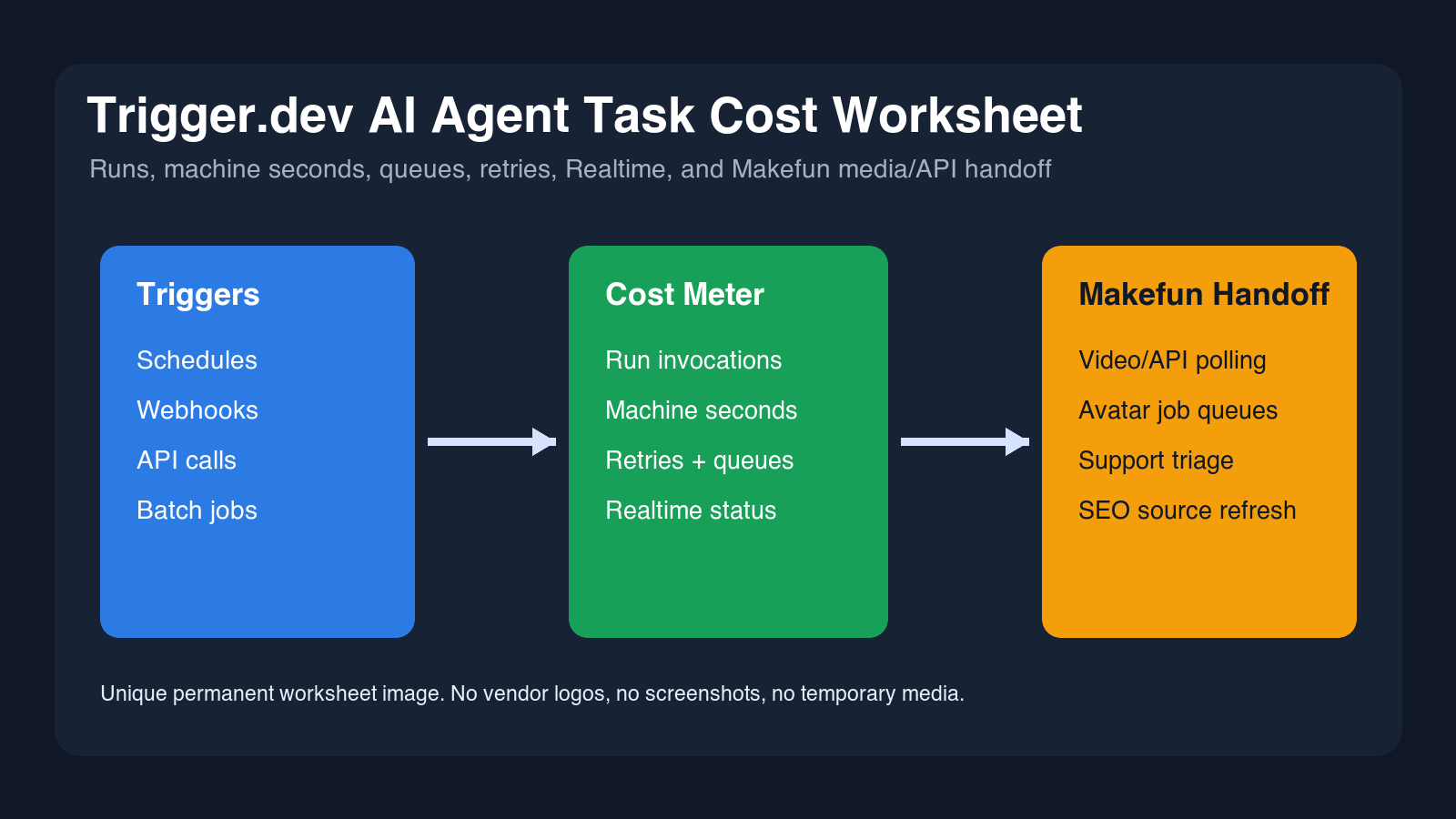
Trigger.dev pricing is easiest to model as a workflow ledger, not a plan-name comparison. For an AI agent, media API job, or SEO source-refresh queue, count executed runs, machine seconds, retries, queue fanout, Realtime subscriptions, and the external model or media API spend that sits outside Trigger.dev.

Quick Calculator Formula
Use this baseline formula for a monthly estimate: executed runs x ((executing seconds x selected machine rate) + run invocation cost). Then add retry percentage, subtask fanout, Realtime connection bundles, external LLM or media API calls, storage, logs, and human QA.
| Input | What to enter | Why it changes cost |
|---|---|---|
| Executed runs | Monthly tasks, subtasks, webhook runs, and scheduled runs | Trigger.dev lists a run invocation unit; retries and fanout create more runs. |
| Machine seconds | Average executing seconds per run by machine size | Current pricing exposes per-second rows such as small and medium machine rates. |
| Retries | 5%, 15%, and 30% failure/retry scenarios | Each retry can add another invocation and more executing time. |
| Queues and concurrency | Base queue, custom queue, burst day, and backlog assumptions | Limits affect whether the workflow needs a higher plan or a different architecture. |
| Realtime | Concurrent progress subscriptions and status updates | User-facing progress is useful for media jobs, but it is a separate planning row. |
Official Source Snapshot
Publication-day checks on June 26, 2026 returned 200 for Trigger.dev Cloud Pricing, Machines, Limits, Queue and Concurrency, Realtime, Realtime how-it-works, and Self-hosting docs. The pricing page exposed run invocation and per-second machine-rate units, including the package’s worksheet rows for $0.000025 per executing run and small-1x at $0.0000338 per second. Treat those as source-backed calculator inputs, not permanent prices.
Three Makefun Workloads
1. SEO Source Refresh And Pricing Monitors
For 20,000 monthly source-refresh jobs, start with executed checks, average runtime, retry rate, and human review sample. A 10-second small-1x job using the currently verified worksheet rows gives a rough infrastructure baseline before external browsing, model calls, storage, and editor review. The point is not the single example number; it is keeping run cost, machine time, and review labor in separate columns.
2. Media And Avatar API Orchestration
For 5,000 monthly media jobs, Trigger.dev can coordinate webhook triggers, polling subtasks, retries, and Realtime progress while Makefun tools create or clean assets. Link the orchestration budget to the commercial workflow: AI image-to-video, the image-to-video app, Talking Video, AI Avatar API, Voice Clone, watermark cleanup, and subtitle cleanup. Those product actions still have their own provider, storage, and QA costs.
3. Long-Running AI Support Agents
For support triage, ticket enrichment, and source-backed handoffs, model longer runs by machine size and by the number of tool calls. Waiting behavior, checkpointing, queue pressure, and self-hosting operations matter as much as the headline machine row. Keep model tokens, vector searches, and human escalation outside the Trigger.dev subtotal.
Same-Unit Alternatives To Check
Compare Trigger.dev against adjacent workflow platforms only after normalizing units. Internal same-use references include the n8n, Pipedream, Sim AI, Retool Agents, and Base44. Use them as comparison rows, not as proof that one provider is always cheaper.
Publisher Checklist
- Check the target slug, WordPress REST search, and post sitemap before publishing.
- Refresh official pricing, machines, limits, queue/concurrency, Realtime, and self-hosting docs on the day of publication.
- Use a unique permanent featured image; do not use vendor logos, screenshots, hotlinks, temporary media, or media ID 7037.
- Verify body links, category blog id 2, Yoast title/meta/canonical/social image, canonical URL, cache-busted URL, and sitemap inclusion after publish.
FAQ
How do I estimate Trigger.dev usage?
Start with executed runs, average executing seconds, machine size, retry rate, and subtask fanout. Add Realtime only when users or operators need live progress.
When does machine size matter?
Machine size matters when the task performs CPU-heavy parsing, media metadata work, large API fanout, or long-running agent steps. For simple webhook routing, invocation count and retry rate can dominate.
Should Makefun self-host this workflow?
Self-hosting can make sense for compliance, infra control, or sustained workloads, but include worker resources, Postgres, Redis, logs, deployment, monitoring, backups, and on-call time. Do not compare managed Trigger.dev to self-hosting by cloud compute alone.