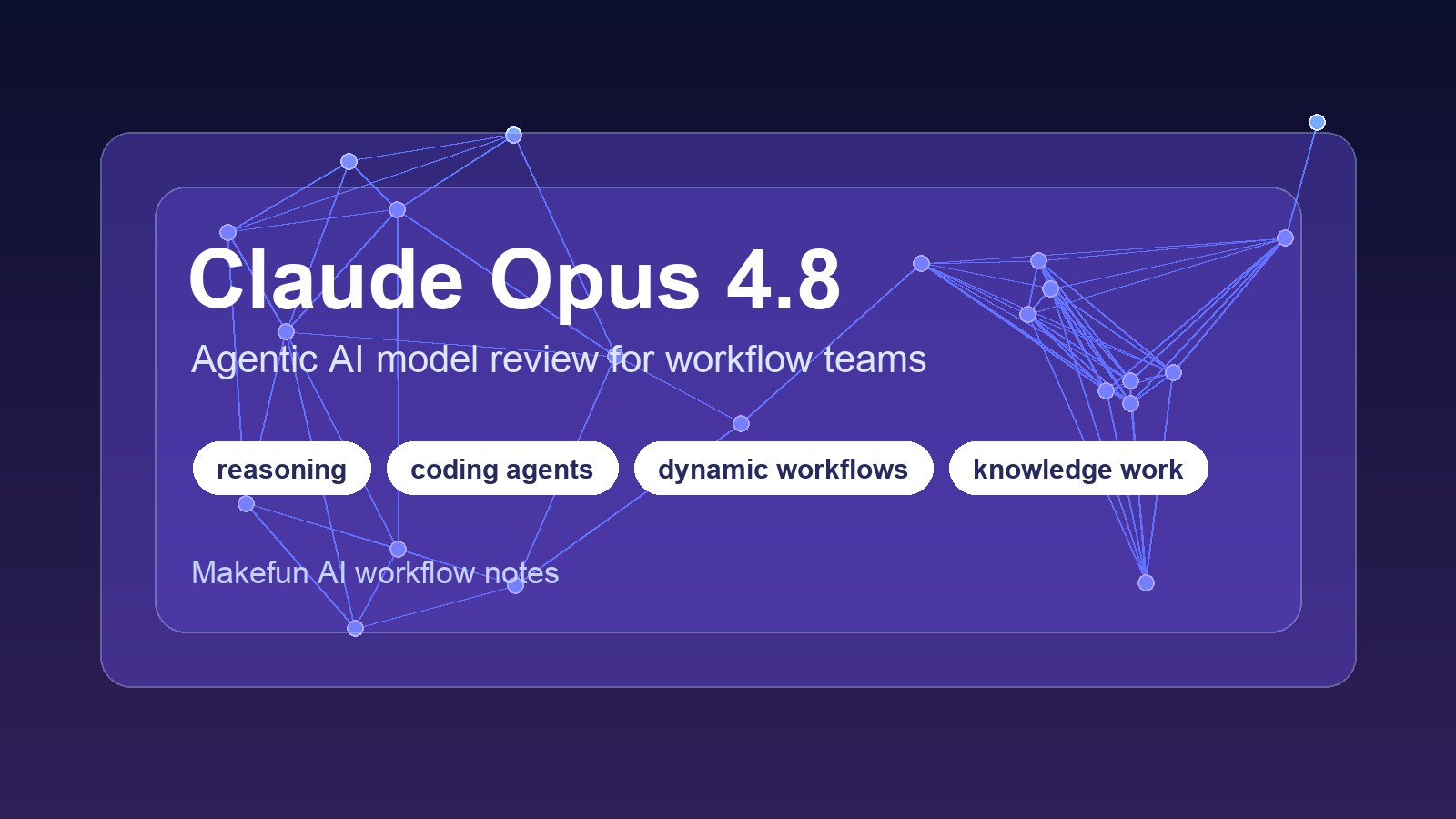
Claude Opus 4.8 is not a video model, image model, or avatar generator. It matters to Makefun readers because it is a planning and agentic-workflow model: the kind of AI system that can help teams research, script, code, compare tools, and coordinate production pipelines before media generation starts.
Anthropic announced Claude Opus 4.8 on May 28, 2026. The release is positioned as an upgrade over Opus 4.7 with stronger benchmark results, better collaboration behavior, effort controls in Claude, dynamic workflows in Claude Code, and cheaper fast mode. AWS also listed Claude Opus 4.8 as available through Amazon Bedrock and Claude Platform on AWS.
Quick verdict
Claude Opus 4.8 looks most useful for teams that need a reliable AI collaborator across long, multi-step work: coding agents, research agents, document-heavy analysis, product planning, and content workflow orchestration. For creators, the important takeaway is not that Opus replaces visual generation models. It is that frontier LLMs are becoming better at running the planning layer around tools like image-to-video, AI avatars, and AI video APIs.
What changed in Claude Opus 4.8?
- Better agentic work: Anthropic says Opus 4.8 improves over Opus 4.7 across coding, agentic skills, reasoning, and practical knowledge-work evaluations.
- Effort control: Claude users can choose how much effort the model spends on a task, trading speed and rate-limit usage against deeper reasoning.
- Dynamic workflows: Claude Code adds a research-preview feature that lets Claude plan very large tasks and run many parallel subagents in one session.
- Cheaper fast mode: Anthropic says fast mode can run at 2.5x speed and is now three times cheaper than fast mode for previous models.
- Same regular pricing as Opus 4.7: Anthropic lists regular usage at $5 per million input tokens and $25 per million output tokens.
Where Opus 4.8 fits in an AI media workflow
A practical AI video workflow has several layers. There is the planning layer, where a team decides the audience, message, script, shot list, source assets, and validation criteria. There is the generation layer, where image, video, avatar, voice, and editing models produce assets. There is also the review layer, where someone checks factual claims, brand fit, link quality, and final delivery.
Claude Opus 4.8 belongs mostly in the planning and review layers. It can help write a campaign brief, compare model options, draft a storyboard, audit a landing page, or turn a messy product note into production instructions. A media model then turns those instructions into visual or audio output. That is why broader AI model coverage still belongs on Makefun: the model layer influences how creators plan and evaluate media production.
Claude Opus 4.8 vs media generation models
| Use case | Claude Opus 4.8 | Video/image generation models |
|---|---|---|
| Research and planning | Strong fit for briefs, comparison notes, and multi-step reasoning | Usually not the main role |
| Script and prompt writing | Strong fit for structured prompts, shot lists, and QA criteria | Consumes prompts and turns them into media |
| Asset creation | Not a direct visual-generation model | Core role: images, video clips, avatars, voice, motion |
| Workflow automation | Useful for agentic orchestration and review | Useful as callable generation steps inside a pipeline |
Cost and pricing comparison
For workflow teams, Opus 4.8 should be evaluated as a premium planning and agentic-work model, not as the cheapest way to generate every token. Anthropic lists regular Claude Opus 4.8 API pricing at $5 per million input tokens and $25 per million output tokens, unchanged from Opus 4.7. Fast mode is listed at $10 per million input tokens and $50 per million output tokens. Anthropic’s pricing table also shows prompt-cache hits at $0.50 per million tokens, while cache writes are priced above base input.
The closest OpenAI comparison is GPT-5.5. OpenAI lists GPT-5.5 at $5 per million input tokens, $0.50 per million cached input tokens, and $30 per million output tokens. That makes input pricing similar to Opus 4.8, while listed output pricing is higher for GPT-5.5. OpenAI also notes that prompts above 272K input tokens are priced at 2x input and 1.5x output for the full session, and that regional processing adds a 10% uplift.
| Model or mode | Input | Cached / cache hit | Output | Cost note |
|---|---|---|---|---|
| Claude Opus 4.8 regular | $5 / 1M tokens | $0.50 / 1M cache hits | $25 / 1M tokens | Premium Claude model; same listed regular price as Opus 4.7. |
| Claude Opus 4.8 fast mode | $10 / 1M tokens | Provider-specific cache behavior applies | $50 / 1M tokens | Better latency, materially higher token price. |
| GPT-5.5 | $5 / 1M tokens | $0.50 / 1M cached input | $30 / 1M tokens | Similar input price; higher listed output price; long-context and regional uplifts can change total cost. |
| Claude Sonnet 4.6 | $3 / 1M tokens | $0.30 / 1M cache hits | $15 / 1M tokens | Lower-cost Claude alternative for drafts, routine coding, and less demanding agent tasks. |
| Claude Haiku 4.5 | $1 / 1M tokens | $0.10 / 1M cache hits | $5 / 1M tokens | Cheaper routing option for classification, extraction, simple rewrites, and high-volume automation. |
The practical recommendation is to route by task difficulty. Use Opus 4.8 for high-stakes planning, difficult coding, multi-document reasoning, agent orchestration, and final review. Use cheaper models for drafting, extraction, bulk metadata work, simple summaries, and repeated QA checks. The bill is driven not only by posted input/output rates, but also by output length, effort level, cache strategy, long-context tiers, and whether the workflow uses fast or priority processing.
Should creators care?
Yes, but with a clear expectation. Claude Opus 4.8 is not a replacement for a dedicated creative model. Its value is in making the workflow around creative models more coherent. A marketing team could use it to compare campaign angles before creating a product avatar video. A developer team could use it to design API workflows before connecting media-generation endpoints. A content team could use it to turn trend research into a publishable article outline, then use Makefun-style tools for visuals and video.
Best-fit article and comparison ideas
- Claude Opus 4.8 vs GPT-5.5 for creator workflows: compare planning quality, evidence handling, cost, and tool use rather than only benchmark headlines.
- Claude Opus 4.8 for AI video production planning: test whether it can turn a product page into scripts, shot lists, image prompts, and QA checks.
- Opus 4.8 plus Makefun AI Avatar workflow: use the model for script and scene planning, then produce avatar assets with a dedicated video workflow.
- Dynamic workflows for content operations: explain how agentic planning could help teams audit hundreds of pages, update briefs, or validate internal links.