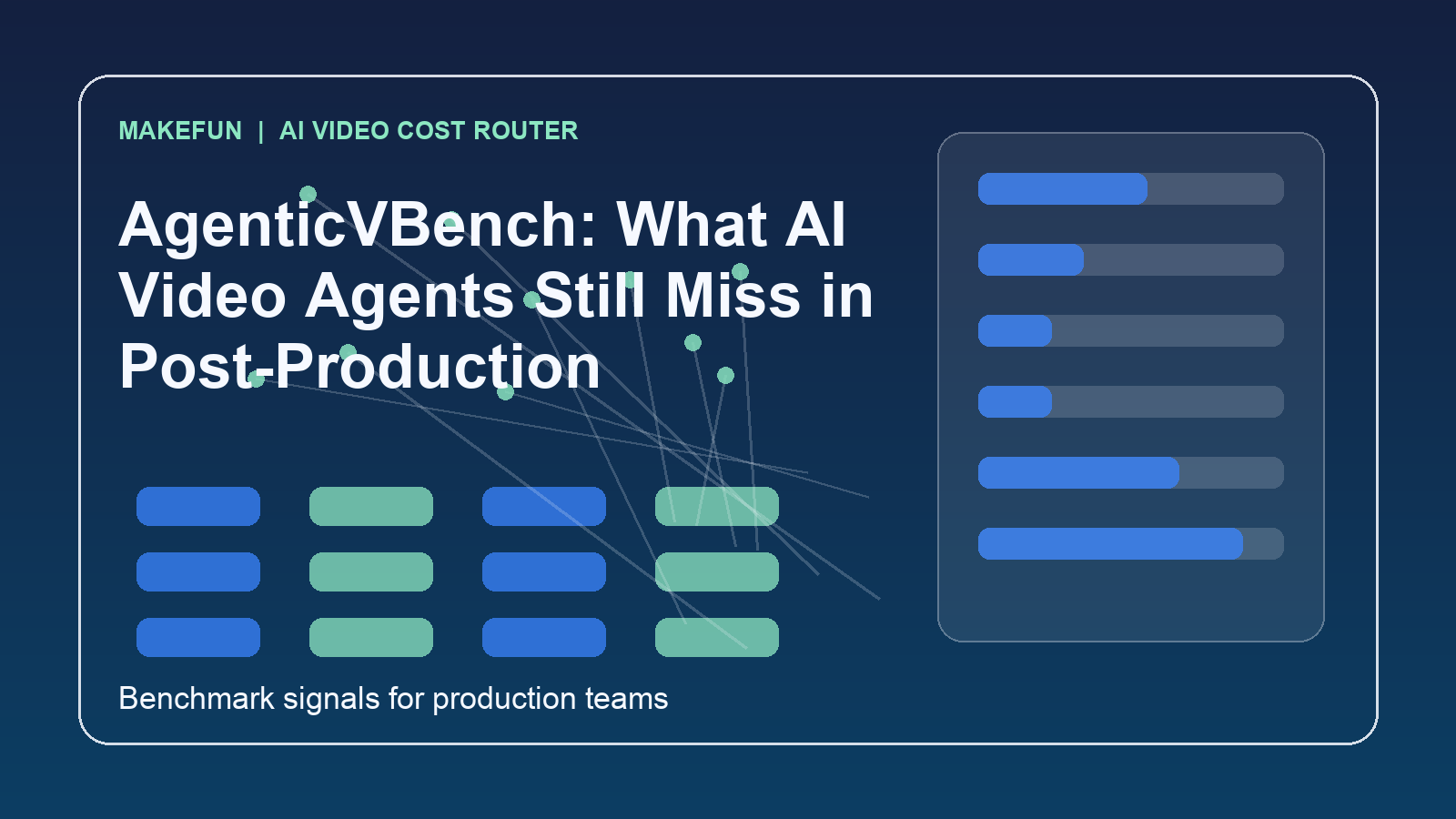
AgenticVBench is a new benchmark for a question that matters to every AI video workflow: can an AI agent actually complete real post-production tasks, or does it only look capable in a short demo? The benchmark is useful for Makefun readers because agentic video tools are moving from prompt-to-clip generation toward planning, editing, reviewing, and publishing workflows.
What AgenticVBench measures
The paper frames video post-production as a demanding test bed for multimodal agents. A useful editor-agent must understand text, images, audio, video, timelines, tool outputs, and project goals at the same time. AgenticVBench turns that into 100 real post-production tasks across four task families, with expert rubrics and programmatic checks instead of a simple final-answer score.
- Task realism: the tasks come from real post-production workflows, not generic single-step prompts.
- Expert grounding: the benchmark uses contributions from experienced post-production professionals.
- Tool-use pressure: models are evaluated inside agent harnesses, so planning and execution matter as much as raw model quality.
- Production relevance: the measured failures help explain why video agents still need checkpoints, review states, and rollback paths.
Why the result matters for AI video creators
The strongest evaluated agent stack reportedly stays far below human expert performance. That is not a reason to ignore agentic video. It is a reason to design the workflow honestly. A creator should let agents draft, sort, label, summarize, and propose edits, but keep human approval around story structure, brand-sensitive cuts, audio alignment, final exports, and client-facing deliverables.
For Makefun-style production, the useful pattern is a narrow agent with clear inputs and outputs: generate candidate scenes, compare versions, prepare captions, route media into an image-to-video AI workflow, and then hand off to a reviewer before publishing. That is different from asking one autonomous system to manage the whole video from brief to delivery.
How it connects to existing Makefun workflows
AgenticVBench supports a more practical way to explain the agentic video generator category. Instead of treating agents as magic editors, the benchmark points to concrete workflow pieces: planning, tool calls, verification, version comparison, and handoff. Those pieces also connect to Makefun’s AI video generator guide and developer-oriented AI video API coverage.
Recent product launches such as Runway Agent and Mobbi-style video agents show the market moving toward conversational production. AgenticVBench adds a useful counterweight: teams should ask how the agent is evaluated, where it pauses for approval, and whether its editing decisions are traceable after the output is generated.
Competitor observations
Runway Agent is positioned around a conversation-to-finished-video experience. Mobbi focuses on agentic editing and longer-form video workflows. D-ID Agentic Videos emphasizes interactive video experiences with real-time AI agents. AgenticVBench is not a competitor product, but it gives creators a way to compare these claims: judge each tool by task completion, review controls, traceability, export reliability, and how gracefully it handles mistakes.
No pricing section needed
This article covers an open research benchmark rather than a paid model, API, SaaS subscription, or usage-metered product review. The practical cost takeaway is indirect: failed autonomous edits create hidden human review cost, so teams should measure rework time, not just generation time.
FAQ
Is AgenticVBench an AI video generator?
No. AgenticVBench is a benchmark for evaluating AI agents on video post-production tasks. It helps creators understand what current agent systems can and cannot reliably do.
What should creators take from the benchmark?
Use agents for bounded tasks with visible checkpoints. Avoid fully autonomous post-production for work that needs brand accuracy, legal review, exact timing, or client approval.
How should Makefun users test an agentic video workflow?
Start with one repeatable task, such as scene selection, caption cleanup, or version comparison. Track completion rate, review time, and edit corrections before expanding the agent into a larger production chain.