Mistral Vibe AI agent is a timely signal for teams that already use AI to plan video, image, API, and creator operations. Mistral is moving Le Chat into Vibe, a unified agent for long-running work and coding, while Medium 3.5 gives the stack a model tuned for reasoning, tool calls, and software workflows.
What changed with Mistral Vibe
Mistral’s May 28, 2026 announcement positions Vibe as one agent across work and code. Work Mode handles multi-stage tasks such as search, analysis, document drafting, scheduled runs, and connector-based workflows. Code Mode adds remote coding sessions, GitHub project context, IDE support, terminal support, diff review, and pull-request-oriented execution.
The earlier May 22 update matters because it ties Vibe remote agents to Mistral Medium 3.5. That model is described as a 128B dense open-weight model with a 256k context window, built for instruction following, reasoning, coding, and long agent runs. For Makefun readers, the relevant point is not only code generation. It is whether an agent can keep product context, API constraints, media handoffs, and review checkpoints visible while work continues in the background.
Where it fits in a Makefun-style workflow
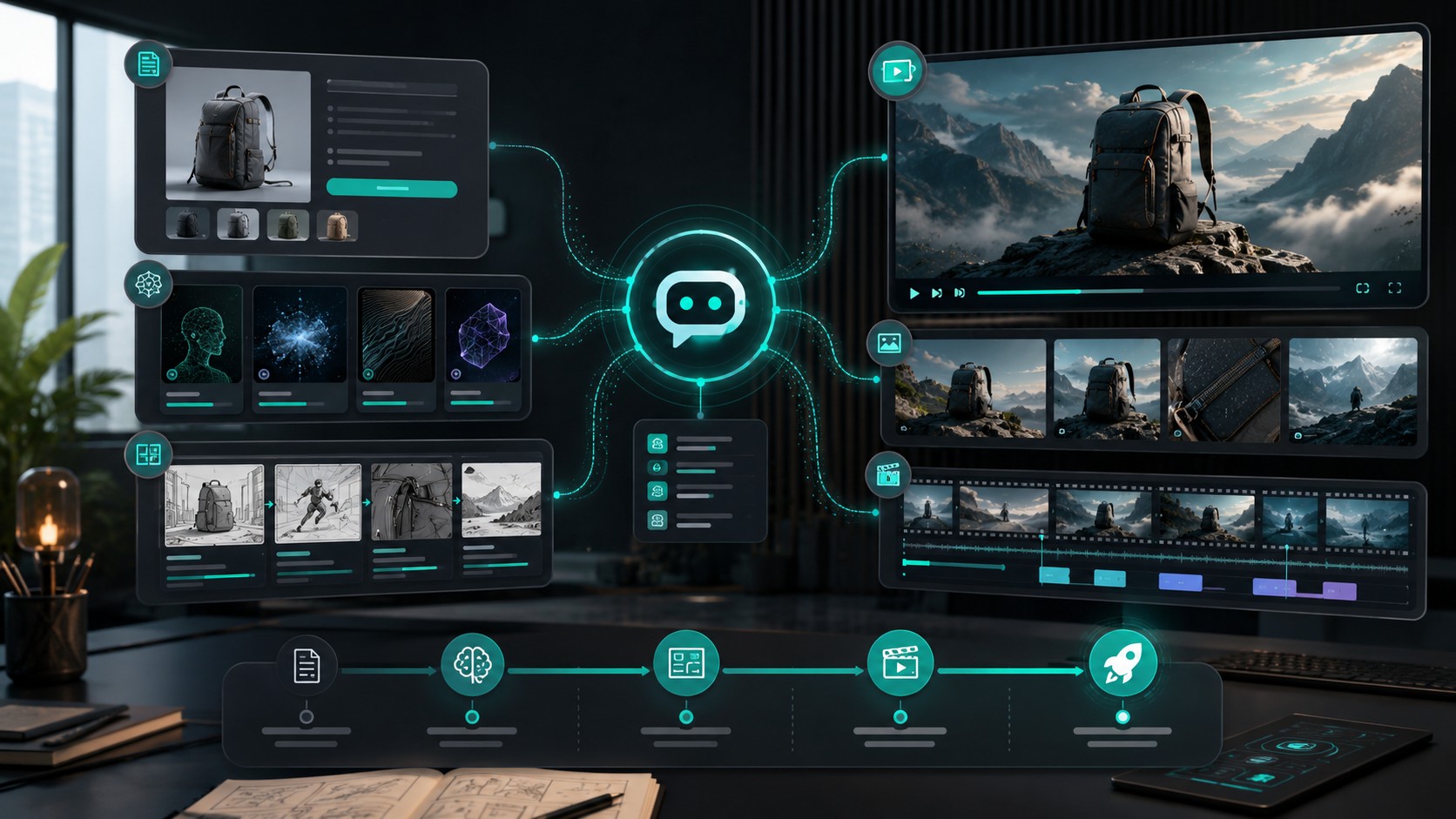
A practical Mistral Vibe workflow would sit around the production pipeline rather than replacing every creative decision. It can draft API integration notes, prepare release checklists, compare model options, write test cases for media jobs, summarize campaign inputs, and keep recurring operations moving. The actual media generation step can still happen through a dedicated AI video API or a focused agentic video generator workflow.
That split is important for creator teams. Agents are useful when the task has explicit inputs, logs, approvals, and rollback paths. They are risky when they silently rewrite brand claims, publish assets without review, or choose media settings without cost controls. Vibe’s visible plans, permissions, and remote sessions make the category easier to evaluate, but teams should still define where a human reviews copy, pricing, compliance, and final creative output.
Competitor observations
The current agent market is converging around the same buyer problem: long-running work needs context, connectors, review, and cost visibility. Cursor Composer 2.5 is focused on coding-agent workflows inside a developer environment, while Claude Opus 4.8 is a high-capability frontier model used for coding and agentic planning. Mistral Vibe is positioned more broadly as one agent for productivity and code, with open-weight Medium 3.5 also creating a self-hosting path for some teams.
For Makefun-adjacent teams, the comparison should be workflow-led. Choose an agent by whether it can hold the right project context, preserve approvals, integrate with GitHub and workspace tools, expose diffs or outputs for review, and keep media/API costs understandable.
Cost and pricing comparison
Mistral’s public pricing page lists Free access for limited Vibe usage, Pro at $14.99 per month, Team at $24.99 per user per month, and custom Enterprise pricing. For API work, Mistral Medium 3.5 is listed at $1.50 per million input tokens and $7.50 per million output tokens. The same pricing page lists Devstral 2 at $0.40 per million input tokens and $2.00 per million output tokens, which can be a lower-cost coding-agent option when the workload does not need the broader Medium 3.5 profile.
A same-use comparison is Claude Opus 4.8 or GPT-5.5 style frontier-agent work. OpenAI’s GPT-5.5 API announcement lists $5 per million input tokens and $30 per million output tokens, with Batch and Flex at half rate and Priority at 2.5x. Anthropic’s Claude Opus 4.8 public pricing is also higher than Mistral Medium 3.5 in common agent comparisons. The right choice is not the cheapest token line: coding agents can burn cost through long contexts, repeated file reads, output-heavy diffs, reasoning or effort settings, cache writes and hits, remote-session retries, team-seat limits, fast or priority modes, and review time after the agent finishes.
How to evaluate it before adopting
- Start with one bounded workflow: for example, API documentation updates, prompt-library cleanup, or campaign brief synthesis.
- Track review cost: measure how long humans spend checking code, links, media settings, and final copy.
- Separate planning from publishing: let the agent prepare assets or changes, but keep final WordPress, campaign, or production approval explicit.
- Compare seat and token economics: subscription limits and API tokens can matter more than headline plan price.
FAQ
Is Mistral Vibe only a coding agent?
No. Mistral is positioning Vibe as a unified work and coding agent. Coding is a major surface, but Work Mode also targets research, analysis, documents, schedules, and connector-based operations.
Why does Medium 3.5 matter for creator operations?
Medium 3.5 is built for reasoning, coding, and long agent runs. Those capabilities are useful when creator teams need to connect API decisions, media workflows, campaign requirements, and review steps across several tools.
Should teams pick Mistral Vibe only because its API price is lower?
No. Token price is only one part of agent cost. Evaluate total workflow cost, including context length, output volume, retries, subscription limits, review time, and whether the agent reduces or increases operational rework.