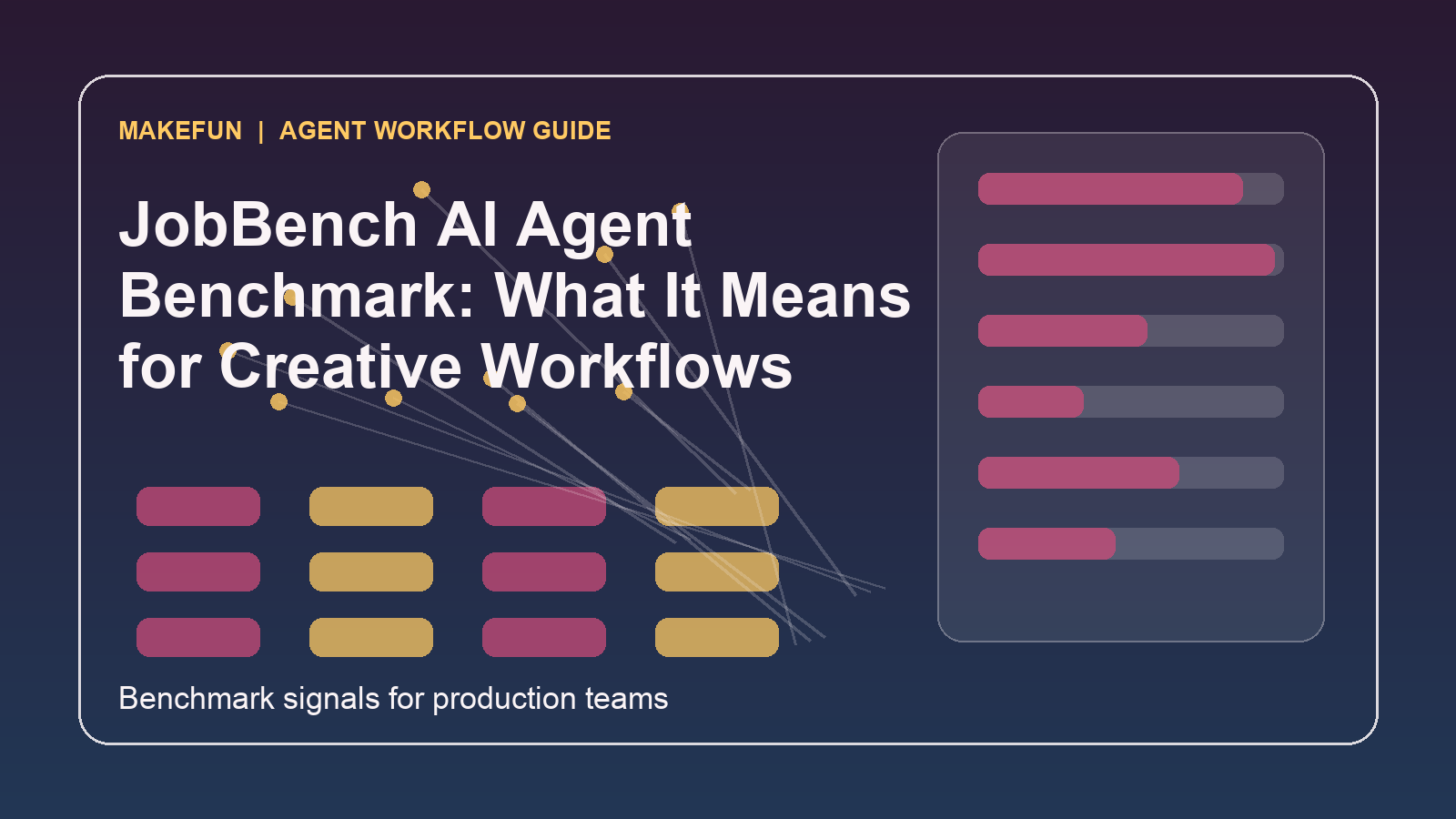
JobBench is a useful signal for teams evaluating AI agents because it asks a different question from most leaderboards: not just what an agent can automate, but whether the work matches what people actually want to delegate.
The May 2026 paper JobBench: Aligning Agent Work With Human Will introduces a benchmark built around expert-prioritized workflows. That framing matters for creator teams, AI video teams, and marketing operations because the best agent is not always the one with the highest raw reasoning score. It is the system that can take a messy brief, inspect assets, make reversible edits, and surface uncertainty before it changes the final deliverable.
Why JobBench fits the AI workflow search trend
Search interest around AI agents is moving from generic chatbot comparisons toward practical workflow questions: which tasks can be delegated, how much review is still needed, and what breaks when an agent touches files, browsers, calendars, creative tools, or production systems. JobBench gives that discussion a more useful vocabulary by focusing on delegation fit instead of replacement claims.
For Makefun-adjacent workflows, the clearest use case is pre-production and operations around media work. An agent might gather references for an avatar campaign, compare AI video generation options, outline a prompt plan, build a shot list, prepare API documentation notes, or check whether final assets match a brand brief. Those tasks are valuable when the agent can preserve context and ask for approval at the right moment.
What the benchmark changes for creators
JobBench makes one point especially clear: autonomous work should be evaluated as a workflow, not as a single prompt. Creative teams should test agents on the handoffs they already understand: intake, research, planning, asset selection, draft generation, QA, and publishing support. That is closer to how an agentic video generator or an AI production assistant is actually used.
The practical takeaway is to score agents on review cost. If a model writes a strong brief but leaves unclear citations, misses a rights constraint, or silently changes a file, the human still pays the cost later. If it produces a slightly less polished draft but preserves source links, explains risks, and keeps outputs reversible, it may be the better production tool.
Cost and pricing comparison
Agent benchmarks can hide cost differences because a completed task may require long context, multiple tool calls, retries, cached reads, and large output drafts. Current official pricing pages show why teams should model the whole run, not only the headline model score.
- Claude pricing lists Opus 4.8 as the high-intelligence agent and coding model, with API pricing at $5 per million input tokens and $25 per million output tokens. Anthropic also lists prompt-cache write/read prices and batch processing discounts, so repeated briefs and reference packs can change the real cost.
- OpenAI GPT-5.5 API docs position GPT-5.5 for complex professional work and show a $5 input / $30 output per-million-token price point. The page also highlights reasoning effort controls, a large context window, and optimization paths such as Batch, Flex, and Priority processing.
- Gemini API pricing shows a broader spread for high-volume agent tasks, including Gemini 3.1 Flash-Lite at lower per-token rates and Gemini 3.5 Flash at higher rates with grounding charges. Search grounding, context caching, storage, and batch mode can materially change the bill.
The hidden cost drivers are output tokens, reasoning or effort settings, context tiers, cache writes and cache hits, browser or computer-use steps, file uploads, generated media, grounding/search calls, batch discounts, priority modes, and regional or enterprise uplifts. For creative workflows, add one more driver: human review time. A cheaper agent that creates hard-to-audit drafts can become expensive when editors must re-check every claim and asset.
How to use JobBench in an AI video or avatar team
Use JobBench as a template for your own acceptance tests. Pick five real tasks that people already want to delegate, such as turning a product page into a video brief, preparing avatar script variants, checking an AI video API integration checklist, comparing model costs, and summarizing launch evidence for a blog post. Then measure completion quality, review burden, and whether the agent preserved the right approval points.
The strongest teams will not treat the benchmark as a winner-takes-all ranking. They will use it to decide where agents belong in the production chain. Research, planning, and QA can often be delegated earlier than final publishing, paid media claims, legal review, or brand-sensitive comparison pages.
Bottom line
JobBench is a timely benchmark because AI agents are entering real creative operations. For teams building around AI video, avatars, image generation, APIs, and creator productivity, the important question is not whether an agent looks autonomous in a demo. It is whether the agent handles the specific work people want to hand off, keeps costs visible, and leaves enough evidence for a human to trust the result.