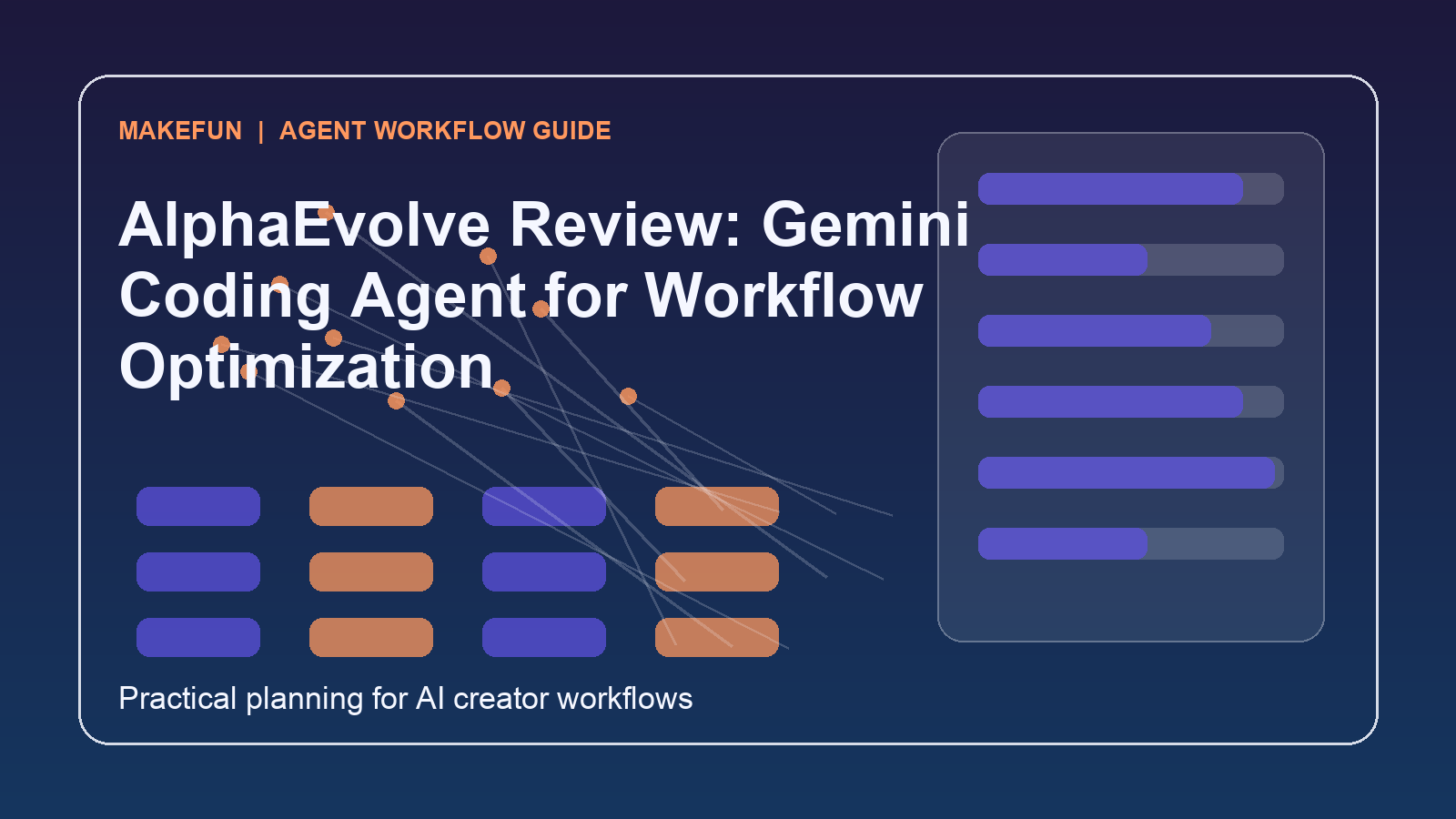
Google DeepMind’s AlphaEvolve update is a useful signal for teams that plan AI agents, API workflows, and media-production systems. The May 2026 update describes AlphaEvolve as a Gemini-powered coding agent that designs and improves algorithms, then shows where those algorithms are already affecting infrastructure, science, routing, and model optimization.
For Makefun readers, the practical point is not that every creator needs a research coding agent today. It is that agent workflows are moving from chat-style assistance toward measurable optimization loops: define a target, generate candidates, test them, keep the best results, and repeat. That pattern can also shape how AI video, avatar, image, and API teams evaluate prompts, queues, render pipelines, moderation steps, and post-production automation.
What AlphaEvolve is
Google DeepMind says AlphaEvolve is a Gemini-powered coding agent for designing advanced algorithms. In the new impact update, DeepMind says the system has been used beyond the original research setting, including infrastructure optimization, genomics, power-grid modeling, quantum circuits, math problems, logistics, advertising-model components, and computational materials work.
The most relevant lesson for creator and product teams is the shape of the workflow. AlphaEvolve is not just writing one answer. It searches through many candidate programs or algorithmic changes, evaluates them against a defined objective, and turns promising discoveries into deployable improvements. That makes it closer to an automated experimentation loop than a normal code autocomplete tool.
Why this matters for creative AI workflows
AI media products already depend on many algorithmic decisions that users rarely see: how jobs are queued, how retries are handled, how reference images are prepared, how audio and video are synchronized, how files are cached, and how a final result is scored before delivery. An AlphaEvolve-style approach points to a future where agents can tune those layers continuously instead of only helping with visible prompt writing.
For example, a video workflow team might ask an agent to reduce failed renders, shorten average queue time, improve lip-sync acceptance, or find cheaper routing between model tiers. The agent would still need human guardrails, but the evaluation target becomes concrete. That is the part Makefun-style teams should watch: agent value increasingly comes from measured workflow improvement, not just fluent text.
Where AlphaEvolve fits beside media and API tools
AlphaEvolve is not a direct replacement for an agentic video generator or an AI video API. It is better understood as infrastructure for discovering better procedures. That can influence creator tools indirectly by improving scheduling, routing, model selection, cache behavior, evaluation scripts, and internal quality-control systems.
This also explains why the update is relevant even when the public examples are scientific or infrastructure-heavy. The same optimization loop can be adapted to creator operations: pick an objective, collect evaluation data, test many variants, and publish only changes that improve a measurable outcome without breaking quality, safety, or user trust.
Cost and pricing comparison
Google has not published a simple self-serve AlphaEvolve SKU in the update. DeepMind says Google Cloud is bringing the technology to commercial enterprises, so teams should treat it as an enterprise or cloud-supported capability rather than a fixed-price consumer agent. That makes cost planning different from a normal subscription tool.
For adjacent build-and-test agent workflows, Gemini API pricing, OpenAI GPT-5.5 model pricing, and Claude pricing are useful comparison anchors. The public rates differ by input tokens, cached input, output tokens, context size, batch discounts, priority or fast modes, and tool or grounding charges. A workflow that tests thousands of candidate variants can become expensive even when each individual prompt looks cheap.
The hidden cost drivers are the same ones that matter in AI video operations: long context windows, repeated failed attempts, evaluator calls, large output traces, cache writes and hits, search or grounding calls, generated media tests, storage, priority queues, human review time, and regional or enterprise deployment requirements. Cost should be judged against the improvement achieved, such as lower render failure rates or shorter production cycles, not just against the model’s headline token price.
How to evaluate the opportunity
Teams should start with a narrow workflow where success can be measured. Good candidates include reducing retry rates, finding cheaper model-routing rules, improving automated QA checks, shortening batch processing time, or testing prompt templates against a known benchmark. Avoid asking a discovery agent to change brand promises, legal copy, or user-facing pricing without human review.
The near-term SEO and product opportunity is to explain these agentic optimization patterns in plain language. Creators, developers, and marketers do not need every research detail, but they do need to understand why the next wave of AI tools may feel less like one-shot generators and more like systems that improve the production process itself.
FAQ
Is AlphaEvolve a video generator?
No. AlphaEvolve is a Gemini-powered coding and algorithm-discovery agent. Its relevance to video and avatar workflows is indirect: it shows how agents can optimize the systems behind creative production.
Does AlphaEvolve have public pricing?
Not as a simple self-serve public SKU in the May 2026 update. For planning, compare adjacent Gemini, OpenAI, and Claude API costs, then add evaluation, compute, storage, and human-review overhead.
What should Makefun-style teams learn from it?
The main lesson is to define measurable workflow objectives. Agent systems are most useful when they can test changes against clear targets such as lower cost, fewer retries, faster delivery, or better quality checks.