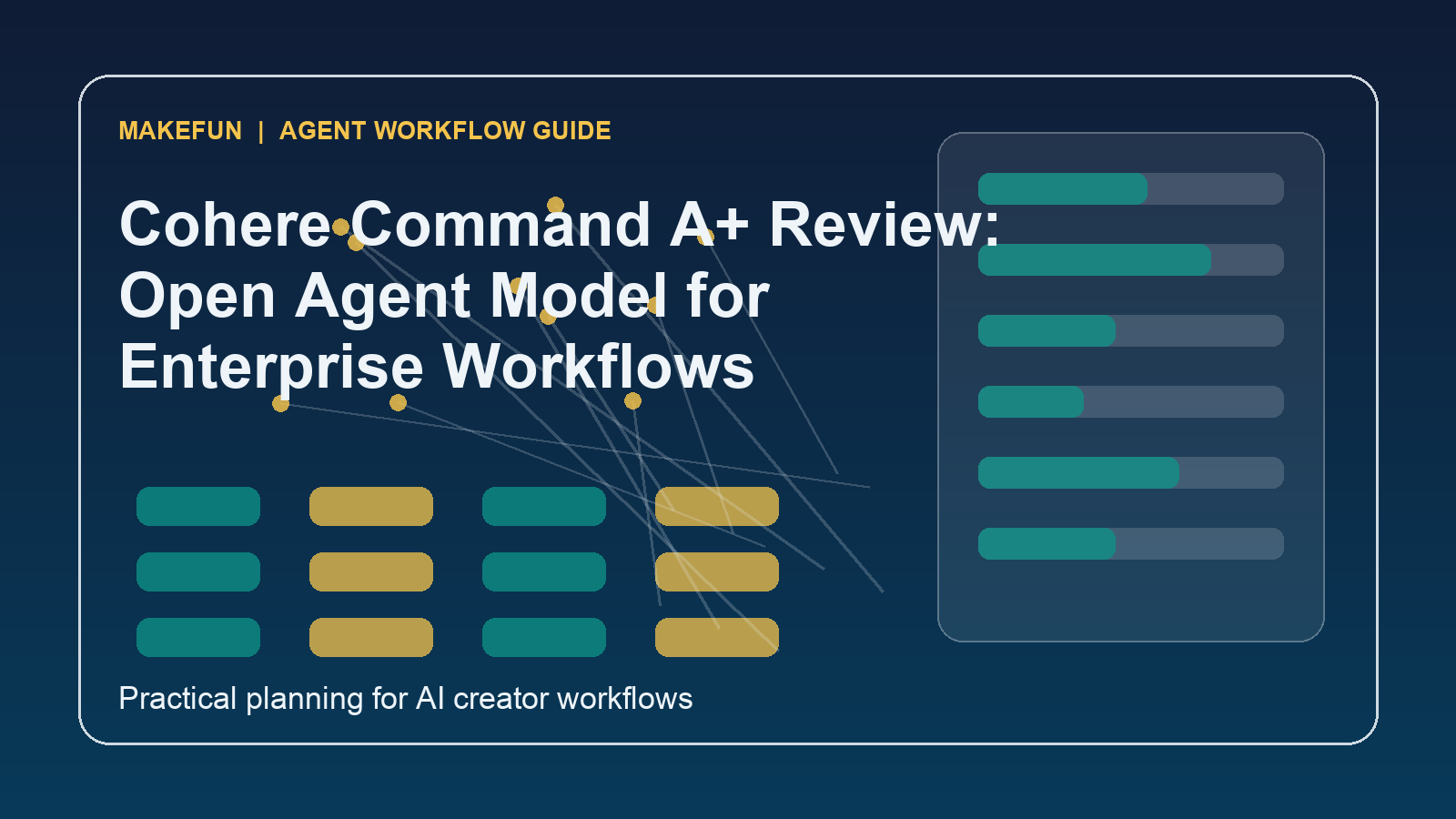
Cohere Command A+ agent model is a timely signal for teams that want powerful agentic AI without giving every workflow to a closed hosted model. Cohere released Command A+ on May 20, 2026 as an open-source, Apache 2.0 model for reasoning, multilingual work, multimodal document understanding, tool use, and retrieval-augmented generation.
For Makefun-style creator and media teams, the important question is not whether Command A+ replaces every video or image model. It is whether an efficient, privately deployable model can sit beside creative tools and handle planning, prompt routing, campaign QA, asset metadata, support workflows, and API orchestration.
What Cohere Command A+ changes
Cohere positions Command A+ as a sparse mixture-of-experts model with 218B total parameters, 25B active parameters, text and image inputs, tool use, reasoning output, 48 supported languages, and open weights available through Hugging Face. The launch post also highlights practical deployment: 4-bit quantized Command A+ can run on two H100 GPUs or a single Blackwell B200-class GPU.
That matters because many agent projects fail on operational economics before they fail on benchmarks. A creative production agent may need to read a brief, inspect images, call search, format prompts for video models, write metadata, retry failed steps, and summarize final assets. If every step uses the most expensive frontier API, costs compound quickly.
Where it fits in creator and API workflows
Command A+ is best framed as an orchestration and reasoning layer, not a direct image or video generator. A practical workflow could use it to:
- Turn a campaign brief into shot lists, avatar scripts, prompt variants, and QA checklists.
- Read long brand guidelines or product catalogs before generating AI video prompts.
- Route easy tasks to cheaper models and reserve premium video or image generation for final assets.
- Support multilingual localization and metadata generation for creator campaigns.
- Power private RAG or internal knowledge agents when customer data should stay inside an enterprise environment.
This makes the topic adjacent to Makefun’s existing coverage of agentic video generator workflows and AI video API planning: the model is not the final render engine, but it can reduce friction around planning, retrieval, prompt generation, tool calls, and review loops.
Cost and pricing comparison
Because Command A+ can be used through API and managed deployment paths, pricing should be read in two layers. Cohere’s current Command A docs list the command-a-plus-05-2026 model ID with API pricing at $2.50 per 1M input tokens and $10 per 1M output tokens. Cohere’s public pricing page also describes Model Vault as a dedicated managed deployment option where pricing is instance-based and can be hourly or committed monthly or annually.
A same-use comparison is Mistral Medium 3.5, which Mistral positions for instruction-following, reasoning, coding, agentic, and multimodal work. Mistral’s pricing page lists Medium 3.5 at $1.50 per 1M input tokens and $7.50 per 1M output tokens, while Mistral Large 3 is listed at $0.50 input and $1.50 output per 1M tokens. Mistral also notes a 50% batch-processing discount and separate tool costs such as libraries, code execution, and agent orchestration.
The hidden cost drivers are the same ones that usually decide AI agent economics: long context, image inputs, repeated tool calls, retries after failed generation, large output traces, RAG indexing, cache behavior, batch discounts, private deployment commitments, GPU utilization, observability, human review, and the cost of downstream media generation. Command A+ may be attractive when privacy, open weights, and deployment control matter more than the lowest token price on a single API call.
How teams should evaluate it
Start with one workflow that has measurable value: creative brief analysis, campaign localization, media metadata QA, prompt-routing, or support triage. Then compare three numbers: quality of the final decision, tokens or GPU hours consumed per completed task, and the number of expensive media-generation retries prevented.
If the model saves one failed video generation or one manual review cycle, its value may be larger than the token bill suggests. If it becomes a general-purpose chat layer with uncontrolled long context, it can still be expensive despite open weights.
FAQ
Is Command A+ a video generator?
No. It is a language, reasoning, multimodal-input, and tool-use model. Its Makefun relevance is workflow orchestration around creative production, not direct video rendering.
Is Command A+ open source?
Cohere describes Command A+ as open-source and Apache 2.0 licensed, with weights available through Hugging Face and deployment guides in its documentation.
When should a creator team consider it?
Consider it when a workflow needs private data, long context, multilingual reasoning, RAG, or agentic tool use before handing final prompts to image, video, avatar, or audio generation models.
What is the biggest cost risk?
The biggest risk is uncontrolled agent loops: repeated calls, long outputs, image inputs, retrieval indexing, and downstream media-generation retries can outweigh a simple per-token comparison.