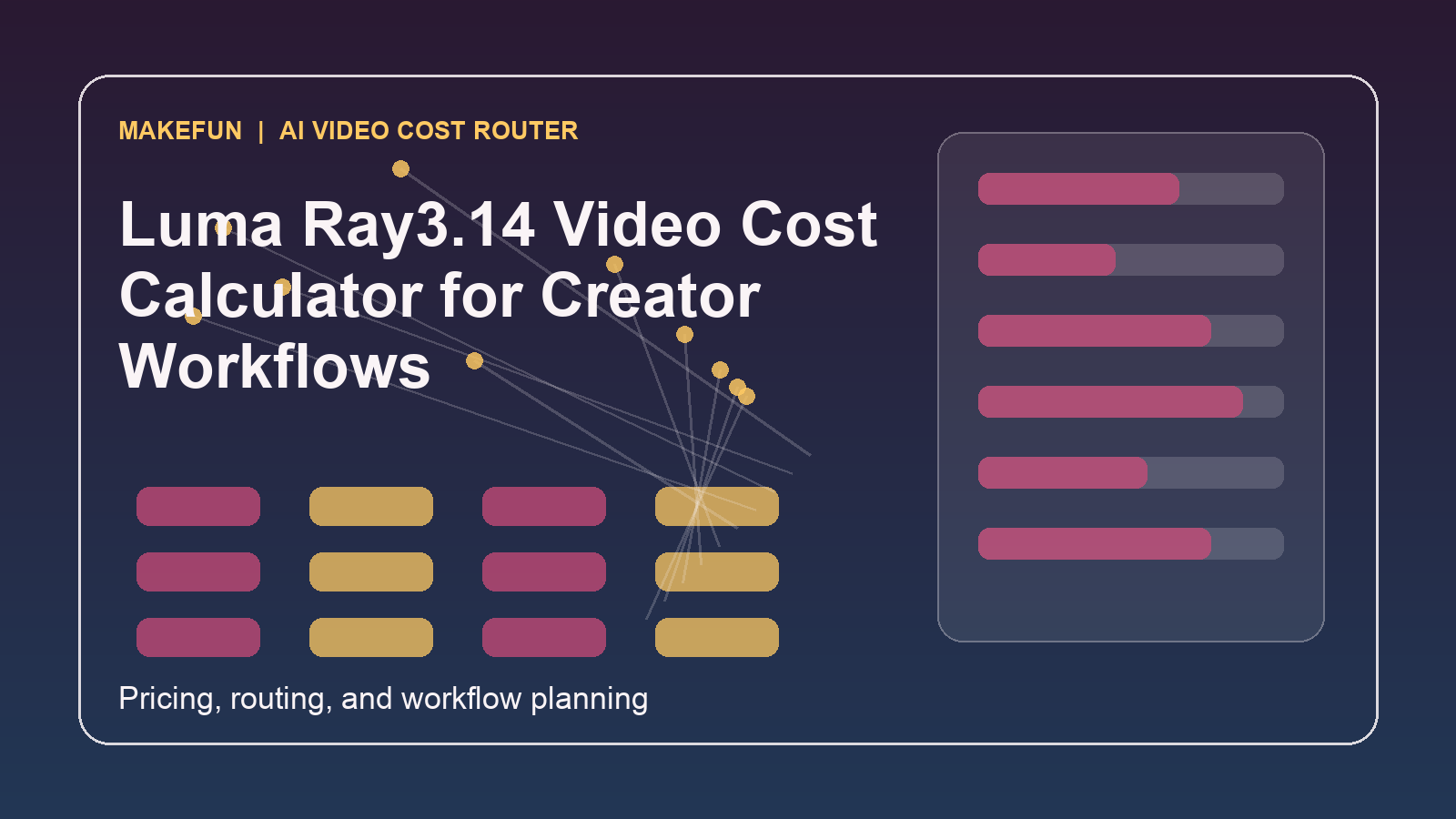
Luma Ray3.14 budgets are easy to underestimate because the visible prompt is only one input. The real cost model depends on seconds, resolution, standard versus HDR mode, whether you are creating from text or modifying an existing video, and how many retries survive creative review. This guide turns the current official Luma credit table into a practical planning calculator for creator teams.
Important scope note: this is a Dream Machine and creator-workflow cost planner for Ray3.14. Current official Luma API material should not be read as confirmed Ray3.14 production API availability, so this post does not position Ray3.14 as a ready API replacement. For broader implementation planning, compare this with Makefun’s AI video API overview.
Luma Ray3.14 cost formula
Use this working formula before a campaign starts:
- Base credits = clip count x seconds x credits per second for the selected Ray3.14 mode and resolution.
- Review allowance = base credits x expected retry rate. A 25% retry allowance means one extra generation for every four approved clips.
- Total planning credits = base credits + review allowance + any upscale, reframe, extension, or post-production pass.
The practical decision is not simply low cost versus high cost. Draft mode is useful for prompt exploration, 540p or 720p can be enough for social tests, 1080p fits final creative review, and HDR should be reserved for outputs where the extra visual range matters. Video-to-video and Modify-style work should be budgeted separately because it tends to multiply cost relative to straightforward text-to-video or image-to-video planning.
Scenario calculator
| Workflow | Planning input | Cost question | Budget control |
|---|---|---|---|
| 5-second social tests | 10 to 30 clips, mostly draft or 720p | How many prompt variants can the team test before choosing a direction? | Cap retries per concept and approve only one final-resolution pass. |
| 10-second product demos | 5 to 15 clips, usually 720p or 1080p | Does the asset need final polish or only a directional storyboard? | Separate exploration renders from final renders in the brief. |
| 30-second campaign batch | Multiple 5s or 10s segments stitched into one concept | How much budget is reserved for failed continuity and re-generation? | Use shorter segments, approve story beats, then upscale only winners. |
| High-volume creative queue | Recurring batches across teams or clients | Will concurrency, manual review, and storage become the real bottleneck? | Track actual credits per approved output, not just credits per generated second. |
Same-use comparison
Luma and Runway do not expose identical billing models, so the comparison should stay workflow-based. Runway’s official API pricing page lists developer credits at $0.01 per credit and gives model-level per-second pricing for video generation, including Gen-4 Turbo and other video models. That makes Runway API pricing a useful same-use reference when teams need an API-oriented benchmark.
For Makefun readers, the useful question is which workflow needs which cost guardrail. Luma Ray3.14 planning is best framed around creator-credit usage, resolution choices, HDR decisions, and quality-control retries. Runway API planning is better framed around credits per second, model selection, queueing, and production integration. Use Makefun’s image-to-video cost comparison when the task is broader vendor selection rather than one Ray3.14 budget.
Hidden cost drivers
- Resolution drift: exploring at 1080p too early burns budget before the prompt direction is proven.
- HDR overuse: HDR can be valuable for premium shots, but it should be a deliberate final-output choice.
- Video-to-video passes: modifying an existing video can be more expensive than first-pass generation and should get its own line item.
- Failed generations: budget by approved asset, not generated asset, because weak motion, inconsistent characters, or brand-review misses still consume credits.
- Upscale and reframe work: final delivery often adds format changes after the creative pass.
- Storage and handoff: approved media should move into permanent hosting before publication or campaign delivery.
Workflow template
- Define the number of final clips, target duration, and delivery resolution before prompting.
- Run cheaper drafts or lower-resolution tests until the creative direction is stable.
- Separate standard Ray3.14, HDR, and video-to-video assumptions in the estimate.
- Add a retry allowance before the project starts, then compare estimated credits with actual approved outputs.
- Only promote final approved media into campaign storage, WordPress media, or other permanent hosting.
If your team also works across still-image and video planning, the existing Luma Uni-1 image generator coverage helps separate image-asset costs from Ray3.14 video costs.
FAQ
Is this a Luma Ray3.14 API calculator?
No. It is a Ray3.14 creator-workflow and Dream Machine credit planner. Current official API material should be checked separately before treating Ray3.14 as a production API option.
What is the safest starting budget method?
Estimate seconds first, choose resolution second, then add a retry allowance. That avoids the common mistake of multiplying only final clip length while ignoring review waste.
Should every final clip use HDR?
No. HDR should be reserved for shots where the final creative quality justifies the higher planning cost. Draft and standard modes are better for early prompt exploration.