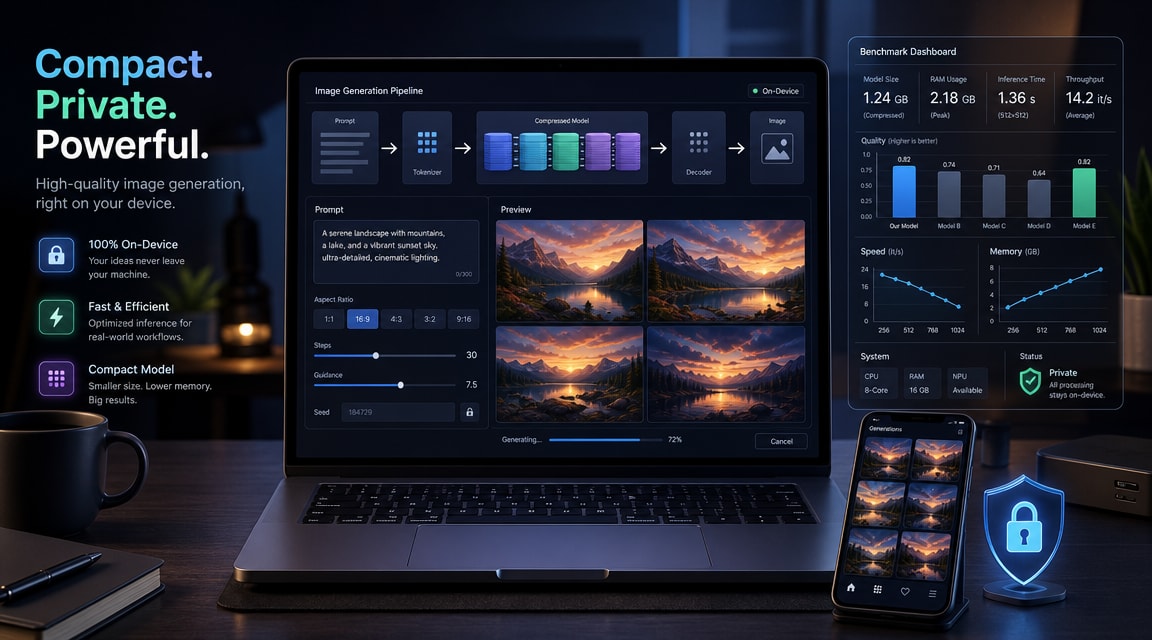
Bonsai Image 4B AI image generator is a timely keyword because image generation is moving in two directions at once: larger hosted models for polished creative output, and smaller compressed models that can run closer to the user. PrismML’s May 26 release gives Makefun a useful long-tail topic around local image generation, private drafting, and fast visual iteration.
PrismML describes Bonsai Image 4B as a family of compact image-generation models built from FLUX.2 Klein 4B, with binary and ternary transformer-weight variants. The practical angle for creators is not that every local model replaces a hosted studio. It is that a lightweight local model can help with early concepts, offline exploration, prompt rough drafts, and privacy-sensitive image ideas before a creator moves into a higher-fidelity hosted workflow.
Why This Model Matters
The official release frames Bonsai Image 4B around compression and local-device inference. PrismML says the ternary version retains much of the FLUX.2 Klein 4B quality while shrinking the diffusion transformer footprint, and PRNewswire coverage highlights the same shift toward practical local hardware. That is a good fit for Makefun readers who compare Flux-style image workflows, GPT Image 2 workflows, and production-oriented tools such as MAI-Image-2-Efficient.
Where It Fits in an AI Image Workflow
For SEO and creator education, the safest positioning is workflow-based. A local AI image generator can help users test scene language, composition, and concept direction without sending every early prompt to a cloud model. Hosted tools still matter for brand-ready output, editing controls, and all-in-one publishing flows. Bonsai Image 4B is best explained as another option in the stack, not a guaranteed replacement for every image generator.
That distinction also supports internal linking. Users interested in model selection can continue to Makefun’s Seedream 5.0 Lite AI image generator coverage, broader image model comparisons, or downstream image-to-video workflows once a still image concept is ready to animate.
Suggested Prompt Structure
Start with one clear subject, one visual environment, and one constraint. For example: describe the product or character, specify the style and lighting, then add a simple composition rule such as centered product shot, wide editorial banner, or mobile-app mockup. If the result is unstable, reduce the number of objects and avoid vague phrases like cinematic magic or perfect realism.
FAQ
What is Bonsai Image 4B?
Bonsai Image 4B is PrismML’s compact AI image generation model family, released with binary and ternary compressed variants for local-device image generation experiments.
Is Bonsai Image 4B only for developers?
Not necessarily. The first audience is technical, but the creator-facing value is easy to explain: smaller local models can make image ideation more private, faster to test, and less dependent on a single hosted model.
Should creators use local image models instead of hosted generators?
Use local models for draft concepts, privacy-sensitive exploration, and quick prompt iteration. Use hosted or all-in-one tools when you need higher polish, editing features, team workflows, or direct publishing into image-to-video pipelines.