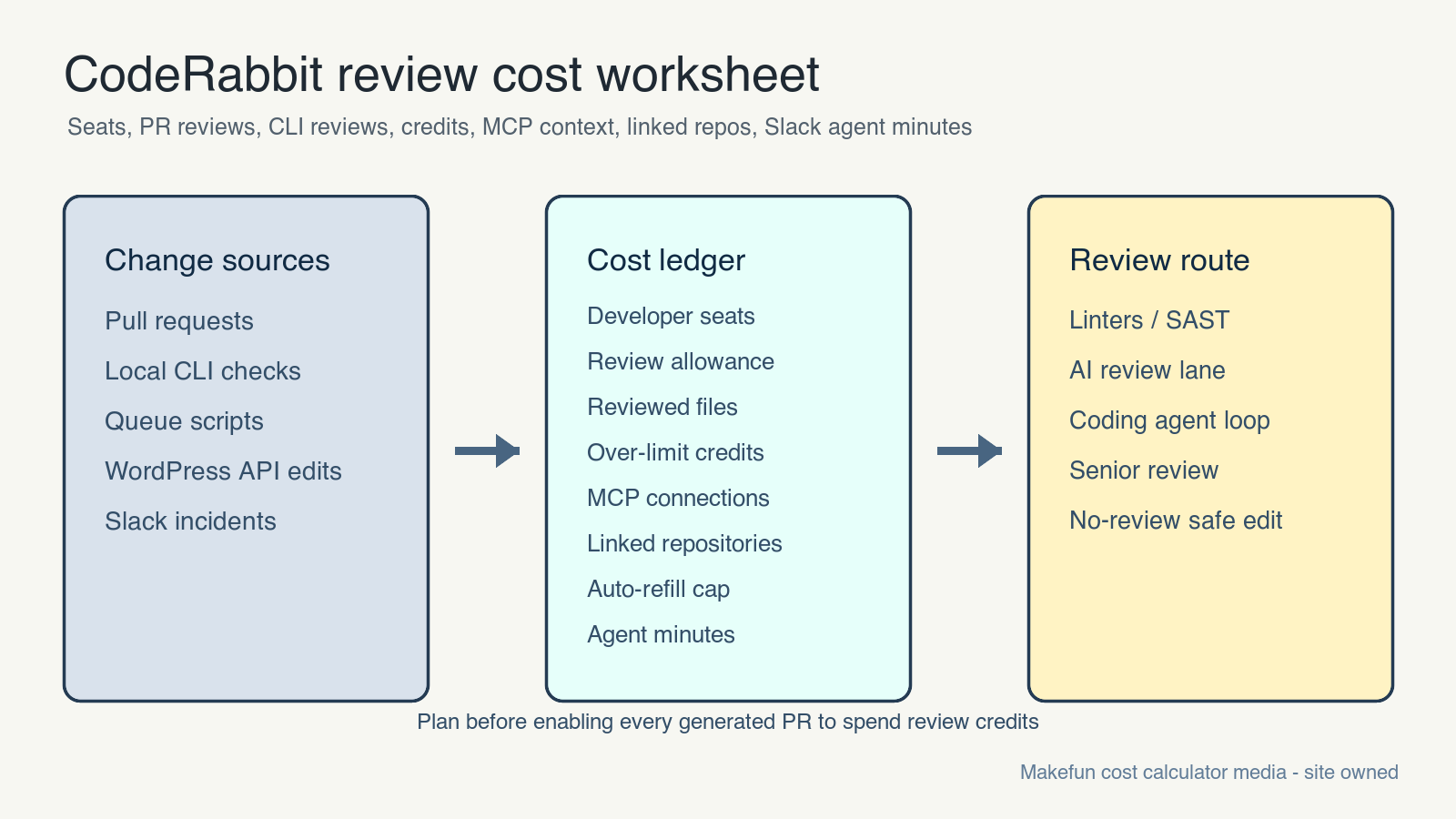
CodeRabbit cost planning starts with who triggers reviews and where the review runs: pull requests, IDE reviews, local CLI reviews, agentic API-key review loops, or Slack Agent tasks. For a Makefun-style automation team, the useful calculator is not a generic AI code-review ranking. It is a spend-control worksheet for seats, refillable PR/IDE/CLI allowances, reviewed files after the limit, shared credits, auto-refill caps, MCP context, linked repositories, and manual review time.
Official source snapshot for June 6, 2026
Publisher refreshed the official CodeRabbit pricing and documentation pages on June 6, 2026 before publication. The current public docs and pricing page expose these planning inputs:
- CodeRabbit pricing and plans documentation list Pro at $24 per developer per month billed annually or $30 month-to-month, Pro+ at $48 per developer per month billed annually or $60 month-to-month, and Enterprise as contact sales.
- The plans documentation shows per-developer review limits: Free includes PR summary-oriented access, Pro has 5 PR, IDE, and CLI reviews, Pro+ has 10, and Enterprise has 12, with refill behavior rather than a simple all-at-once reset.
- Feature limits are separate from review limits: MCP connections are listed as 5 for Pro, 15 for Pro+, and custom for Enterprise; linked repository analyses are listed as 1 for Pro, 10 for Pro+, and 20 for Enterprise.
- Usage-based add-on documentation states that Pro and above organizations share one credit balance for eligible over-limit PR and CLI reviews, with $1.00 per credit, $0.25 per reviewed file, and 4 files per credit.
- CodeRabbit Agent for Slack documentation says Slack Agent usage is billed separately from review subscriptions and measured in accumulated agent minutes.
Use those fields as the calculator inputs, not as a promise that every repository will spend the same way. Review volume, file count, agent loops, and manual escalation rules matter more than the headline seat price.
Seat and allowance worksheet
| Planning row | What to count | Why it changes spend |
|---|---|---|
| Assigned seats | Developers who need CodeRabbit review access | Seat count drives the recurring Pro or Pro+ subscription line. |
| PR reviews | Automatic reviews, manual full reviews, and repeated pushes that trigger another review | High PR churn can consume the refillable review allowance faster than expected. |
| IDE and CLI reviews | Local checks before commits, risky refactors, and agent-generated patches | CLI usage should be attributed to the right user and repository before enabling broad loops. |
| Reviewed files | Files included in eligible over-limit reviews | The usage add-on charges by reviewed file after the applicable review limit is reached. |
| Manual review time | Senior engineer minutes for auth, billing, queue locks, cache, publishing, and data deletion changes | CodeRabbit should reduce review routing friction, not replace required human judgment. |
CLI and agentic review routing
For local Makefun automation work, use CodeRabbit CLI reviews selectively. A useful rule is: run linters and tests first, use CodeRabbit CLI for changes where a structured review can catch missed edge cases, and keep high-risk changes on a human approval path. The CodeRabbit CLI documentation and usage add-on docs make the important billing point: authenticated CLI and agentic API-key reviews use the assigned user’s plan allowance first, and credits are consumed only after the applicable limit is reached.
That makes CLI review a governance decision. A single maintainer may stay within Pro limits, while an automated PR factory can turn repeated generated patches into reviewed-file credit spend unless the team caps auto-refill and narrows which changes receive AI review.
Over-limit credit worksheet
| Input | Example formula | Control |
|---|---|---|
| Over-limit reviews | Eligible reviews after the plan allowance is reached | Enable the add-on only for repositories where interruption is more expensive than credits. |
| Reviewed files | Over-limit reviewed files x $0.25 | Exclude generated lockfiles, snapshots, and low-risk bulk files when review quality would be low. |
| Shared credit balance | Credits available across the organization | Track the balance beside CI minutes and coding-agent spend. |
| Auto-refill cap | Monthly cap for automated top-ups | Set a cap before enabling review loops from agents or scheduled maintenance. |
MCP context and linked repository planning
MCP connections and linked repositories are feature-limit rows, not only capability rows. If a review needs repository history, cross-repository context, issue tracker context, or project-specific tooling, count those limits before selecting Pro versus Pro+. A small Makefun automation repo may need one linked repository and a handful of MCP connections; a multi-repo agent stack may need higher limits or Enterprise terms.
Keep the comparison narrow: MCP context can make review comments more relevant, but it also expands what the review lane depends on. Do not use it as a reason to bypass tests, static analysis, deploy previews, or a senior review for high-risk changes.
Slack Agent minutes are separate
CodeRabbit Agent for Slack should be modeled as a separate runtime line. The Slack Agent docs state that Agent usage is billed separately from review subscriptions, based on accumulated agent minutes rather than seats or review counts. For incident triage, customer-ticket investigation, and recurring task automation, track Slack Agent minutes beside CodeRabbit review seats and reviewed-file credits instead of blending them into one review allowance.
Same-use comparison for Makefun review workflows
CodeRabbit is one lane in a code-review stack. For Makefun teams comparing review cost and coverage, keep same-use alternatives in the same table: GitHub Copilot AI Credits Agent Cost Calculator for AI-credit review costs, Morph Fast Apply WarpGrep Agent Token Cost Calculator for coding-agent edit loops, and Macroscope Check Run Agent Review Cost Calculator for check-run review governance.
Do not normalize these tools by vendor name. Normalize them by the same workflow: files reviewed, PRs opened, agent loops, CI minutes, manual escalation, and how often the result changes a production path.
Makefun review-routing template
- Queue scripts, locks, publishing, payment, auth, cache purge, and deletion: require tests or static checks plus human review; CodeRabbit can provide an advisory pass.
- WordPress copy, Yoast metadata, internal links, and low-risk reports: use lint-style checks and a light human scan unless the change touches publishing state.
- Generated code from agents: require local tests first, then selective AI review for risky files, and cap usage-based credits before running broad loops.
- Incident or support tasks in Slack: budget Slack Agent minutes separately and decide when the output should open a PR versus create an issue for human follow-up.
Risk controls before enabling pay-as-you-go review
Set the organization policy before the spend starts: which repos can use usage-based review, which users can trigger CLI reviews, which file types are excluded, what the monthly auto-refill cap is, and which changes still require senior review. The goal is not to make every generated PR more expensive. The goal is to spend review credits where the review can prevent a defect that linters, tests, CI, or a short manual scan would miss.
FAQ
How should a CodeRabbit CLI cost calculator start?
Start with review route and attribution: PR, IDE, CLI, agentic API key, or Slack Agent. Then add assigned seats, per-developer review allowance, reviewed files after the limit, shared credits, auto-refill caps, MCP connections, linked repositories, and human review gates.
When do CodeRabbit usage-based credits matter?
Credits matter only when eligible PR or CLI reviews continue after the applicable review limit. The worksheet should count reviewed files for over-limit reviews and keep the shared organization credit balance and auto-refill monthly cap visible.
Should CodeRabbit replace manual review for Makefun automation code?
No. Treat CodeRabbit as an advisory review lane for routing and early findings. Publishing, payment, auth, cache recovery, data deletion, and queue-lock changes still need human review plus tests or static checks when risk is material.