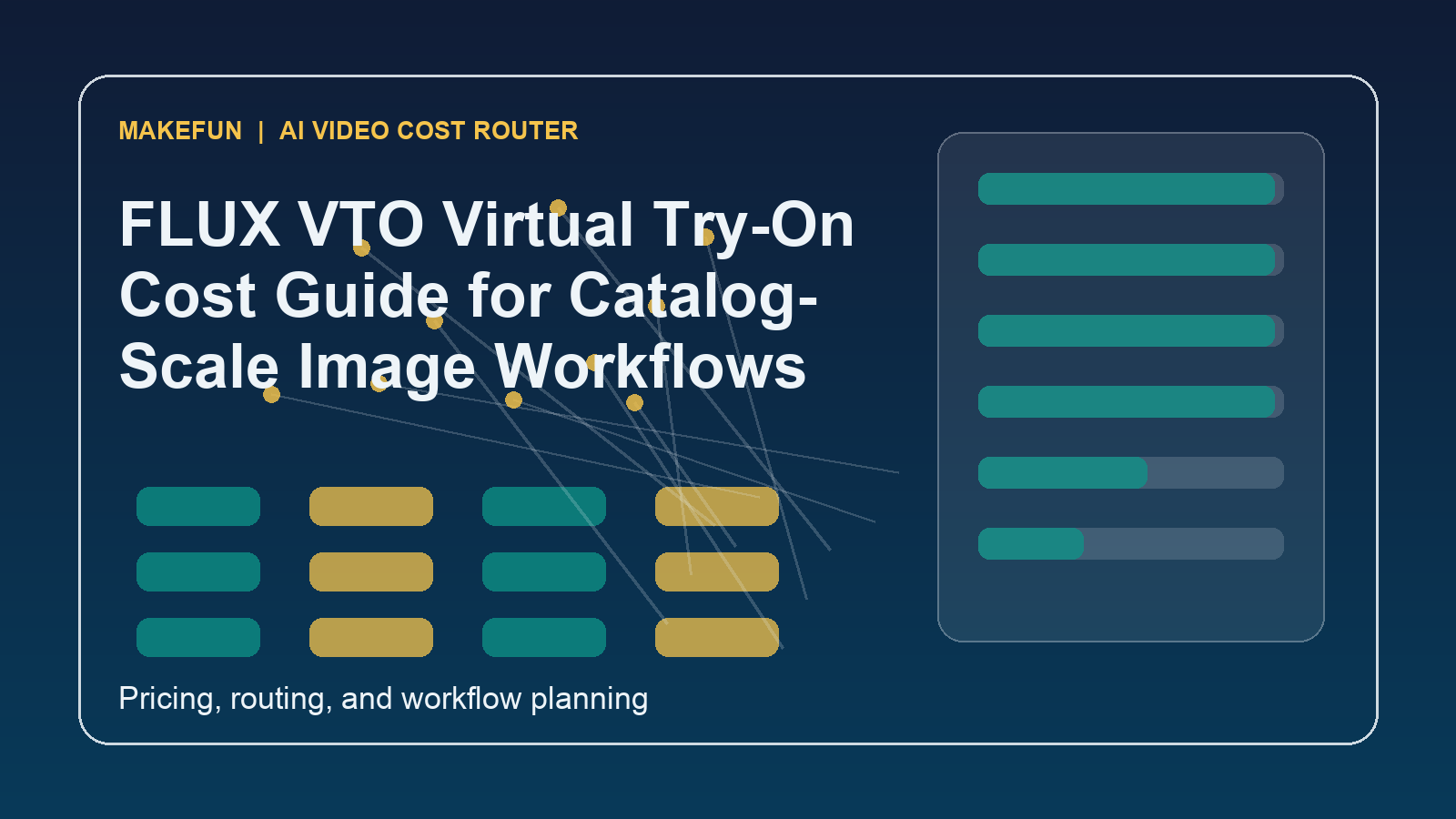
FLUX VTO is useful only if the catalog math works. A demo with one person image and one garment reference is simple; a 500-SKU refresh with multiple model looks, marketplace crops, failed generations, and human QA is where virtual try-on cost planning starts to matter.
This guide treats Black Forest Labs’ FLUX VTO release as the product-scope source, fal’s FLUX Virtual Try-On API page as the pricing source, and FASHN API pricing as a same-use comparison point. It is a cost worksheet, not a claim that any model can guarantee sizing, conversion lift, or brand-approved results.
What FLUX VTO changes for catalog teams
Black Forest Labs positions FLUX VTO for catalog-scale virtual try-on: apparel teams can combine a person image with garment references, create try-on outputs, and scale the workflow beyond one-off creative tests. The same announcement also makes the important caveats clear: identity and garment fidelity still need review, moderation and use-rights matter, and likeness rights remain the operator’s responsibility.
That makes the best SEO angle a practical one: estimate the budget before uploading hundreds of SKUs. If the workflow is mostly inspiration images, a simple clothes-swap tool may be enough. If it becomes an API-backed catalog refresh, every input image, output size, retry, and QA reject changes the real cost.
FLUX VTO pricing worksheet
fal lists FLUX VTO with megapixel-based pricing: the first input megapixel, additional input megapixels, and output megapixels are priced separately. The model page currently shows a two-input-image 1024 by 1024 output example at about $0.0475 per request. Use that as a sample scenario, not as a universal bill, because real inputs and outputs may have different dimensions.
| Cost driver | How to estimate it | Why it matters |
|---|---|---|
| Input megapixels | Person image plus garment references, rounded by the provider’s billing rules. | Higher-resolution source assets can increase the bill before any output is created. |
| Output megapixels | Final image size for catalog, social, marketplace, or localization variants. | A 1 MP output and a larger campaign asset do not have the same cost profile. |
| Garment/reference count | Number of items tested per model image. | More references may be needed for outfits, bundles, or full looks. |
| Retries and rejects | Expected percentage of generations that fail visual QA. | Identity mismatch, garment distortion, moderation, and styling issues create hidden spend. |
| Human review | Minutes per approved asset for QA, rights checks, and marketplace formatting. | API price is not the full catalog cost. |
Scenario math for catalog-scale planning
| Scenario | Planning assumption | Budget note |
|---|---|---|
| 50-SKU pilot | One model image, one garment image, one output per SKU, plus a small retry buffer. | Good for validating prompt, garment prep, and review criteria before full rollout. |
| 500-SKU catalog refresh | One to two approved outputs per SKU, with batch QA and marketplace resizing. | Retries and review time can matter more than the base API price. |
| Seasonal campaign variants | Multiple looks, backgrounds, crops, and regional catalog variants. | Localization and creative approvals add cost even when the model price is predictable. |
| Influencer or model variation set | Several consented model/person images for the same garment set. | Likeness rights and model-release tracking become first-order workflow costs. |
FLUX VTO vs FASHN vs Makefun cloth-swap workflows
Use the comparison by workflow fit, not by a universal winner label. FLUX VTO through fal is attractive when your team wants a FLUX-family virtual try-on API with megapixel-based planning. FASHN is a same-use virtual try-on API reference with credit-based pricing, useful when you want a different billing unit to benchmark against. Makefun’s Cloth Swap page and the older AI clothes changer tools guide are better internal references for lightweight creator workflows and non-API exploration.
| Option | Billing lens | Best fit | Main caution |
|---|---|---|---|
| FLUX VTO via fal | Input/output megapixels and request shape. | Catalog-cost worksheets, API pilots, FLUX-family image teams. | Budget depends on dimensions, references, retries, and QA rejects. |
| FASHN API | Credit-based virtual try-on outputs. | Same-use benchmark for apparel try-on API pricing. | Failed predictions, top-ups, and plan discounts need current official review. |
| Makefun Cloth Swap | Workflow/tool fit rather than API billing. | Creator tests, visual exploration, simple clothing swaps. | Not a full catalog API cost model by itself. |
| Manual photoshoot | People, studio, styling, retouching, and schedule. | High-control brand campaigns and exact product approvals. | Slower and harder to scale across large SKU sets. |
Rights and QA checklist before scaling
- Confirm model, likeness, garment, and product-image rights before generation.
- Keep records for source images, prompts, model versions, and approved outputs.
- Run a small pilot before full-catalog generation and measure reject rate.
- Review identity, garment fidelity, logos, text, seams, hands, and marketplace policy fit.
- Use neutral language for swimwear, lingerie, adult-content, and moderation-sensitive assets.
- Store approved outputs on permanent, controlled hosting; do not publish temporary generation URLs.
Internal workflow template
- Group SKUs by garment type, source-image quality, and output size.
- Estimate person-image megapixels, garment-reference megapixels, output megapixels, and expected retries.
- Run 20 to 50 pilot outputs and calculate the approval rate before scaling.
- Compare FLUX VTO API spend with FASHN-style credit pricing and any manual production baseline.
- Publish only approved assets with documented rights and permanent storage.
Where this fits in the Makefun image stack
FLUX VTO belongs near Makefun’s image and product-shot workflows, not generic model news. Teams already comparing FLUX 2 or FLUX 2 vs Nano Banana Pro can use this worksheet to decide whether virtual try-on should be a catalog API project, a creator experiment, or a manual-production fallback.
FAQ
Is FLUX VTO the cheapest virtual try-on API?
Do not reduce the decision to one headline price. FLUX VTO uses a megapixel-based cost model on fal, while FASHN uses a credit-based model. Your real cost depends on image dimensions, retries, SKU count, output variants, review time, and rights management.
Can FLUX VTO guarantee fit or sizing accuracy?
No. Treat virtual try-on outputs as generated visual assets that need review. Do not claim precise sizing, exact fit, conversion lift, or production approval without separate evidence and brand-side validation.
What should I test before a 500-SKU rollout?
Test source-image quality, garment preparation, output sizes, retry rate, moderation constraints, visual QA time, and marketplace acceptance. A small pilot gives a more realistic budget than multiplying one demo request by the full catalog.