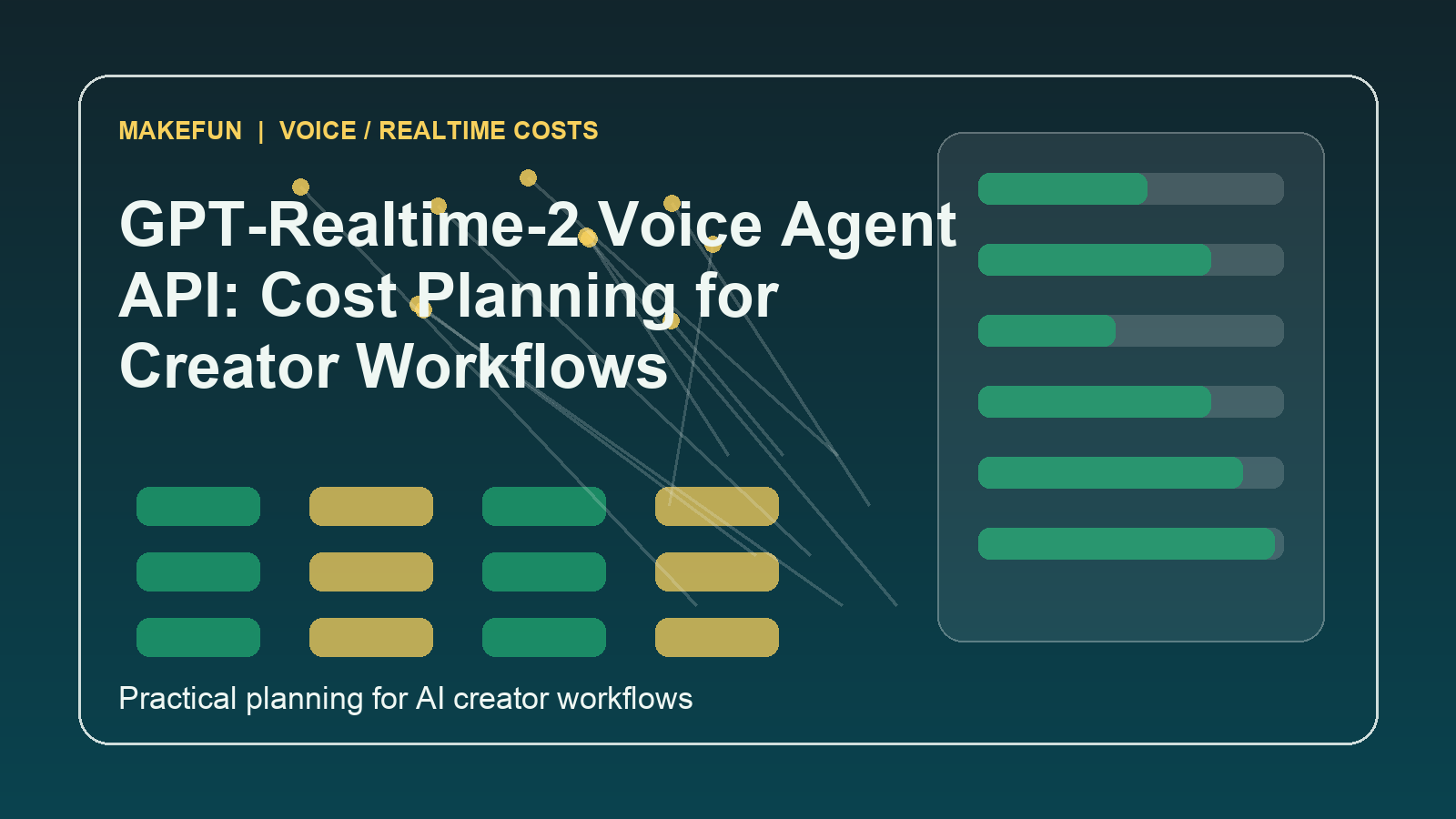
GPT-Realtime-2 is a timely voice-agent API topic because voice interfaces are moving from simple transcription into live production assistants, avatar support flows, multilingual review loops, and creator workflow copilots. For Makefun readers, the important question is not only whether a model can speak naturally. The operational question is how a realtime voice stack changes cost, latency, QA, and handoff design for AI video and avatar products.
OpenAI’s May 2026 voice-model update introduced GPT-Realtime-2 alongside realtime translation and streaming transcription models. The release gives builders a clearer path for speech-to-speech agents, but it also moves budgeting away from a flat subscription mindset. Teams now need to estimate audio input tokens, audio output tokens, cached context, text side channels, tool calls, and session behavior before they can compare vendors fairly.
Who should evaluate GPT-Realtime-2?
- AI avatar teams that want a spoken assistant to answer questions, collect script changes, or guide a viewer through an interactive video.
- Creator workflow teams that need realtime voice review for edits, captions, localization, or campaign approvals.
- API teams comparing a model-native speech-to-speech stack with modular speech vendors and separate LLM orchestration.
- Support and sales teams that care about interruption handling, correction loops, multilingual sessions, and human handoff.
Cost comparison: OpenAI, Deepgram, and ElevenLabs-style agents
GPT-Realtime-2 pricing should be read as usage-metered audio-token pricing, not as a fixed per-call plan. Current official OpenAI pricing lists GPT-Realtime-2 audio at $32.00 per 1M input tokens, $0.40 per 1M cached input tokens, and $64.00 per 1M output tokens. That makes output length, repeated context, and interruption-heavy conversations the key levers to watch.
Deepgram’s public pricing is useful as a same-use comparison because its Voice Agent API pricing is presented per minute, with Standard listed at $0.075/min and options around speech-to-text, text-to-speech, bring-your-own LLM, and orchestration. This can be easier to forecast for call-center-style minutes, but it may shift LLM and prompt complexity costs outside the visible voice-agent line item.
ElevenLabs Agents pricing is another useful comparison path for teams that want bundled voice-agent tooling. Its public help materials describe voice and multimodal calls as connection-duration based, with bundled minutes by plan, additional call charges, text-message charges for multimodal/text interactions, silence discounts, burst/concurrency behavior, and separate LLM pass-through costs. The practical lesson is that connection time and silent waiting can matter as much as speech quality.
| Budget line | GPT-Realtime-2 | Deepgram Voice Agent API | ElevenLabs Agents-style stack |
|---|---|---|---|
| Primary billing unit | Audio input/output tokens plus cached input | Per-minute voice-agent pricing | Plan minutes, extra minutes, text messages, and LLM pass-through |
| Best fit | Model-native speech reasoning and tool-using voice agents | Forecastable voice-agent minutes with modular speech components | Packaged agent experiences, voices, widgets, and concurrency controls |
| Hidden drivers | Long answers, context retention, tool loops, translation/transcription add-ons | BYO LLM cost, TTS characters, websocket duration, concurrency, EU endpoints | Connection duration, silence, burst pricing, text messages, separate LLM costs |
Workflow template for Makefun-adjacent teams
- Define the session type. Separate support calls, avatar Q&A, production review, and localization review because each has different talk/listen ratios.
- Estimate turn length. Track expected user audio, assistant audio, tool calls, and retry loops instead of using a single average call minute.
- Choose memory rules. Cache stable instructions, trim stale transcript context, and summarize long sessions before they become expensive.
- Add handoff thresholds. Route billing, legal, abuse, or production-blocking issues to a human instead of letting the voice agent loop.
- Test with a media workflow. Use one script-review or avatar-feedback scenario from agentic video generation and one API planning scenario from AI video API before scaling.
When GPT-Realtime-2 is likely worth testing
GPT-Realtime-2 is strongest when the voice agent needs to reason across context, recover from corrections, call tools, or drive a creative workflow rather than only transcribe and respond. A Makefun-style use case could be a spoken assistant that reviews an avatar scene, asks for missing brand constraints, checks production status, and summarizes the next video-generation step.
If the product only needs low-cost transcription, simple IVR replacement, or predictable call minutes, a modular stack may be easier to budget. If the product needs a polished voice surface and packaged agent controls, a platform approach may reduce implementation time even when plan limits and pass-through costs require careful monitoring.
Bottom line
For creator and AI video workflows, GPT-Realtime-2 should be evaluated as a high-capability realtime voice layer with token-sensitive economics. The winning setup will usually come from cost instrumentation, shorter agent answers, cached instructions, explicit handoff rules, and a workflow-specific benchmark rather than from headline model pricing alone.