Mistral Physics AI is a useful signal for teams that plan AI video, world-model, avatar, and production-agent workflows: the next wave of AI systems will not only write prompts or code, but also reason about physical constraints before creative or operational work reaches production.
Mistral announced the Physics AI direction around AI Now Summit 2026, describing a stack for industrial engineering that combines advanced physics models, engineering expertise, robotics, private deployment, and agentic workflow tooling. The immediate customers are manufacturers and engineering teams, but the search angle matters for Makefun users because physically grounded simulation affects product videos, digital twins, interactive scenes, synthetic footage planning, and review workflows.
What Mistral Physics AI changes
The core idea is to move some physics analysis from slow solver loops into learned models that can predict fields or design behavior much faster. Mistral frames this as a way to explore many more design variants, use simulation earlier in the workflow, and keep traditional solvers for verification and edge cases.
For creator and media teams, the practical lesson is not that Mistral is launching a consumer video generator. It is that physically aware AI is becoming part of the agent stack. If an AI pipeline is planning a product demo, storyboard, avatar scene, virtual studio, or generated commercial, physics-aware checkpoints can help teams catch unrealistic movement, lighting, scale, thermal behavior, or object interaction before expensive production steps.
Where it fits Makefun workflows
Makefun already covers AI video, avatar, API, and agentic production workflows. Mistral Physics AI fits that map in three places:
- Pre-production planning: teams can use physics-aware reasoning as a review layer before rendering product videos, industrial explainer clips, or training visuals.
- World-model evaluation: physically faithful world models are easier to trust when they preserve geometry, motion, collisions, and constraints across a scene.
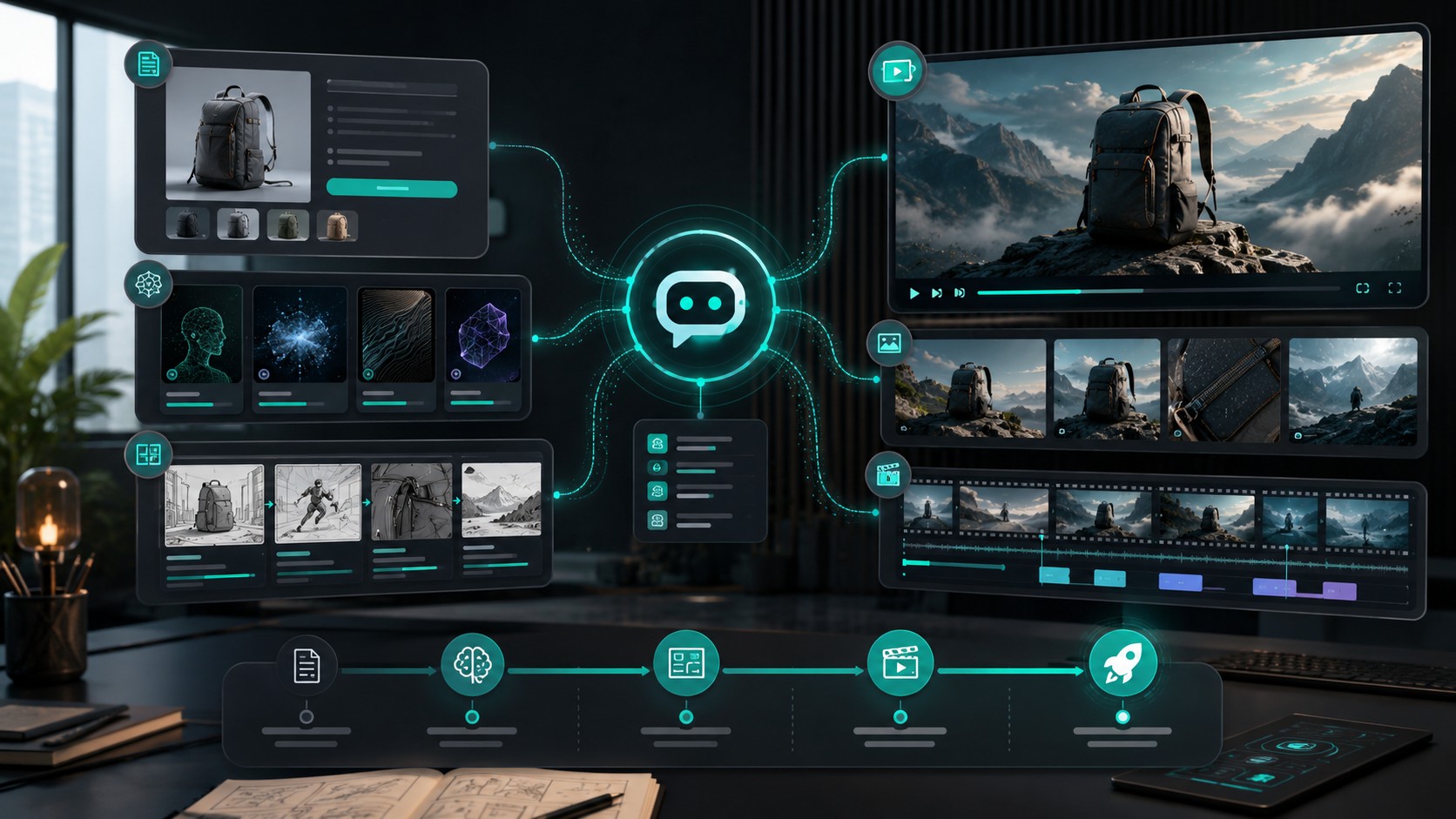
- Agent orchestration: long-running agents can route work between text planning, retrieval, simulation, human approval, and final media generation instead of treating video generation as a single prompt.
That makes the topic adjacent to agentic video generation, AI video API planning, and open world-model coverage such as SANA-WM.
Competitor and market observations
Mistral is not alone in connecting AI, physics, and production systems. NVIDIA Omniverse and simulation tooling focus on physically accurate digital twins, while cloud simulation platforms price work around compute, storage, and runtime. Research projects in video world models are also pushing toward better temporal consistency and controllable scenes.
The difference in Mistral’s positioning is the combination of physics models with enterprise agents, private deployments, and workflow orchestration. For SEO, the opportunity is the long-tail intersection: “Mistral Physics AI”, “physics AI for video planning”, “AI agents for simulation”, and “world model production workflows”.
Cost and pricing comparison
Mistral has not published a public per-use price for its Physics AI industrial offering, so teams should treat it as an enterprise solution that likely depends on deployment scope, custom models, data residency, support, and infrastructure. Public Mistral pricing is still useful for the adjacent agent and API layer: Mistral Pro is listed at $14.99 per month, Team at $24.99 per user per month, Mistral Medium 3.5 API at $1.50 per million input tokens and $7.50 per million output tokens, and Devstral 2 at lower coding-agent token rates.
A same-use comparison should look beyond token price. NVIDIA-style digital twin stacks can shift cost into GPU infrastructure, Omniverse/RTX simulation deployment, integration, and specialist labor. AWS SimSpace Weaver style simulation pricing has historically been tied to EC2 instance-hours, with published examples showing large multi-instance simulations reaching five-figure monthly compute bills. Traditional CFD/FEM workflows also carry solver licenses, HPC queues, failed runs, mesh preparation, and expert review costs.
The hidden cost drivers are model training or fine-tuning, geometry preparation, solver-generated training data, GPU inference, context tokens for agent planning, cache writes and hits, repeated tool loops, region or private-deployment uplifts, storage for simulation snapshots, evaluation runs, and human verification. The lowest-cost workflow is not always the cheapest token rate; it is the workflow that reduces failed renders, bad physical assumptions, and late-stage rework.
Practical takeaway
Mistral Physics AI is best understood as an enterprise physics-and-agent signal rather than a direct Makefun replacement. For creators, product marketers, and AI video teams, the useful move is to add physics-aware review before final generation: validate object motion, camera constraints, scene scale, product geometry, and approval checkpoints before spending credits on final media.
For Makefun’s roadmap coverage, this is a low-risk topic to watch because AI video, avatars, digital twins, and agentic production are converging. The teams that connect planning, simulation, retrieval, and generation will have a better shot at producing credible media workflows instead of one-off demos.
FAQ
Is Mistral Physics AI an AI video generator?
No. Mistral positions Physics AI around industrial engineering and simulation. The Makefun relevance is that physically aware models can improve planning, validation, and review around AI video and world-model workflows.
Why does this matter for creator teams?
Creator teams increasingly use agents to plan scripts, shots, edits, assets, and API calls. Physics-aware checks can reduce unrealistic scenes and help teams decide what needs simulation, human review, or final generation.
What should teams compare before adopting this kind of stack?
Compare deployment model, data privacy, solver integration, GPU and token costs, specialist review time, reliability, and whether the system reduces expensive rework in the actual production workflow.