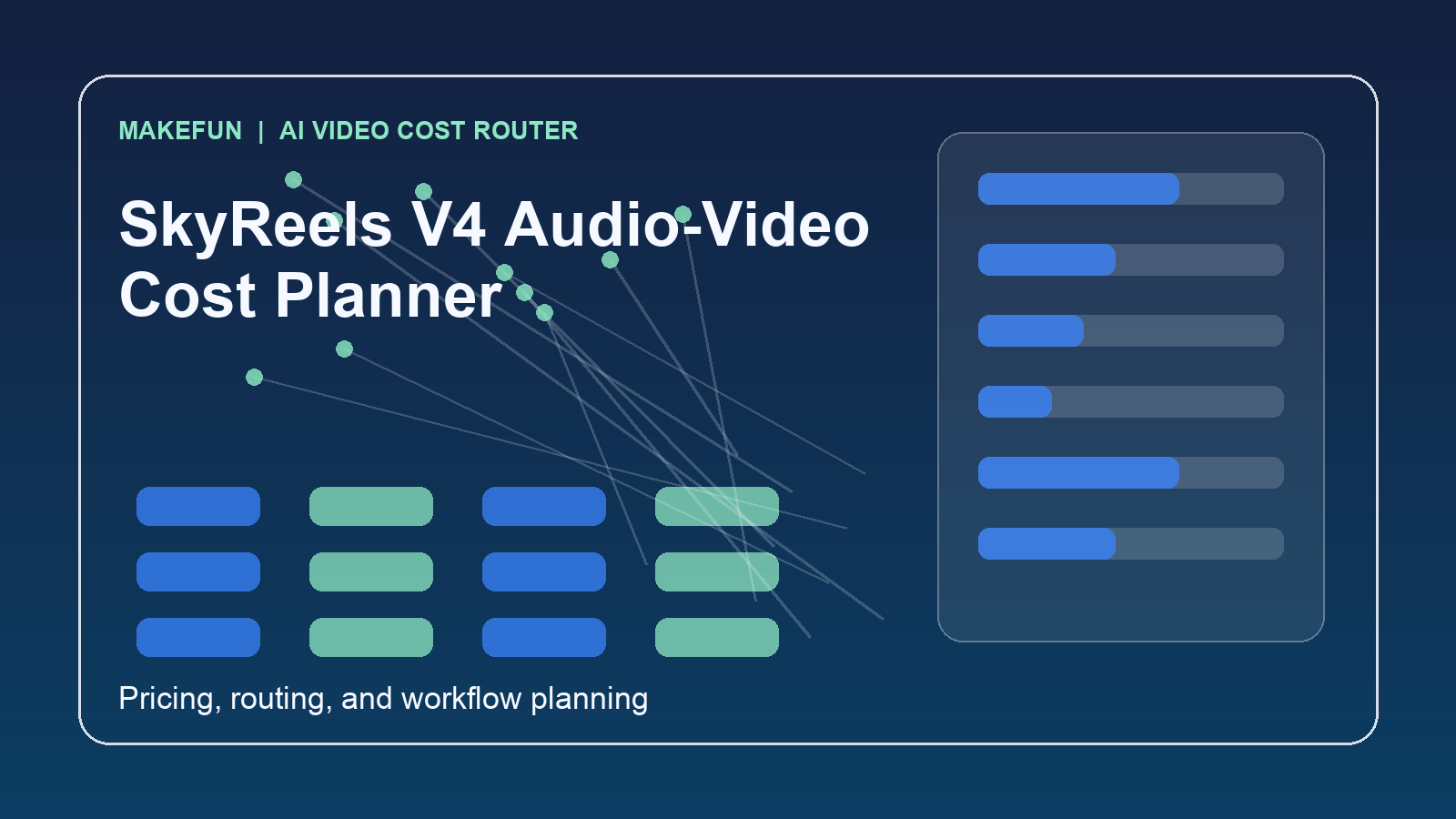
SkyReels V4 pricing is easiest to plan as a native audio-video workflow, not as a generic AI video rate. The official SkyReels developer pricing page should remain the source of truth for first-party credits, while the Runware SkyReels V4 API docs and SkyReels-V4 paper explain why this model is different from silent video generation plus a separate audio stack.
This planner uses the current developer-price framing captured during publication: 1 USD equals 100 credits. SkyReels V4 Fast without video input is 27.5 credits per second at 1080p, 11 credits per second at 720p, and 8 credits per second at 480p. SkyReels V4 Std without video input is 35 credits per second at 1080p, 14 credits per second at 720p, and 11 credits per second at 480p. Video-input workflows cost more, so teams should verify the pricing page again before buying capacity or quoting a client.
SkyReels V4 cost calculator
| Route | Rate used for planning | 15 second clip | 60 seconds | Best planning use |
|---|---|---|---|---|
| V4 Fast, 1080p, no video input | 27.5 credits/s = $0.275/s | $4.13 | $16.50 | High-resolution first-pass native audio-video tests. |
| V4 Fast, 720p, no video input | 11 credits/s = $0.11/s | $1.65 | $6.60 | Social clips and budget-sensitive concept batches. |
| V4 Fast, 480p, no video input | 8 credits/s = $0.08/s | $1.20 | $4.80 | Early prompt exploration before an approved-resolution pass. |
| V4 Std, 1080p, no video input | 35 credits/s = $0.35/s | $5.25 | $21.00 | Higher-quality production candidates when native sound matters. |
| V4 Fast, 1080p, with video input | About $30.00/min | About $7.50 | About $30.00 | Reference-video, edit, or guided replacement workflows. |
| V4 Std, 1080p, with video input | About $37.50/min | About $9.38 | About $37.50 | Premium guided edits where video input is required. |
Native audio-video versus stitched workflows
| Workflow | SkyReels V4 native route | Stitched route | Decision rule |
|---|---|---|---|
| 15 second product ad | Generate picture and synchronized audio together, then review one approved clip. | Generate silent video, create TTS or music, then sync and edit. | Use native audio-video when sound timing is part of the creative concept. |
| 60 second social cut | Plan four 15 second clips, then budget edit/extend and failed-sync retries. | Generate multiple silent clips, then assemble voice, music, captions, and lip-sync separately. | Compare final approved minute, not only first-generation price. |
| Localized demo | Use native sound for each language only when the audio rights and localization copy are final. | Reuse approved video and swap TTS, subtitles, or dubbing externally. | Stitched workflows may win when localization needs many voice variants. |
| Talking-product explainer | Useful when camera motion, product timing, and sound are generated as one unit. | Use video generation, voice clone, lip-sync, and human QA as separate steps. | Budget sync failures and rights review in both routes. |
Capability and source checks
Runware lists SkyReels V4 as a live model path with text, image, video, and audio-to-video modes, plus edit and extend support. Its model page also exposes hosted pricing by task type, including text/image-to-video and video-to-video rates, which is useful as same-use hosted API context. The arXiv paper describes SkyReels V4 as a multi-modal video-audio model with synchronized audio, inpainting, editing, 1080p support, 32 FPS, and 15 second duration. Use the paper for capability scope, not for billing.
Hidden cost drivers
- Resolution: 1080p can be several times the 480p planning cost, so draft at the lowest acceptable resolution before final approval.
- Video input: reference-video and edit paths cost more than no-video-input generation and can change the budget quickly.
- Edit and extend loops: a short clip may need multiple fixes before sound, motion, and product timing align.
- Audio rights: music, voice likeness, brand sounds, and localization scripts need clearance before public use.
- Sync failure: failed lips, off-beat sound effects, and mistimed cuts can turn one planned clip into several paid attempts.
- Storage and review: final approved assets should be stored permanently and reviewed by a human before campaign use.
Makefun workflow fit
For Makefun readers, the right comparison is workflow outcome. Start with the SkyReels V4 native audio-video quote, then compare it against adjacent Makefun planning references such as AI video API, Luma Ray3.14 video cost calculator, agentic video generator, AI video generator, and voice clone. Do not declare a universal price winner; compare the cost of a final approved clip with the same duration, resolution, input mode, retry rate, and audio-rights burden.
FAQ
Is SkyReels V4 pricing just a per-minute video price?
No. A useful plan separates duration, resolution, video input, native audio, edit or extend loops, retry rate, storage, review, and audio-rights work.
When is native audio-video worth paying for?
It is most useful when sound timing is part of the first creative pass, such as a product ad, music-driven short, sound-effect-heavy demo, or talking-product concept. If voice variants or localization dominate, a stitched video plus TTS or lip-sync route may be easier to control.
Can I compare SkyReels V4 directly with Veo, Kling, Runway, or Vidu?
Only with matched assumptions. Use the same duration, resolution, input mode, audio requirement, and retry policy. Otherwise the comparison becomes a workflow difference, not a clean model-price difference.