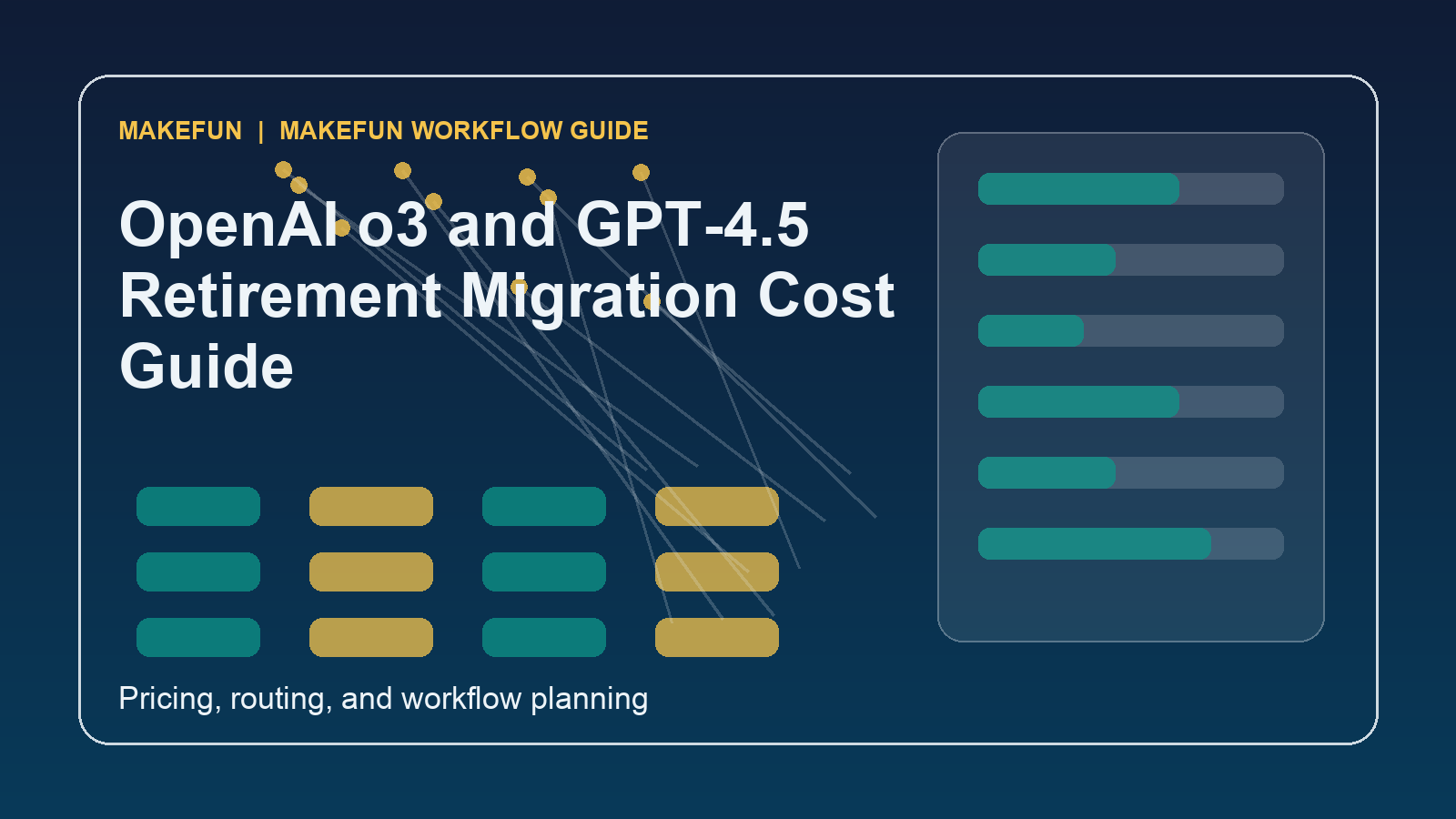
OpenAI’s latest ChatGPT model retirement notice creates a planning problem for teams that rely on saved prompts, custom GPTs, coding assistants, and creative workflow reviews. The important detail is narrow but easy to miss: the official OpenAI Help Center notice says GPT-4.5 retires from ChatGPT on June 27, 2026, and OpenAI o3 retires from ChatGPT on August 26, 2026. It also says the change applies to ChatGPT only and does not change the API.
That means the immediate task is not panic-migrating every API integration. The better task is to separate ChatGPT-only workflows from API-backed workflows, then estimate the cost of replacement, retesting, and output drift before the dates arrive.
What Actually Changes
| Dependency | Affected by this notice? | Action | Cost risk |
|---|---|---|---|
| ChatGPT conversations using GPT-4.5 | Yes, after June 27, 2026 | Move saved prompts and playbooks to a supported model | Output style, longer responses, human review |
| ChatGPT conversations using o3 | Yes, after August 26, 2026 | Retest reasoning-heavy workflows before sunset | Reasoning effort, latency, review time |
| Custom GPTs or internal prompt libraries | Likely, if pinned to retiring ChatGPT models | Inventory, switch model, run side-by-side tests | Prompt rewrites and regression checks |
| API apps using model IDs | Not changed by this Help Center notice | Check official API deprecation pages separately | Only act if an API-specific notice applies |
Migration Cost Matrix
The budget impact usually comes less from the retirement notice itself and more from how teams replace model behavior. A cheap model can become expensive if it needs longer prompts, more retries, or more human review. A premium model can be cheaper in production if it reduces failed runs.
| Workflow | Likely replacement path | Measure before switching | Hidden cost driver |
|---|---|---|---|
| Creative briefs and video prompts | Newer OpenAI ChatGPT model or API-assisted prompt generator | Prompt length, output length, edit rate | Human creative QA and rewritten templates |
| Agentic research or coding tasks | OpenAI reasoning model, Codex-style workflow, or Claude alternative | Tool calls, output tokens, cache use | Failed loops, search/retrieval calls, review time |
| Media workflow QA | OpenAI model plus Makefun production checklist | Number of variants reviewed per asset | Generated media, storage, and approval cycles |
| Long-context documentation review | OpenAI long-context option or Claude model | Input tokens, cache hit rate, batch eligibility | Context window, cache writes, batch timing |
OpenAI vs Claude Cost Questions
For a serious migration estimate, compare official OpenAI API pricing with official Claude API pricing. Do not compare only headline input-token prices. For agent and creator workflows, the total bill can move because of output tokens, reasoning settings, cache behavior, tool calls, search, retrieval, and retries.
A simple 1M-token test should be split into two scenarios:
- Input-heavy workflow: long briefs, transcripts, documentation, or asset notes with short outputs.
- Output-heavy workflow: scripts, code, prompt rewrites, QA notes, and multi-step agent summaries.
Then repeat the same estimate at 10M tokens or your real monthly volume. Add a separate line for migration labor: prompt rewrites, regression tests, reviewer time, and documentation updates.
Checklist for Makefun-Adjacent Teams
- Export saved prompts, custom GPT instructions, internal playbooks, and API model strings.
- Mark each item as ChatGPT-only, API-backed, or mixed.
- For ChatGPT-only items, test the replacement model before June 27 for GPT-4.5 and before August 26 for o3.
- For API-backed systems, check API-specific deprecation notices instead of relying on ChatGPT release notes.
- Run the top five production workflows side by side and record output length, revision rate, and reviewer time.
- Update internal docs so media, support, and creator teams know which model is approved for each workflow.
Where This Fits in AI Media Workflows
For Makefun users, the practical risk is workflow drift. A prompt that creates a clean video brief, avatar script, or image-to-video instruction today may produce a different structure after model migration. Teams using AI video API workflows, GPT-5.5 Codex-style coding reviews, or GPT-Realtime-2 voice-agent cost planning should test output quality and cost together, not as separate workstreams.
FAQ
Is OpenAI shutting down o3 or GPT-4.5 in the API?
Not based on the ChatGPT Help Center notice reviewed for this article. The notice says the retirement applies to ChatGPT only and that there are no API changes. API migration claims need an API-specific source.
Should API teams do anything?
Yes, but the action is verification, not panic. Inventory model IDs, check official API deprecation sources, and estimate replacement cost only for affected systems.
What is the biggest hidden migration cost?
For most teams, it is not the first token-price comparison. It is output drift: longer answers, extra reasoning, failed tool loops, prompt rewrites, and human review of creative or production-critical outputs.