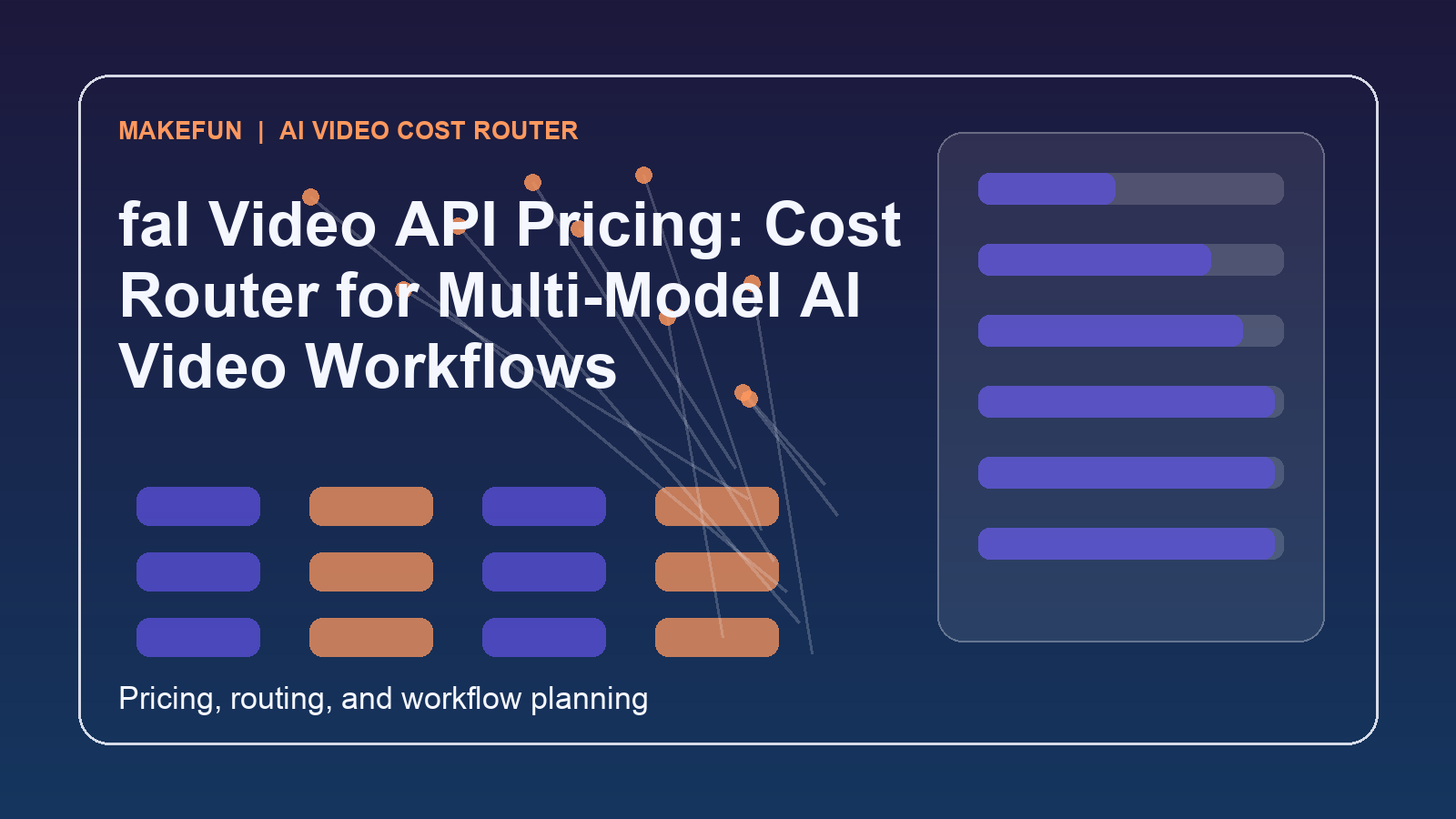
Why fal video API pricing needs a router
fal gives AI video teams a single API surface for many video model families, but the bill is not a single flat number. A short prototype, a 50-clip ad batch, and a production fallback pipeline can all hit different billing units, durations, resolutions, audio settings, retry rules, and storage paths.
This guide is a practical cost router for teams comparing fal, direct model providers, Replicate, WaveSpeed, and Makefun-managed workflows. It is not a universal price ranking. The right route depends on the model family, output quality target, engineering time, and how many approved clips you actually keep.
Official fal pricing signals to check first
Start with the fal Model API pricing documentation. fal documents output-based billing, per-model billing units, prepaid credits, successful-output charging, and no charge for server errors or queue wait. For applications that need live estimates, the fal pricing API returns endpoint-level unit prices for cost estimators.
The fal text-to-video API catalog is useful because it shows the router problem directly: video teams can evaluate routes for models such as Veo, Sora, Kling, Seedance, Wan, PixVerse, and other text-to-video endpoints under one developer workflow. The catalog also shows why exact rates must be refreshed before committing a production budget.
Cost router table
| Workflow | fal route to inspect | Billing unit to normalize | Hidden driver | Makefun decision point |
|---|---|---|---|---|
| Quick prototype | One or two text-to-video endpoints | Cost per generated second or per video | Prompt iterations and rejected clips | Use fal when endpoint switching matters more than a managed editorial flow. |
| Ad variant batch | Model family with stable duration and resolution settings | Cost per approved clip | Resolution, clip length, audio toggle, and review rejection rate | Use a Makefun workflow when creative review, asset reuse, and operator time dominate API cost. |
| Fallback routing | Primary model plus backup models | Blended cost across successful outputs | Fallback frequency and duplicate generation after poor results | Keep fal-specific logs so fallback models do not silently become the main spend path. |
| Lip-sync or audio add-on | Video endpoint plus audio or lip-sync endpoint | Video seconds plus add-on unit | Separate audio generation, speech alignment, and re-render passes | Compare against an end-to-end managed avatar or video workflow before scaling. |
| Production webhook pipeline | Async fal jobs with webhook handling | Approved output plus engineering operations | Queue orchestration, storage, CDN, monitoring, and retry handling | Use Makefun or a managed layer when workflow operations cost more than raw inference. |
Same-use comparison checklist
Use official competitor sources as context, not as proof that one provider always wins. Replicate pricing is useful for understanding hardware and model-page cost exposure. WaveSpeed pricing is useful for another unified image/video API route. Makefun’s own AI video API page helps compare raw API orchestration against a managed production path.
- fal: best to inspect when the team wants a pricing API, multiple video endpoints, and one SDK route.
- Replicate: best to inspect when model-page estimates and hardware/runtime billing are central to the decision.
- WaveSpeed: best to inspect when another unified media API route is in the shortlist.
- Direct provider APIs: best to inspect when a single model family dominates the workflow and direct account terms matter.
- Makefun workflows: best to inspect when creative setup, review, asset handling, and repeatable campaign operations matter more than raw endpoint switching.
Approved-output cost formula
Do not estimate budget from prompt count alone. A safer planning formula is:
Approved-output cost = generated output cost + paid add-ons + retry cost + fallback cost + storage/operations cost, divided by approved clips.
That formula matters because video teams rarely keep every generated clip. If a campaign needs 40 approved clips and the practical approval rate is 50%, the routing budget should plan for roughly 80 generations before final storage, publishing, and review work.
Hidden cost drivers
- Duration: per-second models scale directly with clip length.
- Resolution: higher resolution can change the billing unit or rate.
- Audio and lip-sync: native audio, speech alignment, and post-processing may add separate cost paths.
- Successful-output rules: fal documents successful-output billing, but user-side retries after low-quality results still cost money.
- Fallback routing: backup models are useful, but a high fallback rate can hide the true blended cost.
- Queue and webhook operations: queue wait may not be billed as inference, but production orchestration still has engineering cost.
- Temporary results and permanent storage: production teams need durable storage, CDN handling, audit logs, and removal rules.
Workflow template
- List the model families you are willing to use and the fallback models you will allow.
- Pick a standard test clip length, resolution, and audio setting before comparing routes.
- Use fal pricing docs or the pricing API to refresh endpoint costs for the exact routes in scope.
- Compare the same workflow against Replicate, WaveSpeed, direct provider APIs, and Makefun-managed production.
- Normalize by approved clip, not raw prompt or raw request.
- Review spend logs after the first batch and remove fallback paths that do not improve usable output.
Where this fits in Makefun planning
If the team is still choosing a model family, start with Makefun AI Video API and use fal as one router benchmark. If the work is a model-specific budget, compare against examples like the Luma Ray3.14 video cost calculator or the PixVerse V6 AI video generator. The goal is to choose the workflow with the best approved-output economics, not the lowest-looking line item.
FAQ
Is fal always cheaper than direct provider APIs?
No. fal can simplify routing and estimation, but direct provider terms, model availability, volume discounts, quality targets, and operational overhead can change the real cost.
Should I compare cost per prompt or cost per approved video?
Use cost per approved video. Prompt count ignores rejected outputs, reruns, fallback routes, and post-generation operations.
Can fal pricing be cached in my own calculator?
Cache carefully and refresh often. fal exposes pricing APIs, but video endpoint rates can change as model families, resolutions, and audio modes evolve.
When is a managed Makefun workflow better than raw API routing?
Use a managed workflow when creative setup, iteration, review, asset handling, and repeatability are more important than switching endpoints manually.