As of June 4, 2026, model Macroscope pricing as three separate ledgers: Code Review diff KB, Agent and Check Run Agent credits, and Status commits. The worksheet below is for engineering teams that need to budget pull-request review, custom GitHub checks, release-note or status summaries, Slack/GitHub/API agent questions, and Makefun-style support or media workflow handoff without turning one headline rate into a false all-in price.
Publication-time checks used the official Macroscope pricing, Agent, Check Run Agents, and release notes pages. Treat those docs as the source of truth because custom rates, annual terms, model support, raw LLM cost, spend controls, and skipped-processing behavior can change.
Macroscope pricing source snapshot
| Ledger | Official unit to model | Budget caveat |
|---|---|---|
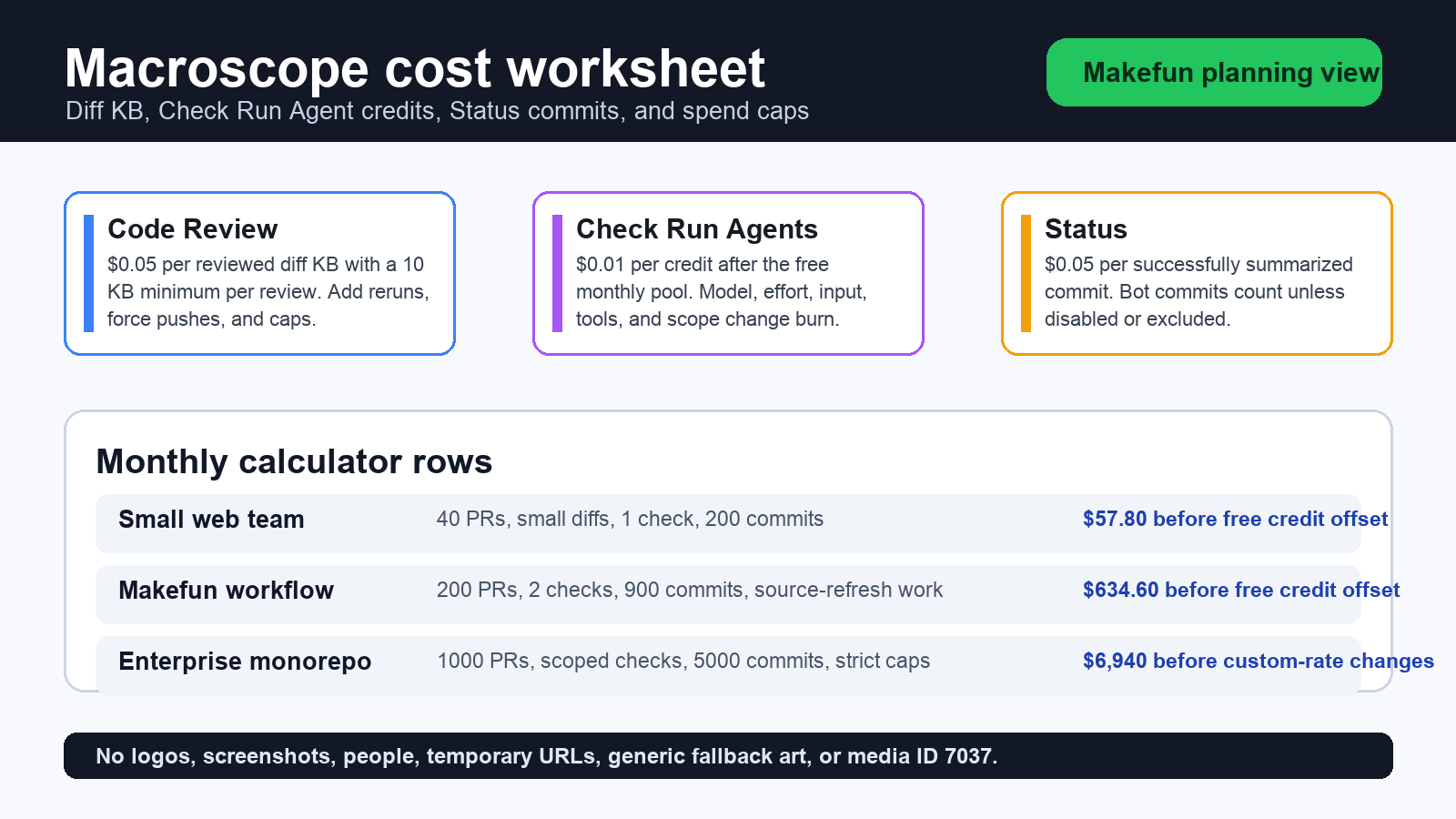
| Code Review | $0.05 per KB of reviewed diff, with a 10 KB minimum per review. | At standard rates, a tiny review still has a $0.50 floor. Reruns, force pushes, rebases, on-demand reviews, per-review caps, and per-PR caps matter. |
| Agent and Check Run Agents | $0.01 per credit, with 1000 monthly free credits and no rollover. | Credit burn depends on raw LLM cost plus markup. Model, reasoning, effort, input mode, tools, include/exclude scope, and task complexity can change cost. |
| Status | $0.05 per successfully summarized commit. | Status is separate from Agent credits. Bot commits are billed unless the team disables or excludes them. |
| Spend controls | Prepaid balance, auto-refill, monthly max, per-review cap, and per-PR cap. | If balance or max spend stops processing, PRs or commits can be skipped rather than retroactively processed later. |
Code Review diff KB worksheet
Start with monthly PR count, average reviewed diff KB, the share of small PRs that hit the 10 KB minimum, and review runs per PR. Then add force pushes, rebases, manual review triggers, generated-file exclusions, per-review caps, and per-PR caps. This keeps Macroscope-specific math separate from CI minutes or human-review time.
Check Run Agent and Agent credit worksheet
For Check Run Agents, count how many custom checks run per PR, which model and effort they use, whether they read the full diff or scoped code objects, which tools are enabled, and whether prerequisite checks gate execution. For Agent work, count Slack questions, GitHub or API prompts, scheduled macros, release-note drafting, support debugging, and complex research tasks separately. Use the free monthly credit pool as an offset, not as a guarantee that all agent work is free.
Status commit processing rows
Status should be modeled by successfully summarized commits. Count human commits, bot commits, Dependabot-style updates, draft PR behavior, disabled repositories, excluded authors, and periods when balance or monthly max prevents processing. A team that pushes many small commits can see Status cost grow even when Code Review volume stays stable.
Three scenario calculator
| Scenario | Assumptions | Macroscope rows before free-credit offset |
|---|---|---|
| Small web team | 40 PRs per month, 70% under 10 KB, 30% at 30 KB, 1.2 review runs per PR, one Check Run Agent averaging 20 credits, 200 Status commits, and 20 quick Agent questions. | Code Review: $38.40. Check Run Agent: $8. Status: $10. Quick Agent: $1.40. Total: $57.80, with 940 Agent credits inside the 1000 monthly free-credit pool if no other Agent usage exists. |
| Makefun API/media workflow team | 200 PRs per month, 25 KB average reviewed diff, 1.4 review runs per PR, two Check Run Agents averaging 35 credits each, 900 Status commits, 80 quick Agent questions, and 20 complex research/debugging runs. | Code Review: $350. Check Run Agents: $140. Status: $45. Quick Agent: $5.60. Complex Agent: $94. Total: $634.60 before up to $10 of free-credit offset. |
| Enterprise monorepo | 1000 PRs per month, 60 KB average reviewed diff after excludes, 1.6 review runs per PR, three Check Run Agents averaging 50 credits each, 5000 Status commits, 200 quick Agent questions, and 80 complex Agent runs. | Code Review: $4,800. Check Run Agents: $1,500. Status: $250. Quick Agent: $14. Complex Agent: $376. Total: $6,940 before custom rates, annual terms, excludes, bot filters, and caps. |
Same-use comparison rows
Compare Macroscope only against the same workflow. For adjacent coding-agent cost governance, use the GitHub Copilot AI Credits calculator, Cursor Composer 2.5 workflow guide, Claude Agent SDK pricing change, GPT-5.5 Codex coding model overview, AWS Bedrock AgentCore cost governance, UiPath coding agents enterprise automation, and Anthropic Stainless agent API workflow. Do not claim Macroscope is cheapest, best, safer, or more accurate unless the same scenario and current official sources prove it.
Makefun handoff checklist
- Refresh official Macroscope pricing, Agent docs, Check Run Agent docs, and release notes before each budget update.
- Record reviewed diff KB, 10 KB minimums, reruns, Check Run Agent credits, Agent credits, Status commits, CI, and human review in separate worksheet rows.
- Use include/exclude scope, waitsFor prerequisites, bot filters, and spend caps as cost-control rows, not as afterthoughts.
- Flag skipped processing when balance, monthly max, per-review cap, or per-PR cap stops work.
- Keep write-code permissions, repository data, connected tools, Sentry/log access, screenshots, and proprietary diffs in the risk review.
FAQ
What is the minimum Macroscope Code Review charge?
At the standard rate in the June 4, 2026 official pricing snapshot, Code Review is $0.05 per reviewed diff KB with a 10 KB minimum per review, so the standard minimum is $0.50 before custom-rate or annual-term differences.
Do Check Run Agents and Status use the same billing meter?
No. Agent and Check Run Agent work uses credits, while Status is priced per successfully summarized commit. Keep those rows separate.
What happens when spend controls stop processing?
Budget the operational effect, not just the dollar cap. When balance or spend limits stop work, Macroscope may skip affected PRs or commits rather than queue them for retroactive processing.