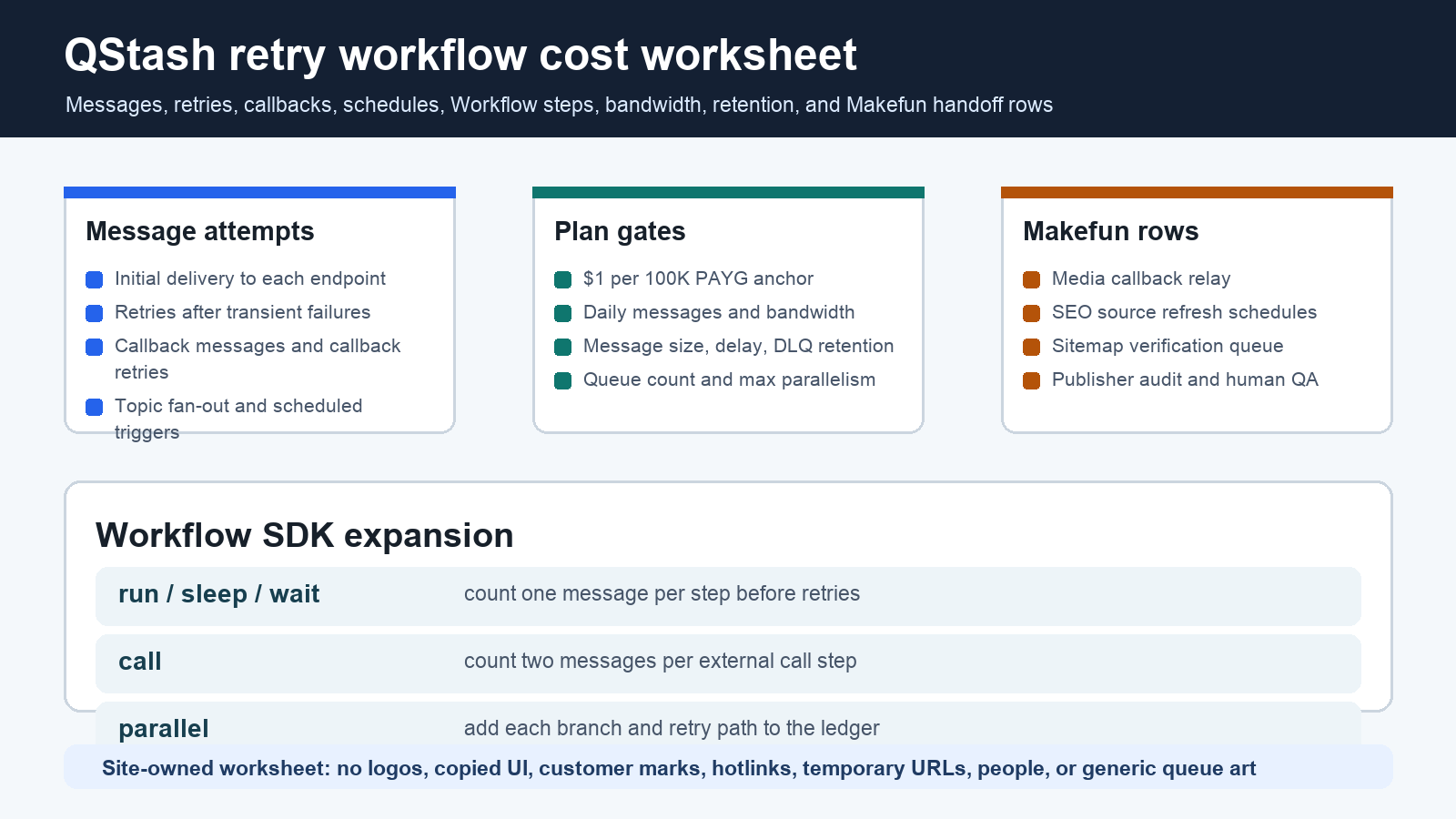
As of June 4, 2026, Upstash QStash cost planning starts with billable message attempts, not only workflow or job count. Count the initial delivery, every retry attempt, callbacks, topic fan-out, scheduled triggers, and Workflow SDK step messages; then check bandwidth, message size, delay, active schedules, DLQ and log retention, queue count, and parallelism before comparing it with durable workflow platforms or local Makefun queues.
Publication-time checks used the official Upstash QStash pricing page, Workflow pricing docs, callback docs, retry docs, flow-control docs, and dead letter queue docs. Refresh those pages before procurement because message price, fixed tiers, bandwidth, retention, delay, schedule, and parallelism limits can change.
Upstash QStash pricing source snapshot
| Row | June 4, 2026 source value | How to use it |
|---|---|---|
| Free plan | $0 with 1,000 messages per day, 50 GB monthly bandwidth, 1 MB max message size, 15-minute max HTTP response duration, 3-day DLQ/log retention, 10 active schedules, 10 queues, and 10 max parallelism. | Use for prototypes and low-volume checks only; schedule count and retry fan-out can exhaust the practical limit before raw job count looks high. |
| Pay as You Go | $1 per 100K messages, unlimited messages per day, 50 GB included bandwidth, 10 MB max message size, 1-year max delay, 2-hour max HTTP response duration, 7-day DLQ/log retention, 1,000 active schedules, 100 queues, and 100 max parallelism. | Use as the main calculator anchor, but multiply by delivery attempts, not source jobs. |
| Fixed 1M | $180/month with 1M messages per day, 1 TB bandwidth, 50 MB max message size, 6-hour max HTTP response duration, 30-day DLQ retention, 14-day log retention, 10,000 active schedules, and 200 max parallelism. | Use when predictable high-capacity scheduling, retention, and message-size gates matter more than per-message PAYG. |
| Fixed 10M | $420/month with 10M messages per day, 5 TB bandwidth, 50 MB max message size, 12-hour max HTTP response duration, 3-month DLQ retention, 14-day log retention, 50,000 active schedules, and 1,000 max parallelism. | Use for larger fan-out, callback, and scheduled workflows after checking whether enterprise support or isolation is required. |
| Message counting | The pricing FAQ states that each delivery attempt counts as one message, retries count as additional messages, topic publishing is billed once per subscribed endpoint, and scheduled messages are billed each time the schedule triggers. | Turn job count into delivery attempts before quoting a budget. |
Cost formula: publishes, retries, callbacks, topic fan-out, schedules, Workflow steps, and Makefun side costs
A practical worksheet is: monthly_cost = billable_messages / 100000 * current_PAYG_message_price + fixed_plan_or_enterprise_floor + bandwidth_or_limit_upgrade + external_media_API_cost + source_fetch_cost + storage + human_QA. Billable messages include initial deliveries, retry attempts, callback messages, callback retries, topic endpoint fan-out, scheduled triggers, and Workflow SDK step messages.
For Workflow SDK planning, convert step design into QStash messages before comparing providers. The current Workflow pricing docs describe run, sleep, sleepUntil, and waitForEvent as one message each; call as two messages; parallel steps as additional messages; and retries as new messages. That means a workflow with several call and parallel steps can cost more than its run count suggests.
Worksheet 1: Makefun media callback relay with retries and callbacks
For 50,000 monthly avatar, video, or API completion callbacks, count one initial delivery per destination, failed-delivery retry attempts, optional callback messages, callback retries, topic fan-out, and any scheduled follow-up. Then add media API generation, R2 or storage, WordPress handoff, and human QA outside QStash. For callbacks, a job can become several billable messages once retries, callbacks, and topic fan-out are enabled.
Worksheet 2: SEO source-refresh scheduler and sitemap verification queue
For Makefun pricing/source refresh jobs, model daily checks at about 30 to 31 fires per month per source and hourly volatile checks at about 720 to 744 fires per month per source. Fan-out to scorer, brief-builder, verifier, cache-pending recheck, and report writer should be separate rows. Add active schedule limits, max delay, log retention, DLQ retention, bandwidth, parallelism, source-fetch/browser/API costs, evidence retention, and manual reviewer minutes.
Worksheet 3: Workflow SDK media QA with sleep, wait, call, parallel steps, and retries
For long-running media QA or source-audit workflows, start with monthly workflow runs and per-run step counts: run, sleep, sleepUntil, waitForEvent, call, and parallel branches. A simple example with run=3, sleep/sleepUntil=2, waitForEvent=1, call=4, and parallel branches=3 produces 17 messages per successful run before retries or callbacks. Add max parallelism, queue parallelism, rate or flow-control key, endpoint response duration, LLM tokens, media API calls, storage, WordPress write path, and human QA minutes outside QStash.
Same-unit comparison table
| Alternative | Same-unit row to model | Use when |
|---|---|---|
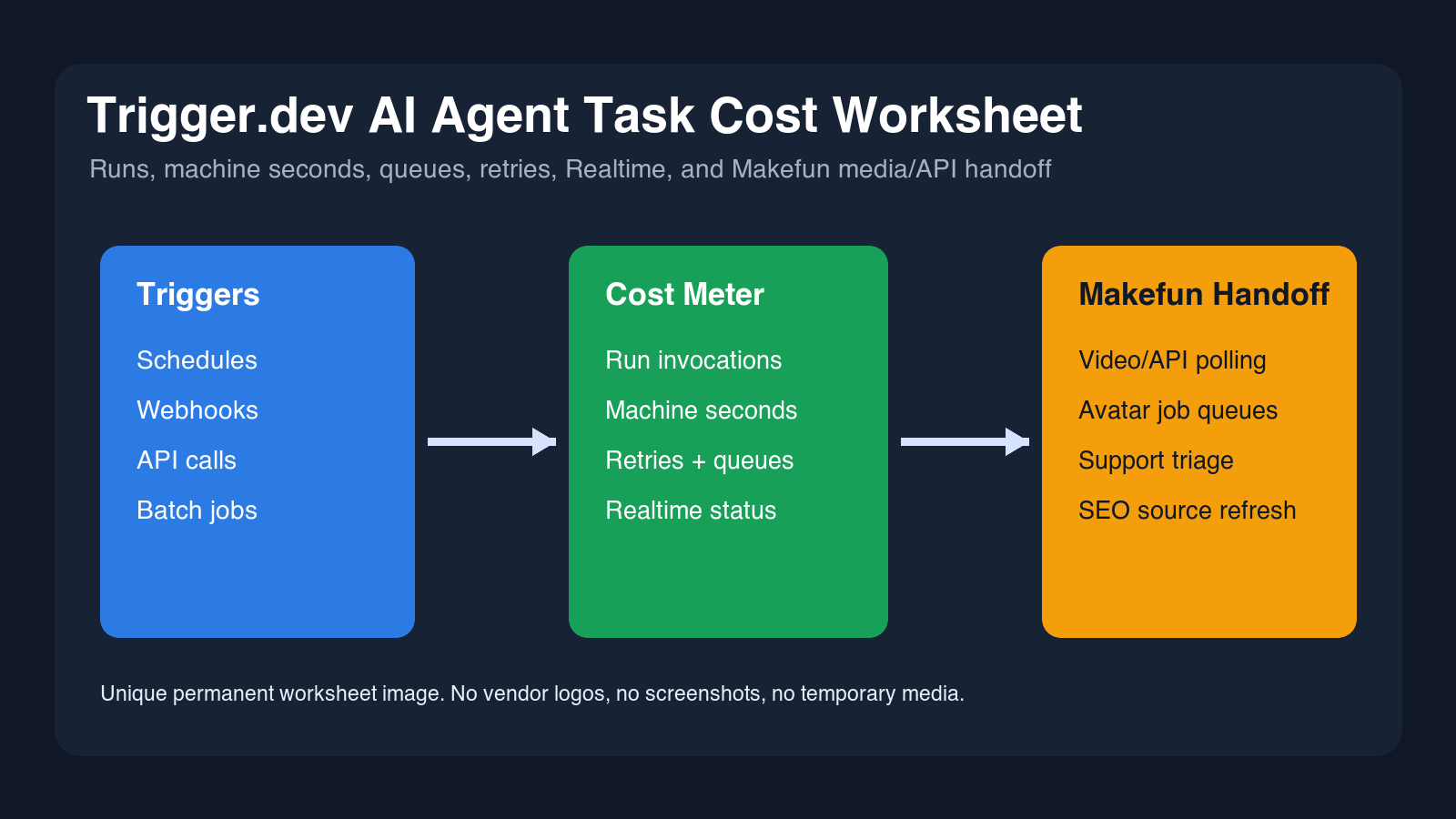
| Trigger.dev | Executed runs, machine seconds, retries, queue behavior, and task runtime overhead. | TypeScript task orchestration and worker runtime are the main buying questions. |
| Temporal Cloud | Actions, active storage, retained storage, support or plan floor, capacity, and customer-hosted workers. | Durable workflow history, signals, child workflows, audit state, and support commitments dominate. |
| n8n | Workflow executions, concurrency, saved executions, self-host operations, and operator editing. | Visual workflow editing and integrations matter more than per-message precision. |
| Pipedream | Credits by compute segment, connector usage, workflow duration, and auth/agent handoff rows. | Connector breadth and hosted workflow operations are the main constraint. |
| Cloudflare Queues | Write/read/delete operations per 64 KB chunk, retry reads, DLQ writes, and Workers platform assumptions. | The workload is queue-operation heavy inside Workers. |
| Vercel Queues | Beta API operations, included monthly operations, and current per-1K operation overage. | The app is already Vercel-native and beta queue limits are acceptable. |
| Svix | Attempted messages, 64 KiB chunks, included messages, additional message rate, and retry treatment. | Webhook delivery is the product surface and provider-managed endpoints matter. |
| Makefun local scripts | Host-runner, lock/preflight, cron, queue state, observability, manual recovery, and maintainer time. | Low-volume deterministic handoff is enough and local recovery effort is acceptable. |
Do not collapse these options into a generic cheapest or best claim. The useful comparison is whether the workflow needs billable message-attempt precision, long-running state, retained audit trails, visual editing, connector breadth, queue operations, or local control.
Relevant Makefun context includes the Temporal Cloud Actions Storage Workflow Cost Calculator for durable workflow-history rows, the Comfy Cloud API workflow cost calculator for downstream media/API handoff rows, and the Browserbeam session proxy AI selector credit calculator for source-refresh and browser automation side costs.
Cost-control checklist
- Count delivery attempts, not only jobs.
- Cap retries for transient failures and mark known malformed or non-retryable failures where appropriate.
- Budget callback messages and callback retries separately from primary deliveries.
- Model topic fan-out by endpoint count.
- Check active schedule, max delay, message size, bandwidth, DLQ/log retention, queue count, and max parallelism before picking a plan.
- Use flow control when downstream media, WordPress, or source-refresh systems should not receive unlimited concurrent delivery.
- Keep external media API, LLM token, source-fetch, storage, support, and human-review costs outside QStash pricing.
Risks and Publisher checklist
Pricing, plan limits, beta features, retry behavior, callbacks, schedules, flow-control behavior, and enterprise terms can change. Refresh official Upstash pages before relying on exact budgets, and avoid unsupported cheapest, best, faster, safer, more reliable, or guaranteed-savings claims. For Makefun publication, keep the page in the blog category, use a topic-specific permanent worksheet image, verify internal links, and recheck sitemap/cache state after publication.
FAQ
What is the first row in a QStash calculator?
Start with billable messages: initial deliveries, retries, callbacks, topic endpoint fan-out, scheduled triggers, and Workflow SDK step messages.
Are retries free?
No. Upstash pricing states that retry delivery attempts count as additional messages, so retry rate belongs in the budget worksheet.
Why separate Makefun side costs?
QStash covers message delivery and workflow-message rows. Media APIs, source fetching, LLM tokens, storage, WordPress handoff, support review, and human QA are separate operating costs.