
Imgix cost planning starts with credits, but a useful worksheet should split those credits into management, delivery, and transformations. For Makefun media workflows, model managed media GB, delivery bandwidth, cache reads, image variants, AI edits, video and caption usage, origin storage, and manual QA before comparing Imgix with Cloudinary, ImageKit, Cloudflare Images and Stream, Vercel Image Optimization, Mux, Transloadit, or R2 plus scripts.

Official source snapshot
This calculator should be refreshed against the official Imgix pricing, pricing FAQ, credit consumption guide, AI transformation, and video optimization pages at publication time. The safe public claim is that Imgix planning spans management, delivery, image transformation, AI transformation, and video workflow rows; exact prices, bundles, credit consumption, and enterprise terms can change.
Management, delivery, and transformation credit ledger
Do not estimate Imgix only by the number of images. Start with the managed media library, then add delivery bandwidth, cache reads, cache behavior, standard transformations, premium AI transformation mix, generated variants, video optimization, caption rows, and overage or plan-upgrade assumptions. The same media library can look inexpensive or expensive depending on whether bandwidth, repeated renders, and premium edits are included.
Worksheet inputs for Makefun media workflows
- Monthly managed media GB and image cache storage.
- Monthly delivery bandwidth, cache reads, and cache-hit assumption.
- Images processed, variants per image, and repeated render behavior.
- AI edit mix: background removal, object removal, super resolution, generative fill, background replacement, text-to-image, image-to-video, or privacy blur.
- Video optimization, adaptive delivery, preview, and caption rows when the workflow includes clips.
- Origin storage outside Imgix, including WordPress media, Cloudflare R2, or provider-native output storage.
- Manual QA for alt text, brand safety, accessibility, social crops, and permanent media registration.
Same-unit comparison frame
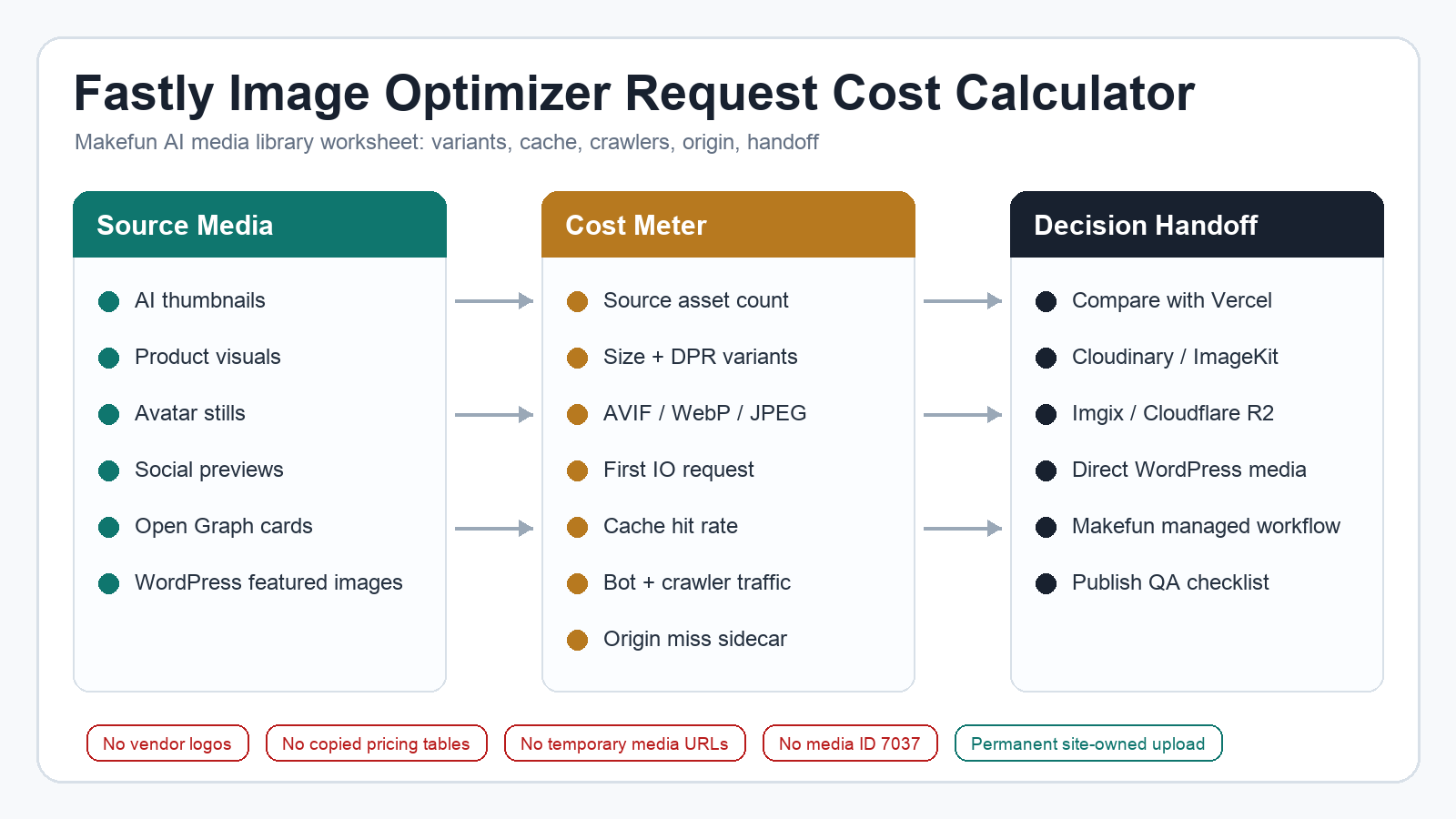
Use the same workload before comparing providers: one Makefun monthly media workflow with managed media GB, delivery GB, cache reads, variants, AI edits, video previews, captions, origin storage, retries, and QA labor. The closest internal references are the Cloudinary AI transformation credit calculator, the ImageKit video extension unit DAM calculator, and the Cloudflare R2 Images Stream media cost calculator. Use those as adjacent comparisons, not as proof that one provider is cheapest or best.
| Route | Rows to normalize | Risk control |
|---|---|---|
| Imgix | Management credits, delivery credits, transformations, AI edits, video rows, cache reads | Refresh official credit and feature pages before numeric claims |
| Cloudinary | Credits, transformations, derived assets, storage, backups, delivery, video rows | Keep as adjacent comparison, not a duplicate article |
| ImageKit | Bandwidth, DAM storage, video units, extension units, purge requests, users | Separate DAM and video units from Imgix credit framing |
| Cloudflare R2 plus Images or Stream | Object storage, operations, images, transformations, Stream minutes, delivery | Do not call self-managed storage free; include labor and QA |
| Manual Makefun workflow | Generate, review, crop, compress, upload, alt text, social preview, cache QA | Use as editorial labor baseline, not a public benchmark claim |
Hidden cost drivers
The hidden cost is often not the first image. Responsive variants, repeated cache reads, AI edit retries, video preview handling, captions, origin storage, WordPress media registration, and manual review can dominate the publishing workflow. If a team only tracks the source generation step, it can miss the media delivery and QA work that happens after the asset is approved.
Publisher checklist
- Confirm the target Imgix slug is not already live before publishing.
- Refresh official Imgix pricing, FAQ, credit consumption, AI transformation, and video optimization pages.
- Refresh comparison sources for Cloudinary, ImageKit, Cloudflare Images and Stream, Vercel, Mux, Transloadit, and R2 before numeric comparison.
- Assign category blog id 2, set Yoast title and description, and verify public Yoast head after creation.
- Use only unique permanent site media; do not use media ID 7037, vendor logos, copied UI, copied pricing tables, third-party hotlinks, or temporary MakeFun URLs.
FAQ
What should an Imgix pricing calculator include?
It should separate management, delivery, and transformation credits, then add media GB, bandwidth, cache reads, variants, AI edit mix, video and caption rows, origin storage, and manual QA.
Are Imgix AI transformations the only cost driver?
No. Delivery, cache behavior, media management, standard transformations, video optimization, origin storage, and QA can matter as much as premium AI edits.
Can this worksheet claim Imgix is cheaper than Cloudinary or ImageKit?
No. A safe comparison needs same-unit math, source dates, and scenario-specific assumptions. Without that, it should remain a planning worksheet rather than a cheapest-provider claim.
When is R2 plus scripts a useful baseline?
R2 plus Sharp or FFmpeg scripts can be a useful baseline when a team can own storage, operations, processing, QA, and WordPress registration. It is not a zero-cost substitute once engineering time and review labor are included.