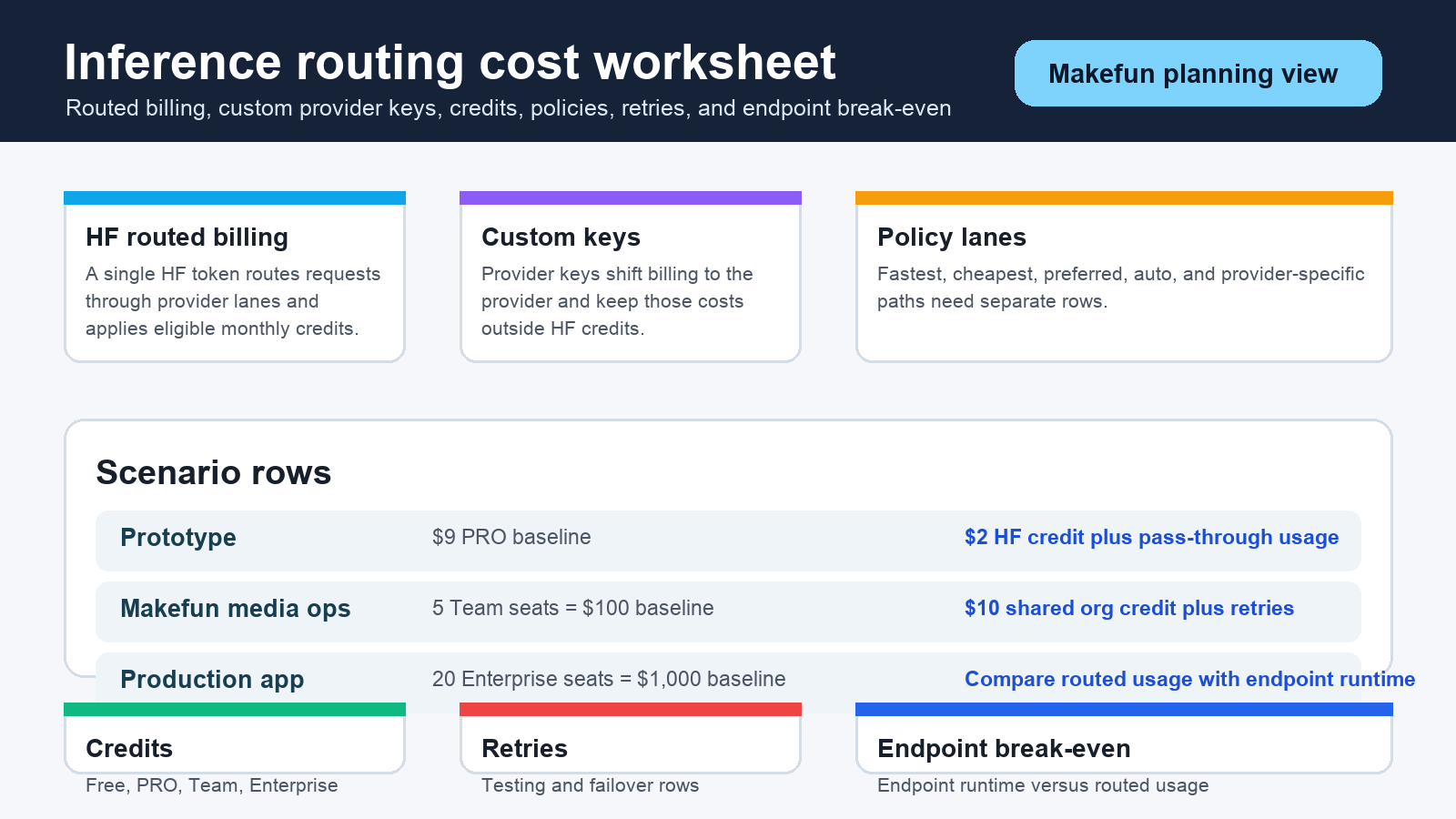
As of June 4, 2026, Hugging Face Inference Providers pricing should be modeled as a routing ledger, not as one flat API price. A useful worksheet separates the task and model, the selected provider policy, whether billing routes through Hugging Face or through a custom provider key, monthly credits, organization billing, retries, testing, and dedicated Inference Endpoint break-even rows. Refresh Hugging Face and provider pricing before using this for procurement.
Publication-time source refresh used the official Hugging Face Inference Providers, Pricing and Billing, Hub Integration, Security, public pricing, and Inference Endpoints pricing pages. Host-runner curl to huggingface.co failed with an SSL certificate subject mismatch, so the official browser-opened docs are the current source snapshot for this post.
Hugging Face pricing source snapshot
| Cost row | What to model | Budget caveat |
|---|---|---|
| Inference Providers | Multi-provider serverless inference through Hugging Face clients, OpenAI-compatible chat, and direct HTTP paths. | Provider selection, task support, availability, latency, and per-provider request shape can differ. |
| Routed billing | Free, PRO, Team, and Enterprise monthly credits apply when eligible requests route through Hugging Face. | Free credits are small and subject to change; Team and Enterprise credits require explicit organization billing. |
| Custom provider keys | The request still uses Hugging Face integration surfaces, but billing moves to the external provider. | Hugging Face monthly credits do not apply to custom-key usage. |
| Provider policies | Fastest, cheapest, preferred, automatic, and provider-specific paths. | Do not claim cheapest, fastest, or best overall without same-scenario provider evidence. |
| Dedicated endpoints | Hourly instance pricing while endpoints initialize and run, calculated by the minute. | Endpoint runtime, idle time, scaling, and quota can dominate steady production traffic. |
Routed request versus custom provider key rows
Start each row by choosing the task: chat, embeddings, image, video, speech, classification, or evaluation. Then choose whether the call is billed through Hugging Face or through a custom provider key. Routed Hugging Face billing can use eligible monthly credits and consolidated usage reporting. Custom provider keys should be modeled as separate provider invoices because the Hugging Face credit pool does not offset those calls.
Credit and organization billing rows
The June 4 source snapshot lists PRO at $9/month, Team at $20/month per user, and Enterprise at $50/month per user on the public pricing page. The Inference Providers billing page lists monthly credits for Free users, PRO users, and Team or Enterprise organizations. Keep the account baseline, included credits, purchased credits, and organization bill_to behavior in separate rows so shared team usage is not mistaken for personal account usage.
Provider policy and metadata rows
Hugging Face supports automatic routing and policy suffixes such as fastest, cheapest, preferred, and provider-specific choices for supported flows. Treat those as routing choices, not as universal recommendations. For chat workloads, the OpenAI-compatible route and model-listing metadata can expose provider pricing, context length, latency, and throughput when available; for non-chat tasks, use the Hugging Face inference clients or direct task routes.
Three scenario calculator
| Scenario | Assumptions | Worksheet result |
|---|---|---|
| Small prototype | PRO account at $9/month, 25,000 chat input tokens, 10,000 output tokens, 200 image tests, 50 embedding batches, and 10% retry overhead. | Account baseline is $9/month. Routed usage is provider pass-through usage after eligible monthly credit; custom-key usage moves to the provider invoice. |
| Makefun media workflow | 5 Team users at $20/user/month, image/video/support-agent experiments, 1,000 chat completions, 500 image requests, 80 heavy media requests, 1,500 embedding batches, and 15% retry overhead. | Seat baseline is $100/month. Shared organization credits offset eligible routed usage only when organization billing is explicit. Makefun QA and handoff stay separate. |
| Production app | 20 Enterprise users at $50/user/month, organization billing, 2 million chat or token-equivalent units, 500,000 embedding units, and one endpoint running up to 730 hours/month. | Seat baseline is $1,000/month before routed provider usage. Compare routed requests with endpoint hourly runtime, calculated by the minute, for steady traffic. |
Same-use comparison rows
Compare Hugging Face only against the same task mix and billing route. Adjacent Makefun worksheets include fal video API cost routing, Runware video API cost routing, GitHub Copilot AI Credits, AWS Bedrock AgentCore cost governance, Comfy Cloud API workflow costs, and Pinecone Assistant context token planning. Do not claim Hugging Face is cheaper, faster, safer, or better than OpenRouter, Together, Replicate, fal, Runware, Fireworks, DeepInfra, Groq, Cerebras, direct provider APIs, or Makefun-owned workflows without current same-scenario evidence.
Makefun workflow handoff worksheet
For Makefun-style work, add rows for prototype experiments, image and video generation, avatar workflows, embeddings and RAG, support assistants, API routing, QA review, retry/failover, and human escalation. Hugging Face can simplify testing through a single token and router, but production budgeting still needs provider policy, source refresh, privacy review, and workflow handoff rows.
Risks and caveats
- Refresh Hugging Face and provider pricing before quoting a budget.
- Keep routed billing and custom provider key billing separate.
- Use organization billing explicitly when Team or Enterprise credits should apply.
- Count retries, playground tests, widgets, evaluations, and Data Studio usage.
- Review each external provider’s security and data policy before sending sensitive prompts or customer data.
FAQ
Do Hugging Face monthly credits apply to custom provider keys?
No. The official billing docs distinguish routed Hugging Face billing from custom provider keys. Custom provider key usage is billed by the provider and should sit in a separate invoice row.
Is the cheapest provider policy always the right choice?
No. Cheapest, fastest, preferred, automatic, and provider-specific routing are worksheet choices. Availability, latency, context length, throughput, data policy, and retries can matter more than one price field.
When should a team compare dedicated Inference Endpoints?
Compare endpoints when traffic is steady enough that hourly runtime, scale behavior, quota, idle time, and operations overhead may be easier to budget than routed pay-as-you-go requests.