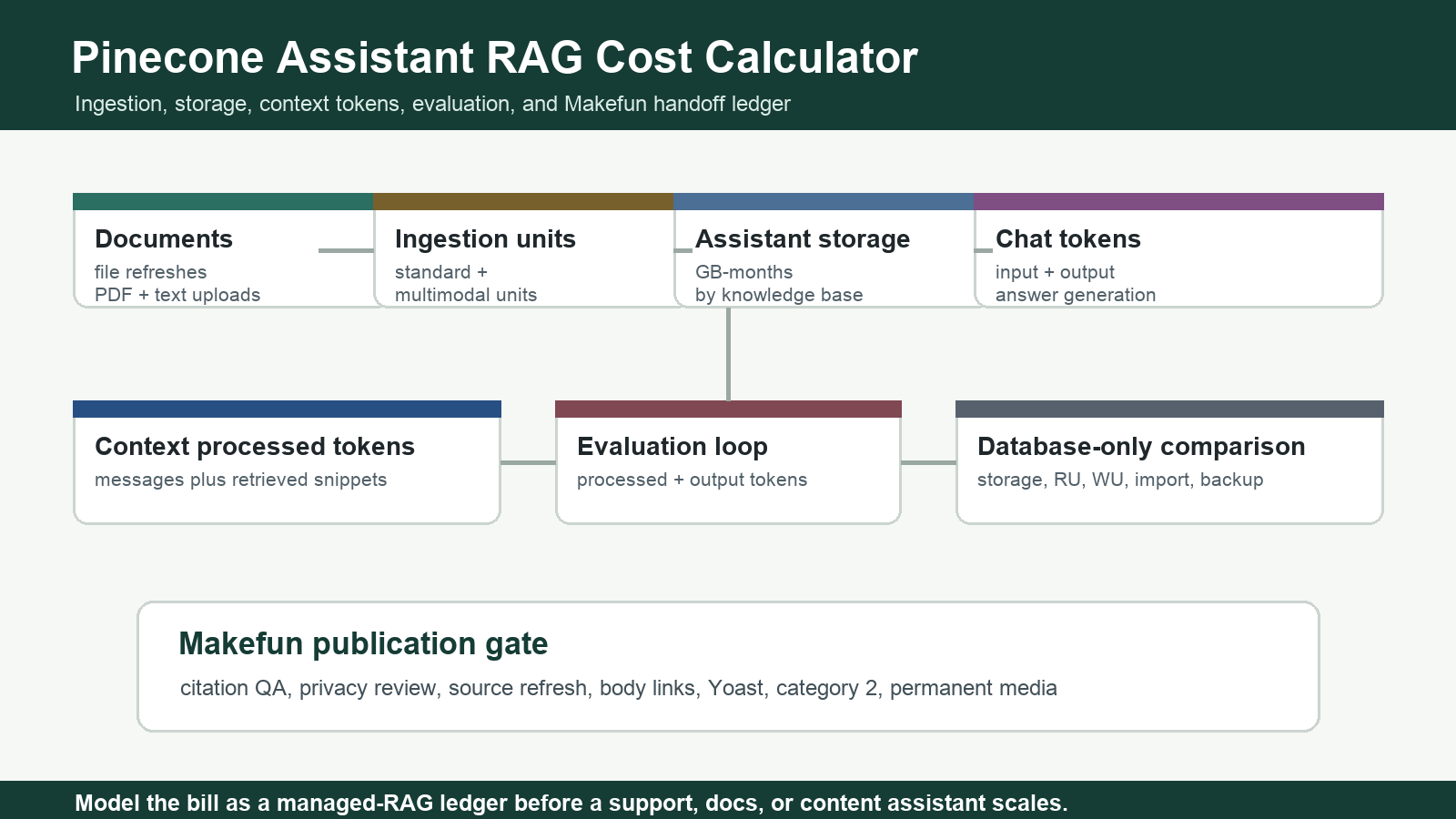
Pinecone Assistant pricing should be modeled as a managed RAG ledger, not as one vector database line item. For a support, documentation, pricing-refresh, or media-research assistant, separate the plan route, Assistant storage, ingestion units, multimodal ingestion, chat input tokens, chat output tokens, context processed tokens, evaluation tokens, optional embedding or rerank rows, database-only comparison costs, and human citation review.
Publication-time checks refreshed the official Pinecone pricing page, the Pinecone Assistant pricing and limits docs, the Assistant overview, and Pinecone’s managed knowledge layer announcement. Use those pages as the source of truth because plan minimums, included allowances, context-token treatment, ingestion units, and support terms can change independently.
Pinecone Assistant pricing source snapshot
At publication, Pinecone listed Starter at $0/month, Builder at a $20/month flat plan, Standard with a $50/month minimum, and Enterprise with a $500/month minimum. For paid Assistant usage, the source rows to keep separate are Assistant storage at $3/GB-month, chat input tokens at $8 per million, chat output tokens at $15 per million, context processed tokens at $5 per million, evaluation processed tokens at $8 per million, evaluation output tokens at $15 per million, standard ingestion units at $0.0005 per unit, and multimodal ingestion at $0.001 per unit. Pinecone describes one ingestion unit as about 400 tokens or 300 words.
Do not turn temporary credits into durable pricing. Recheck included usage, Marketplace input-token promotions through June 30, 2026, bulk import credits through July 31, 2026, Starter/Builder feature availability, file and page limits, rate limits, HIPAA, BYOC, support add-ons, and cloud or region variance before using this worksheet for procurement.
Pinecone Assistant cost stack
| Row | What to count | Why it matters | Publication caveat |
|---|---|---|---|
| Plan route | Starter, Builder, Standard, Enterprise, included usage, and any monthly minimum. | The minimum or included allowance can dominate small assistants before usage grows. | Refresh current plan limits and promo allowances before committing budget guidance. |
| Assistant storage | Knowledge-base GB-months after uploaded files are processed. | Large document sets and stale files quietly add recurring cost. | Pair storage rows with retention and deletion rules. |
| Ingestion units | Standard ingestion units plus multimodal ingestion units for files such as PDFs. | Source refresh cadence can cost more than a one-time upload. | Do not mix standard and multimodal unit assumptions. |
| Chat tokens | Input tokens and output tokens for Assistant conversations. | Visible answer length is only part of the bill. | Estimate by workflow, not by average consumer chat length. |
| Context processed tokens | Messages plus retrieved snippets used for grounded context retrieval. | Context can grow faster than output tokens when retrieval brings long snippets. | Keep this row separate from answer output tokens. |
| Evaluation tokens | Evaluation processed tokens and evaluation output tokens. | Launch gates and recurring QA loops create their own token ledger. | Budget evaluation cadence before production rollout. |
| Database comparison | Pinecone database storage, read units, write units, import, backup, and restore. | A database-only RAG build may be cheaper in usage but higher in orchestration labor. | Compare same workload and same QA standard. |
Three worksheet scenarios
| Scenario | Monthly inputs to model | Formula starter | Decision it supports |
|---|---|---|---|
| Small documentation assistant | One assistant, small storage footprint, 25,000 chat turns, modest document refresh, a light evaluation set, and optional reranking. | plan route + storage + ingestion + input tokens + output tokens + context tokens + evaluation tokens + optional rerank + human QA | Decide whether included usage is enough or usage-based billing is more realistic. |
| Makefun source-refresh assistant | Pricing-source research, WordPress update support, weekly file refresh, multimodal PDFs, 75,000 context-heavy calls, and publication citation QA. | plan minimum + storage GB + ingestion units + multimodal units + chat tokens + context tokens + evaluation tokens + citation review hours | Compare Pinecone Assistant with manual source refresh, search APIs, or Firecrawl plus vector storage. |
| Enterprise support and content operations | High conversation volume, larger storage, frequent document refresh, database-only comparison rows, context retrieval before answers, evaluation loops, and privacy review. | max(plan minimum, assistant usage + database comparison + inference + support or compliance add-ons) + review labor | Decide whether managed upload, citations, chat, context, and evaluation justify the extra usage rows. |
Assistant versus database-only RAG
Use Pinecone Assistant when managed upload, chunking, storage, grounded chat, citations, context retrieval, and evaluation reduce enough operational work to justify the Assistant-specific usage rows. Use Pinecone database-only RAG when the team wants tighter orchestration control and can own document processing, prompt routing, answer generation, citation review, and evaluation outside the managed Assistant layer.
The same comparison should include adjacent Makefun planning pages that returned live HTTP 200 during publication checks. For agent infrastructure governance, see the AWS Bedrock AgentCore cost guide. For coding-agent credits, use the GitHub Copilot AI Credits calculator. For search and metadata workflows, compare the TwelveLabs Pegasus video intelligence cost matrix. For frontend agent workflows, see CopilotKit AG-UI agentic frontend cost governance. For live support and voice/video operations, compare Pipecat Cloud agent hosting costs and the GPT-Realtime-2 voice agent API guide.
Makefun handoff checklist
- Refresh official Pinecone pricing and Assistant docs before each publication or budget update.
- Record storage, ingestion, multimodal ingestion, input tokens, output tokens, context processed tokens, and evaluation tokens as separate rows.
- Keep citation QA, privacy review, stale-document cleanup, and human approval in the worksheet.
- Avoid cheapest, best, security, or accuracy claims unless the same workload and source evidence prove them.
- Use a permanent, topic-specific featured image and do not reuse generic media or temporary generation URLs.
FAQ
What is the easiest way to estimate Pinecone Assistant cost?
Start with the plan route or monthly minimum, then add Assistant storage, ingestion units, input and output tokens, context processed tokens, evaluation tokens, optional inference or rerank rows, database-only comparison costs, and human review time.
Are context processed tokens the same as output tokens?
No. Context retrieval tokens are based on messages and retrieved snippets. For context-only retrieval, there may be no answer text, so context processed tokens need their own worksheet row.
Should a team use Pinecone Assistant or Pinecone database-only RAG?
Use Assistant when managed upload, citations, context retrieval, chat, and evaluation reduce operational work enough to justify the extra rows. Use database-only RAG when the team wants more control and can own orchestration, evaluation, and QA.