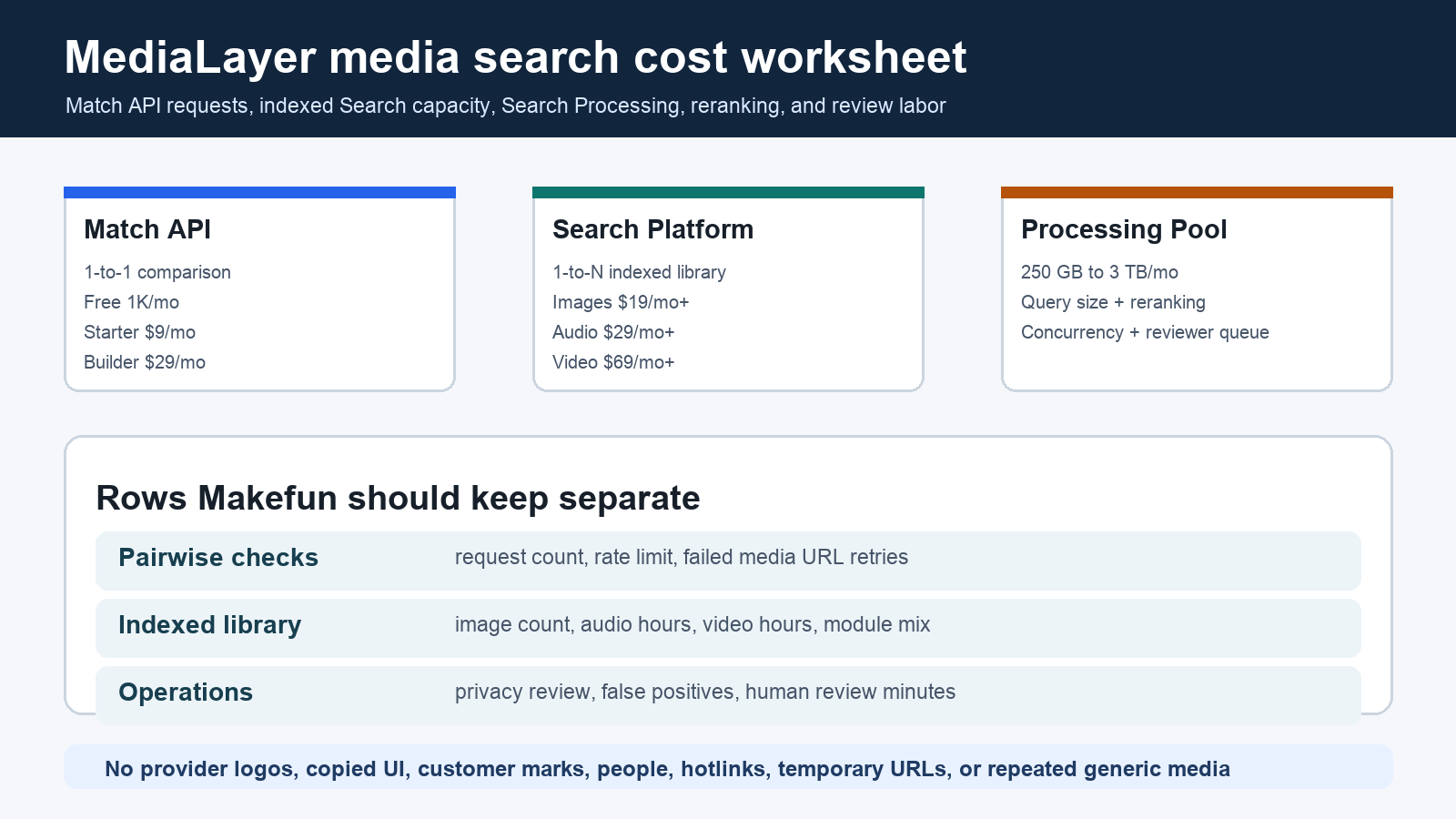
As of June 4, 2026, MediaLayer pricing should be modeled as two different cost paths. Match API is for 1-to-1 comparisons between two media assets. MediaLayer Search is for a persistent 1-to-N indexed library across images, audio, and video. Treat Search Processing, query size, reranking, concurrency, privacy review, false positives, and human review labor as separate rows instead of folding them into one request price.
Publication-time source checks used the official MediaLayer pricing page, MediaLayer docs, and the pricing page’s Search Processing and FAQ sections. These sources show current Match API, Search Platform, AI Cost Optimizer, RapidAPI, and Enterprise deployment framing. Refresh them before procurement because request limits, media capacity, RapidAPI terms, and enterprise deployment scope can change.
MediaLayer pricing source snapshot
| Cost path | Current rows to model | Planning caveat |
|---|---|---|
| Match API | Free $0/mo for 1,000 requests and 10/min; Starter $9/mo for 5,000 requests and 20/min; Builder $29/mo for 25,000 requests and 60/min; Pro $79/mo for 100,000 requests and 120/min; Scale $199/mo for 500,000 requests and 300/min. | Use this only for stateless 1-to-1 media comparison. It is managed through RapidAPI and is not the same workload as indexed library search. |
| Search Platform | Image plans start at $19/mo, audio at $29/mo, video at $69/mo, and all-three bundles start at $99/mo. Public rows include Starter, Growth, and Scale capacity. | Search plans bundle indexed media capacity and monthly Search Processing; use media type, index size, and processing pool as separate columns. |
| Search Processing | Starter rows use 250 GB/month, Growth rows use 1 TB/month, and Scale rows use 3 TB/month Search Processing. | Longer audio/video queries, larger files, reranking, and deeper search can consume more of this pool. |
| Enterprise | Custom capacity, dedicated infrastructure, private or VPC deployment, on-prem options, SLAs, security review, and dedicated support are scoped through sales. | Do not convert enterprise requirements into a public-plan overage estimate without a current scoped quote. |
Match API request worksheet
Use Match API when the workflow compares two assets on demand: a product image against a reference image, one uploaded clip against a suspected source, or a short audio file against a known asset. The calculator should include monthly comparison count, required requests per minute, media type, failed URL retry rate, reviewer minutes per flagged match, and whether the team needs a persistent searchable library. If a persistent library is required, move the workload to Search Platform rows instead of forcing it into request tiers.
Indexed Search capacity worksheet
Use MediaLayer Search when Makefun or an editorial team needs to search one new file against an indexed image, audio, or video library. A practical Makefun scenario is 40,000 images, 80 audio hours, and 40 video hours for duplicate featured-media checks, reused-creative review, product-image audits, and moderation queues. The cost row should include indexed image count, indexed audio hours, indexed video hours, Search Processing pool, query duration, reranking depth, concurrency, and human review queue time.
Same-use alternatives
Compare alternatives by workload unit. TwelveLabs is a stronger comparison for video understanding and semantic video search, not generic 1-to-1 matching. Cloud video intelligence products are usually priced around video analysis features or input duration. DAM visual search only fits if the media library already lives in that DAM. An internal perceptual-hash pipeline needs its own rows for storage, compute, retries, false positives, privacy review, and maintenance ownership.
Relevant Makefun context includes the TwelveLabs Pegasus video intelligence cost matrix, fal video API cost router, Runware video API cost router, and the Makefun AI Video API. Do not claim MediaLayer is cheaper, faster, more accurate, safer, or copyright-safe unless a current same-scenario comparison proves that exact claim.
Makefun media-governance workflow
For Makefun operations, the most useful worksheet separates the technical match cost from the publishing workflow. Add rows for featured-media dedupe, product-image audit, reused video creative review, audio reuse checks, reference-library search, moderation queue triage, false-positive review, escalation, and final editor approval. That prevents the API plan from looking complete while privacy, copyright review, and human judgment are still unpriced.
Risks and caveats
- Refresh MediaLayer pricing, docs, RapidAPI terms, indexed capacity, and Search Processing before quoting exact numbers.
- Keep Match API request tiers separate from Search Platform indexed library plans.
- Privacy, copyright review, security review, false positives, and reviewer labor are cost rows, not solved guarantees.
- Enterprise private, VPC, on-prem, SLA, and support needs require current sales scoping.
- Use topic-specific permanent media; do not reuse generic video art or media ID 7037.
FAQ
Is Match API the same as Search Platform?
No. Match API compares two media files on demand. Search Platform indexes a media library and searches one query against that library.
What is Search Processing?
MediaLayer describes Search Processing as the processing pool used during similarity search. Query size, longer audio or video, reranking, and search depth can change how quickly that pool is consumed.
When should Makefun use manual review rows?
Use manual review rows whenever a match affects publication, moderation, copyright review, privacy review, or brand safety. A similarity score does not remove the need for editorial judgment.