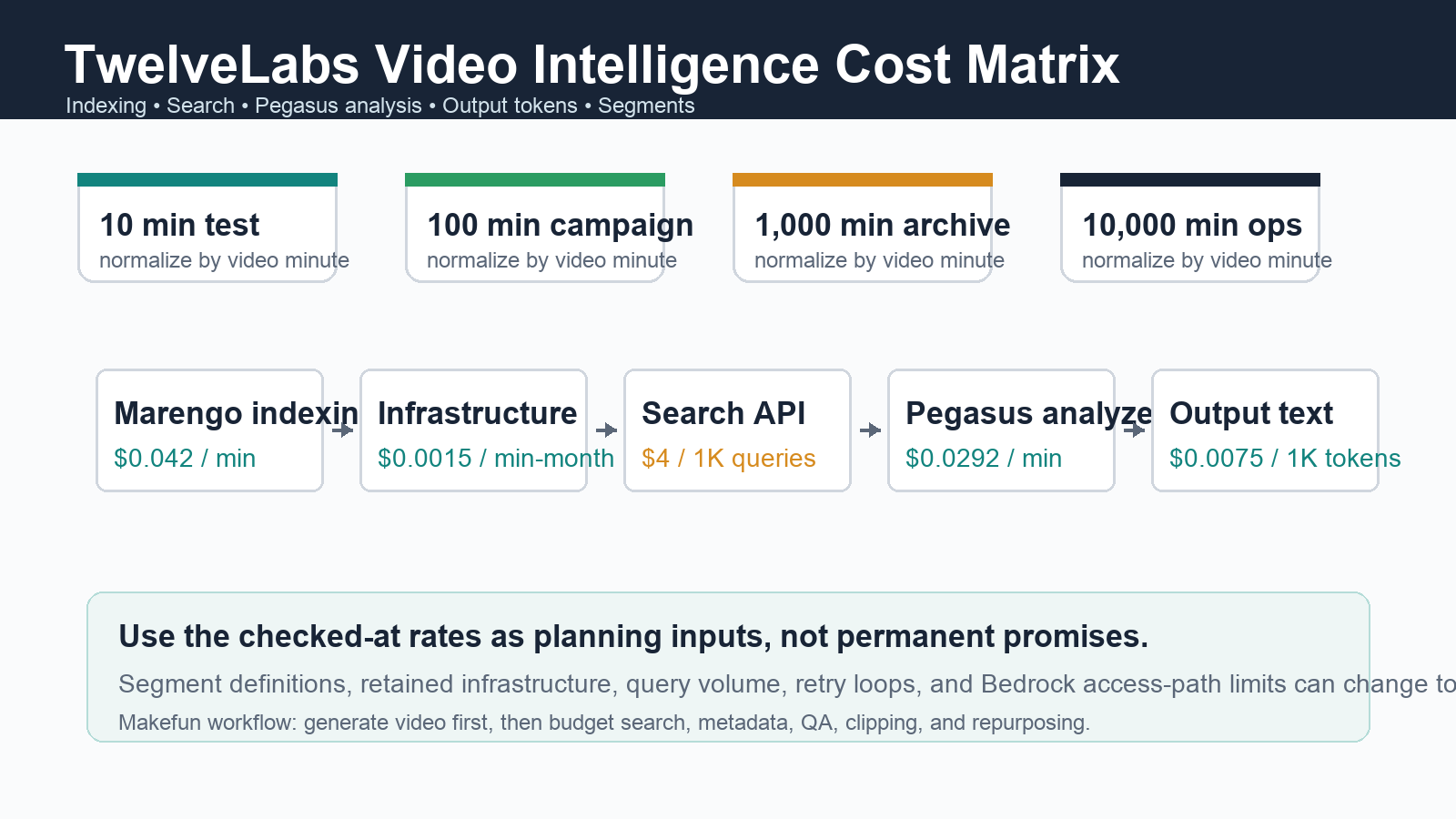
TwelveLabs pricing is not the same problem as text-to-video generation pricing. It sits after the video is created: indexing a library, searching it, extracting metadata, generating summaries, segmenting clips, and routing QA or repurposing work. This cost matrix gives Makefun readers a practical way to budget that post-generation layer before they connect AI video output to a searchable archive or metadata workflow.

TwelveLabs billing map
Checked at 2026-05-30T05:32:23Z, the official TwelveLabs pricing page and pricing calculator exposed the main units teams need to model:
| Workflow unit | Checked planning rate | What it means |
|---|---|---|
| Marengo video indexing | $0.042 per minute | One-time indexing for searchable video libraries. |
| Embedding infrastructure | $0.0015 per minute per month | Recurring retention cost while indexed video remains available. |
| Search API usage | $4 per 1,000 queries | Search/query cost after a library is indexed. |
| Embed API video input | $0.042 per minute | Video embedding when using the Embed API path. |
| Embed API audio input | $0.008 per minute | Audio embedding for non-video or extracted-audio workflows. |
| Embed API image input | $0.100 per 1,000 requests | Image input requests for visual retrieval or reference workflows. |
| Embed API text input | $0.070 per 1,000 requests | Text input requests for query/document embedding paths. |
| Pegasus analyzed video | $0.0292 per minute analyzed | Video-to-text analysis for summaries, metadata, and reasoning over video. |
| Pegasus output text | $0.0075 per 1,000 tokens | Generated text output from analysis prompts. |
Use those numbers as checked planning inputs, not permanent promises. TwelveLabs can change plan limits, unit prices, or calculator assumptions. Segment workflows need extra care because the input video duration is charged per segment definition, so a single source video can create more billable analysis units than a simple “minutes uploaded” estimate suggests.
Cost scenarios for video libraries
A useful TwelveLabs cost model separates one-time indexing, monthly retained infrastructure, query volume, Pegasus analysis, output tokens, and Segment multipliers. The table below is a planning template rather than a quote.
| Scenario | Best use | Cost drivers to estimate | Decision note |
|---|---|---|---|
| 10-minute creator test | Prototype search, summary, and clip notes. | Indexing minutes, a small query set, Pegasus prompt output. | Good for validating whether metadata improves editing or repurposing. |
| 100-minute campaign library | Search multiple generated ads, avatar takes, or social cuts. | Indexing, one month of infrastructure, search queries, QA retries. | Budget by approved asset, not by raw generated clip count. |
| 1,000-minute product archive | Internal video search, localization, and product-knowledge extraction. | Retention months, query volume, Pegasus summaries, output tokens. | Infrastructure and query behavior become as important as indexing. |
| 10,000-minute media operation | Large creator libraries, support recordings, or video intelligence pipelines. | Batch indexing, retained infrastructure, Segment definitions, retry loops, downstream storage. | Model a monthly run-rate and operational review process before scaling. |
Where Pegasus fits
The Pegasus documentation frames Pegasus as a video-to-text model for understanding and generating text from video context. That makes it relevant for metadata extraction, structured summaries, timestamped descriptions, clipping prompts, reference-image prompts, and long-video review. It does not replace a video generation API. For generation-side cost planning, use Makefun resources such as the AI Video API guide, the fal video API cost router, the Luma Ray3.14 cost calculator, or the SkyReels V4 audio-video cost planner.
Direct API vs Amazon Bedrock
AWS has announced TwelveLabs video understanding models in Amazon Bedrock, and the AWS News Blog post is useful access-path context. Treat it carefully in a cost matrix: current AWS material should be checked for exact model, version, region, and pricing before you compare it with direct TwelveLabs API usage. In this run, the Publisher did not use Bedrock to claim Pegasus 1.5 availability or a cheaper route; Bedrock is only a governance and procurement path to evaluate against official Amazon Bedrock pricing.
Hidden cost drivers
- Retention period: embedding infrastructure is monthly, so an archive kept for six months is not priced like a one-time upload.
- Query volume: search usage can dominate low-indexing workflows if many editors, agents, or support users query the library.
- Output token length: rich summaries, shot lists, localization notes, and QA reports cost more than short labels.
- Segment definitions: segment-based analysis can multiply billable input duration.
- Retry and review loops: poor prompts, bad source organization, or repeated QA passes add cost beyond the base API unit.
- Downstream storage: metadata, embeddings, clips, captions, and workflow handoffs need their own storage and review assumptions.
Makefun workflow template
- Classify the job: search, summary, metadata extraction, segmentation, clipping, QA, localization, or repurposing.
- Estimate source minutes, retained months, monthly query volume, Pegasus analysis minutes, output tokens, and segment count.
- Separate one-time indexing from recurring infrastructure and recurring query/analyze costs.
- Normalize cost by approved video, searchable minute, or finished campaign asset.
- Compare direct TwelveLabs API with Bedrock only after confirming model/version/region support and current pricing.
- Route generation-side planning back to Makefun’s agentic video generator and API cost guides.
FAQ
Is TwelveLabs a text-to-video generator?
No. This guide treats TwelveLabs as video intelligence infrastructure for understanding, searching, summarizing, and segmenting video after creation.
What should I refresh before using this matrix?
Refresh TwelveLabs pricing, the pricing calculator, Segment definitions, Pegasus documentation, AWS Bedrock model/version support, and all internal workflow assumptions.
Can I compare TwelveLabs directly with video generation APIs?
Only as adjacent workflow cost. Video generation APIs price creation; TwelveLabs prices understanding, search, metadata, and post-production intelligence around the video library.