As of June 6, 2026, a Roboflow workflow inference credit calculator should start with credits, not a flat per-image price. Separate subscription credits, prepaid credits, flex credits, data usage, training, deployment, serverless processing-time headers, workflow blocks, batch jobs, local inference, retries, and manual QA before comparing Roboflow with generic vision APIs or self-hosted computer vision.
The practical shortcut: estimate monthly images or sampled video frames, average processing time, workflow complexity, hosted-versus-local split, batch retry rate, confidence threshold, and reviewer minutes. Then refresh Roboflow’s official pricing and credit references before quoting exact spend, because plan credits, feature rows, and workflow behavior can change.
Roboflow pricing source snapshot
Publication-time checks reached the official Roboflow pricing page, Roboflow credits reference, billing credits docs, serverless API pricing docs, workflow deployment docs, and batch-processing pricing docs. Use those pages as the source of truth for current plan credits, credit consumption, serverless formulas, workflow deployment, and batch behavior.
| Cost row | Current planning value | Worksheet use |
|---|---|---|
| Plans and included credits | The refreshed pricing page shows Public as free, Core as the paid self-serve plan, and Enterprise as custom. Treat included credits and plan limits as plan-specific. | Put subscription and included credits in their own row before adding extra usage. |
| Prepaid and flex credits | Roboflow exposes prepaid and flex-credit paths. The exact price should be refreshed on the pricing page before procurement. | Use prepaid credits for planned volume and flex credits as overage or elasticity. |
| Serverless inference | The official serverless API v2 docs describe credit use with x-processing-time and x-remote-processing-time response headers. | Model processing time and workflow overhead separately from simple image count. |
| Batch processing | The official batch-processing path points readers back to Roboflow’s credit reference for current compute and workflow credit rows. | Use for large asynchronous image or video-frame jobs with retry and review rows. |
| Local or self-hosted inference | Workflow deployment docs support hosted API, dedicated deployment, local Inference server, and batch routes. | Split Roboflow credits from local hardware, maintenance, and reviewer time. |
Credit ledger formula
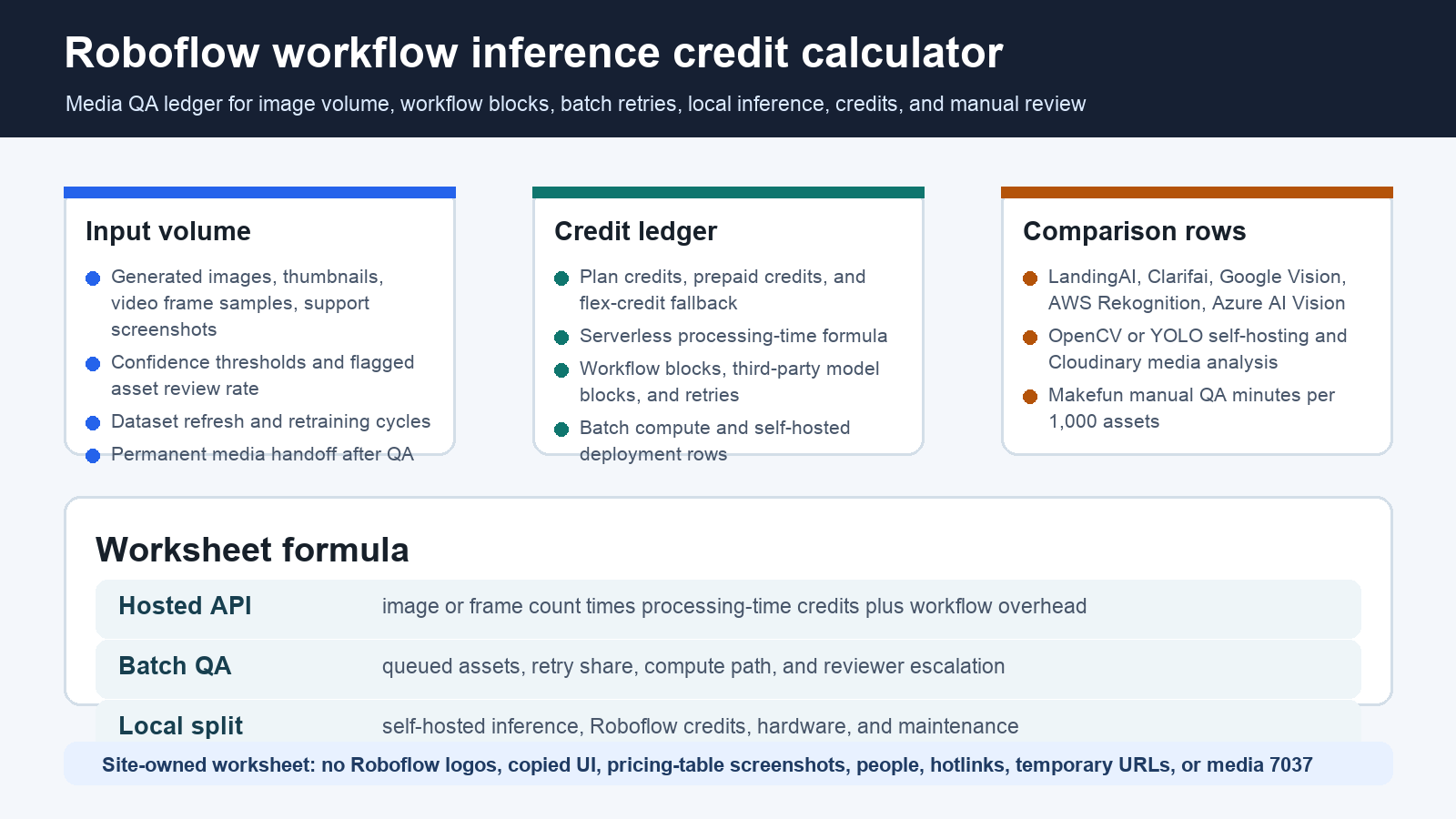
A useful planning formula is: monthly_cost = subscription + prepaid_or_flex_credits + hosted_processing_credits + workflow_block_credits + batch_compute + training_or_dataset_refresh + local_hardware + retries + manual_review_minutes + Makefun_publication_handoff. Keep provider-reported credit math separate from your own QA and publishing work.
Worksheet 1: generated-media QA
A Makefun media workflow reviews generated images, thumbnails, and publish candidates before WordPress handoff. Start with monthly assets, sampled thumbnails, average workflow processing time, unsafe-output checks, duplicate-layout checks, retry rate, confidence threshold, and reviewer minutes. Roboflow credits cover the vision workflow path; permanent media upload, SEO review, and editorial QA stay outside the vendor row.
Worksheet 2: video-frame sampling
For video QA, do not price the whole video as a single image task. Choose sampled frames per clip, then multiply by workflow blocks, processing-time headers, batch retry share, and manual review rate. This is where batch jobs and local inference can change the cost shape more than the headline plan price.
Worksheet 3: support screenshot triage
Support screenshots need a different worksheet: intake volume, redaction needs, classification workflow blocks, low-confidence handoff, reviewer minutes, and storage. If screenshots include private or regulated content, keep data handling, retention, and human review decisions separate from pure inference pricing.
Same-unit comparison matrix
Compare Roboflow with LandingAI, Clarifai, Google Vision or Vertex AI Vision, AWS Rekognition, Azure AI Vision, OpenCV or YOLO self-hosting, Cloudinary media analysis, and Makefun manual QA by the same unit: 1,000 images or sampled frames processed through a visual QA workflow. Use Cloudinary AI transformation credit calculator for media transformation context and MediaLayer match API search processing calculator for media matching context, but do not treat either page as a Roboflow duplicate.
Hosted versus local inference split
Hosted serverless inference is easier to start and easier to meter with response headers. Local inference can reduce some hosted dependency, but it adds hardware, deployment, maintenance, monitoring, and fallback work. The worksheet should show both routes rather than hiding local operations under a zero-provider-cost assumption.
Manual review and confidence thresholds
Confidence thresholds often decide whether the automation saves money. A strict threshold may increase manual review and rework; a loose threshold may publish weak or unsafe media. Track reviewer minutes per flagged asset and approved-output cost, not only credits per image.
Makefun routing checklist
- Refresh Roboflow pricing, credits, serverless formula, workflow deployment, and batch docs before procurement.
- Use Makefun AI tools as the conversion path for teams that need publication-ready media workflow handoff.
- Do not claim Roboflow is cheapest, best, more accurate, or safer than alternatives without current same-scenario evidence.
- Keep temporary MakeFun URLs, third-party hotlinks, vendor logos, copied UI screenshots, and copied pricing tables out of published media.
- Use a permanent topic-specific WordPress featured image, not repeated media ID 7037.
FAQ
How does Roboflow charge for workflow inference?
Model it as credits across data, training, deployment, serverless processing time, workflow processing, batch jobs, local or self-hosted behavior, and third-party model blocks where used.
What is the safest comparison unit?
Use images or sampled video frames per month, then add processing time, workflow blocks, retries, confidence thresholds, and reviewer minutes.
Can local inference make Roboflow free?
No. Local inference can change the hosted-cost row, but the worksheet still needs hardware, operations, Roboflow feature credits where applicable, maintenance, QA, and publication handoff.