Google Flow Music AI video generator is a timely long-tail topic because Google is moving Flow from one-off video prompting toward a music-led creative workflow: creators can start with a song or scene idea, then plan visuals, pacing, and iteration around Gemini Omni and Flow Music.
What Google Flow Music changes for AI video workflows
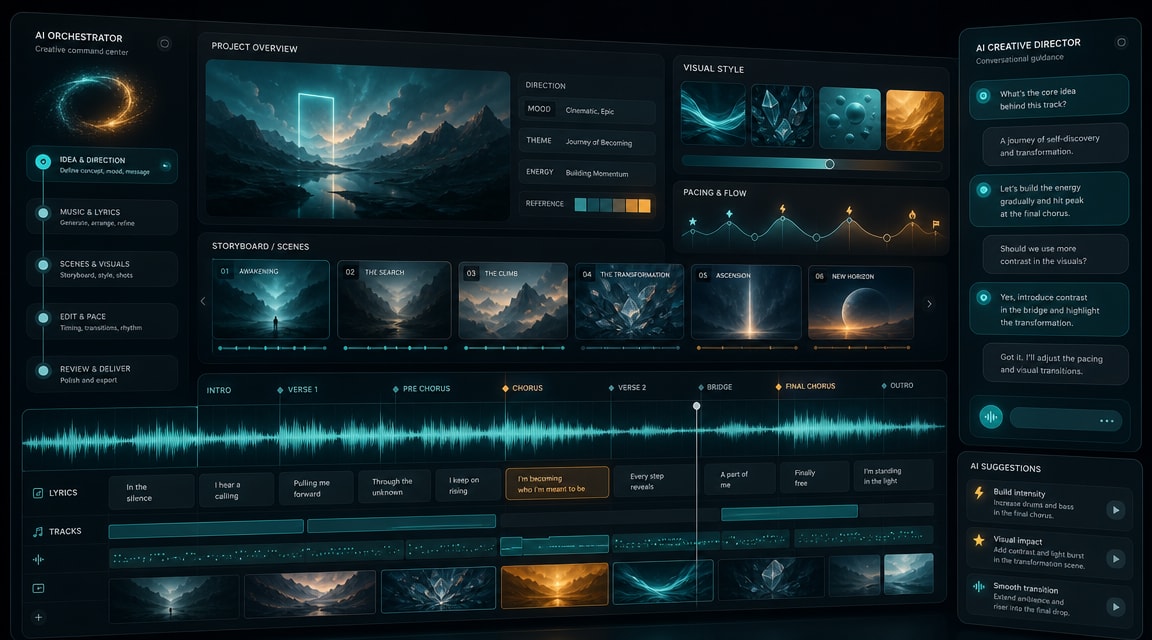
Google’s Flow update points to a more directed workflow for short-form creative work: song choice, visual scene planning, shareable clips, and conversational iteration sit closer together. For search intent, this is different from a generic text-to-video query. The user is often asking how to turn music, lyrics, or an audio mood into a finished video plan.
That makes the keyword useful for Makefun because it overlaps three existing creator needs: selecting the right video model, converting an idea or reference into scenes, and building repeatable all-in-one workflows instead of testing each model in isolation.
Where Gemini Omni fits
Google describes Gemini Omni as a multimodal model family, and Makefun already has a dedicated Gemini Omni AI video generator explainer. Flow Music gives that broader model story a concrete creator use case: a music or campaign brief can become a set of scenes, directions, and video variations.
The safe framing is not that one model is automatically best for every music video. A practical creator still needs to compare prompt control, reference image handling, audio timing, clip length, export quality, cost, and revision speed.
How creators should plan a Flow Music-style brief
Start with the audio structure, not just a visual prompt. A useful brief should name the mood, tempo, key lyric moments, scene count, aspect ratio, and whether the output needs product shots, avatars, abstract visuals, or narrative transitions.
For creators already using Makefun, this planning layer connects naturally to the existing AI music video generator from audio guide. The next step is to decide whether the music should drive every scene or whether a still reference, product image, or character image should anchor the video.
When to use image-to-video instead
Flow Music-style workflows are strongest when the song drives the concept. For product demos, avatar content, or brand-consistent visuals, an image-to-video workflow may be easier to control because the first frame, character, or product reference stays visible throughout production planning.
That is why this topic should be positioned as part of a broader model-selection workflow, not as a replacement for every generator. The best all-in-one workspace lets a creator move between music-led prompting, image-to-video, reference-to-video, and manual review without rebuilding the whole brief.
What to compare before choosing a model
- Audio fit: does the workflow understand song sections, rhythm, and pacing?
- Visual control: can the creator keep characters, products, or brand style consistent?
- Revision loop: can one section be changed without remaking the full clip?
- Output format: does it support vertical, horizontal, and social-ready cuts?
- Workflow fit: does it connect with an all-in-one planning process like the one discussed in Makefun’s AI video generator trends guide?
FAQ
What is Google Flow Music?
Google Flow Music is best understood as a Flow creative workflow that brings music selection and video generation planning closer together. For SEO and creator education, the useful angle is how music can guide scene planning, pacing, and iteration.
Is Flow Music the same as a normal AI video generator?
No. A normal AI video generator may start from a text prompt or image reference. A Flow Music-style workflow starts closer to the audio, song mood, or clip concept, then builds visuals around that structure.
Should teams use Flow Music or image-to-video?
Use music-led planning when the song or campaign audio is the creative driver. Use image-to-video when a product shot, character, avatar, or reference image needs to stay consistent.
How does this help an all-in-one AI creator workflow?
It gives creators a planning layer: audio, scenes, references, and model selection can be handled as one workflow instead of a sequence of disconnected prompts.