Hedra Character-3 pricing is not just a plan-price question. Teams planning avatar videos need to convert seconds, model route, audio readiness, retries, and approved outputs into credits before comparing Hedra with realtime video-agent systems or older avatar tools.
Publication-time source checks found Hedra’s official pricing and model docs listing Basic at $15 per month with 1,500 monthly credits, Creator at $30 per month with 5,400 monthly credits, Professional and Teams at $75 per month with 14,400 monthly credits, monthly subscription credits that do not roll over, and separately purchased credit packs that can roll over. The same official source set lists Hedra Character-3 at 6 credits per second, Hedra Avatar at 7 credits per second, and Hedra Omnia at 15 credits per second. Treat those as planning inputs, not permanent quotes.
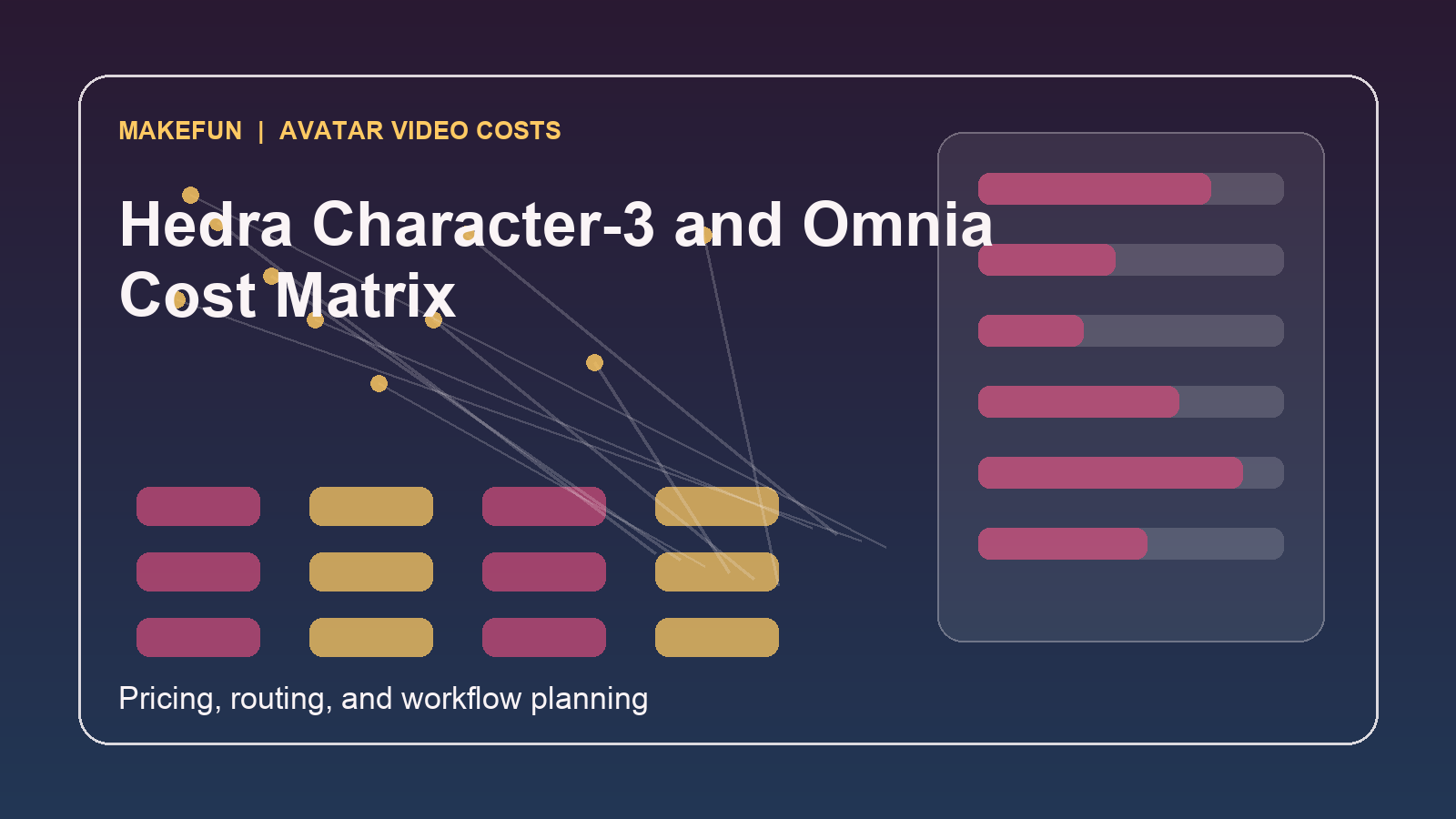
Hedra avatar video cost matrix
| Workflow | Best Hedra route to test | Planning unit | 30 second first pass | Hidden driver |
|---|---|---|---|---|
| Presenter explainer | Hedra Avatar | 7 credits/s | 210 credits before retries | Script timing, voice cleanup, and long-dialogue QA. |
| Short cinematic dialogue ad | Hedra Omnia | 15 credits/s | 450 credits before retries | Camera direction, motion prompt revisions, and character consistency review. |
| Character-3 avatar clip | Hedra Character-3 | 6 credits/s | 180 credits before retries | Lip-sync checks, prompt variants, and approved-output ratio. |
| UGC ad batch | Character-3 or Omnia by creative type | Seconds x variants x retry rate | Five 30s drafts can start near 900 to 2,250 credits before retries | Localization, audio rights, moderation, and final storage. |
| Realtime sales or support agent | Compare with a video-agent platform | Conversation minutes or session limits | Not comparable to simple clip credits | Concurrency, replica training, telephony, LLM, STT, TTS, and analytics. |
Character-3, Hedra Avatar, and Omnia routing
Use Character-3 when the job is a short avatar clip and the budget needs a lower per-second starting point. Use Hedra Avatar when the job is a longer presenter, tutorial, or explainer where reliable lip sync and dialogue duration matter. Use Omnia when the job needs character dialogue plus cinematic framing, expressive motion, or a short ad-style scene. Do not price Omnia with the Character-3 rate; the current model guide separates the two routes.
Same-use comparison rules
For realtime conversation, compare Hedra’s pre-rendered avatar routes against platforms built for live or conversational video only after normalizing the job type. For example, Tavus pricing is useful context for conversational video minutes, generation minutes, replica work, and concurrency, but it should not be treated as a direct replacement for a 30 second pre-rendered Hedra clip.
Makefun readers can map the decision against related planning assets such as Runway Characters API real-time avatar cost, top avatar APIs, HeyGen Avatar V, LongCat Video Avatar, and Napster Omniagent API video agent cost. The right comparison is the cost of an approved workflow result, not one model’s first generation price.
Hidden cost drivers
- Monthly credit reset: unused subscription credits expire at the next billing cycle, so high-volume teams should plan around approved deliverables.
- Credit-pack rollover: separately purchased packs can change the economics of overflow work, but only after monthly credits are consumed.
- Retry rate: lip sync, hands, framing, brand visuals, and motion can turn one approved clip into several paid attempts.
- Audio preparation: voice recording, cleanup, translation, timing, and rights review happen before the model cost is even meaningful.
- Likeness and consent: avatar workflows need documented permission for reference faces, voices, personas, and brand characters.
- Permanent storage: approved outputs should be stored in a durable asset library, not left as temporary generation URLs.
Approved-output worksheet
Start with the seconds you expect to approve, not the seconds you expect to generate. Then multiply by the model route, language count, and retry factor. A 30 second Character-3 clip at 6 credits per second starts at 180 credits, but a three-language ad set with two retries per language can behave more like 1,080 generated credits before editing and storage. A 30 second Omnia concept starts at 450 credits, so the same retry pattern reaches 2,700 generated credits before human review.
Workflow template
- Classify the job as presenter, cinematic dialogue, UGC batch, localization, or realtime conversation.
- Select Character-3, Hedra Avatar, Omnia, or a video-agent platform based on the job type.
- Estimate approved seconds, language variants, retry rate, audio readiness, and QA time.
- Normalize against same-use alternatives only after matching duration, interaction model, replica needs, and storage requirements.
- Store final outputs permanently and document source media, consent, persona rules, and review notes.
FAQ
Is Hedra Character-3 the same as Omnia?
No. Current official model guidance separates Character-3, Hedra Avatar, and Omnia. This article uses Character-3 at 6 credits per second, Hedra Avatar at 7 credits per second, and Omnia at 15 credits per second based on publication-time checks.
Should I compare Hedra directly with Tavus, D-ID, Runway, or HeyGen?
Only after matching the workflow. A pre-rendered avatar ad, a cinematic dialogue clip, a long presenter video, and a realtime support agent have different billing units and hidden costs.
What is the safest budgeting shortcut?
Budget by approved output. Estimate the final seconds, multiply by the model route, add retries and language variants, then reserve time for audio, likeness review, QA, and permanent storage.