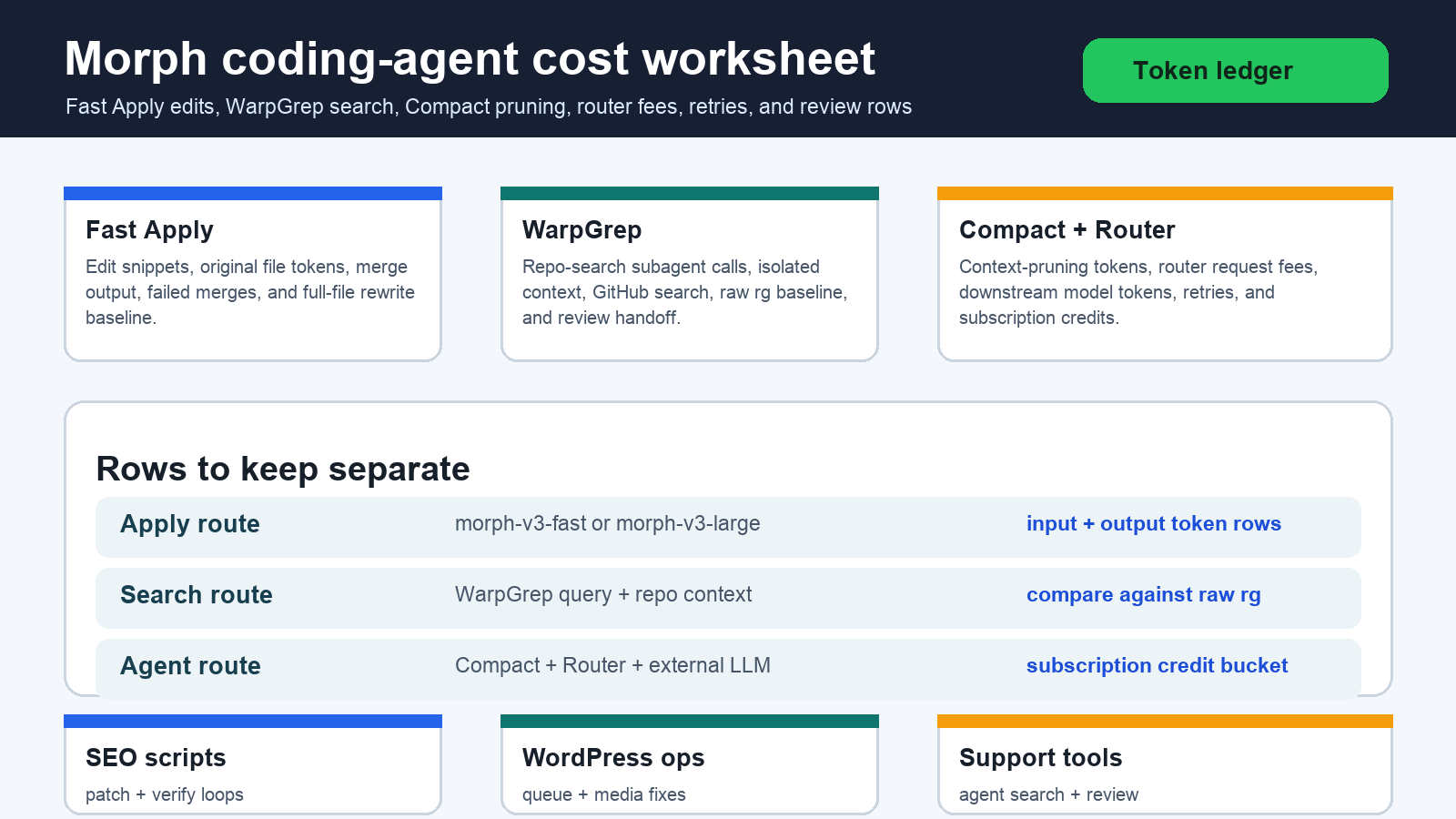
As of June 4, 2026, Morph pricing is easiest to understand as a coding-agent loop, not as one generic model bill. A practical calculator separates Fast Apply edit-merge tokens, WarpGrep repo-search calls, Compact context-pruning tokens, Router request fees, subscription credits, failed edits, retries, and the external OpenAI, Anthropic, Gemini, Copilot, Cursor, or Claude Code spend that may still happen around Morph.
Publication-time source checks used Morph’s official pricing page, Fast Apply documentation, Apply Model documentation, WarpGrep documentation, Compact documentation, and Model Router documentation. These pages should be refreshed before procurement or publication updates because token prices, context rows, model names, subscription credits, and product behavior can change.
Morph pricing source snapshot
| Component | Current unit to model | Budget caveat |
|---|---|---|
| Free tier | Official pricing page showed 200 free requests per month and a Free subscription credit bucket. | Free requests do not remove downstream model tokens, retries, or review work. |
| Fast Apply | morph-v3-fast at $0.8 input / $1.2 output per 1M tokens; morph-v3-large at $0.9 input / $1.9 output per 1M tokens. | Compare edit-snippet tokens against the full-file rewrite baseline before claiming savings. |
| WarpGrep | morph-warp-grep-v2 at $0.8 per 100K with context limits shown on the pricing page. | Count code-search calls, repo scope, review time, and whether raw rg would have been enough. |
| Compact | morph-compact at $0.2 input / $0.5 output per 1M tokens. | Compaction can lower later context cost, but it is not free and can lose lines that matter. |
| Router | morph-router at $0.005 per request. | The router fee is separate from the model you call after routing. |
| Subscriptions | Starter, Pro, and Scale plans expose prepaid credit buckets on the official pricing page. | Credits apply to Morph model usage, not every external agent cost around the workflow. |
Fast Apply edit-token worksheet
Fast Apply should be modeled against a full-file rewrite baseline. Add rows for original file tokens, edit-snippet tokens, instructions, output tokens, failed merges, retry attempts, and final review. Morph’s docs describe an agent pattern where the parent model emits changed lines with existing-code markers, then Morph merges the edit server-side. That is a different cost shape from asking a general model to regenerate the whole file.
| Scenario | Rows to include | Decision test |
|---|---|---|
| Small patch in a large file | Original file tokens, edit snippet, instruction, merge output, one review pass. | Fast Apply may fit when the edit is localized and the full-file rewrite baseline is wasteful. |
| Complex multi-edit refactor | Multiple snippets, morph-v3-large option, failed-merge retry rate, test failure repair loop. | Use the larger apply model only when the complexity justifies the higher output row. |
| Automation maintenance | Queue script patch, WordPress verifier fix, media workflow repair, and reviewer minutes. | Track approved fixes, not just successful API calls. |
WarpGrep repo-search worksheet
WarpGrep belongs in a separate row from apply tokens. It is a code-search subagent route: budget query count, repository size, local repo versus GitHub search, context returned to the main agent, and the human or automated review that checks whether the returned code sections were actually relevant. A raw rg search may be enough for simple local work, while WarpGrep can be more useful when the main agent should avoid polluting its context with broad search output.
Compact and Router rows
Compact and Router are useful only if they are kept visible. Compact has its own input and output token rows; Morph’s docs describe verbatim line deletion, high token throughput, and a typical 50-70% reduction. Router adds a per-request classification row before the downstream model call. For long-running Makefun automation work, the calculator should show: compact before expensive context calls, router when prompts vary in difficulty, and the external model bill after routing.
Same-use comparison rows
Compare Morph only against the same workflow. Cursor apply, GitHub Copilot, OpenAI Codex, Claude Code, Sourcegraph Cody, Continue, Aider, raw rg, and manual patching do not share the same billing units. For Makefun planning, live internal references that can frame adjacent costs include GitHub Copilot AI credits, AWS Bedrock AgentCore cost governance, Pinecone Assistant context-token planning, Claude Batch API prompt-cache planning, Botpress AI spend planning, Airtable Field Agents credit planning, and Comfy Cloud API workflow costs. Do not claim Morph is cheaper, faster, safer, better, or more accurate unless every comparison uses current same-scenario evidence.
Makefun handoff worksheet
For Makefun operations, use this worksheet around script edits, WordPress verifier fixes, queue-state cleanup, media workflow repair, support tooling, browser review loops, and performance audits. Separate the parent model’s planning tokens, Morph apply tokens, WarpGrep search calls, Compact tokens, Router requests, WordPress/R2/MakeFun network checks, test runs, and human review. That prevents one automation run from looking cheap just because external tokens or approval labor were hidden in another row.
Risks and caveats
- Refresh Morph pricing and docs before quoting exact numbers.
- Keep Fast Apply, WarpGrep, Compact, Router, subscription credits, and external model calls as separate rows.
- Count failed edits, test failures, retries, review minutes, privacy review, and repository access constraints.
- Do not use generic coding-agent art or repeated media; the featured image should match this worksheet.
- Do not publish cheapest or best claims without same-scenario evidence.
FAQ
What is the main Morph pricing mistake?
The common mistake is mixing every agent cost into one line. Fast Apply, WarpGrep, Compact, Router, subscription credits, failed edits, retries, and external model tokens should be separate rows.
When does Fast Apply fit best?
Fast Apply fits localized code edits where the parent agent can output a clear edit snippet and a full-file rewrite would spend unnecessary tokens or time.
When should WarpGrep be budgeted separately?
Budget WarpGrep separately whenever repo search is part of the workflow. Search calls, returned context, relevance review, and raw rg alternatives have a different cost shape from code merging.
Does Compact automatically save money?
No. Compact can reduce later context size, but it has its own token rows and can remove lines that matter. Compare the compacted downstream call against the uncompressed baseline.