
As of June 5, 2026, a Cloudinary AI transformation credit cost calculator should separate the original generation bill from the post-generation media operations bill. The worksheet needs rows for credits, uploads, derived transformations, AI effects, video processing, storage, backups, delivery bandwidth, cache reuse, DAM search, WordPress handling, CDN behavior, and Makefun editorial review.
The short answer: Cloudinary is not just an image CDN line item when AI effects, derived assets, video previews, named transformations, and governed media libraries are in the workflow. Treat Cloudinary pricing as the source of truth for credits and platform terms, then keep provider generation, custom R2 storage, WordPress media, human review, and social preview variants as separate worksheet rows.

Cloudinary source snapshot for the calculator
Publisher checks refreshed the official Cloudinary pricing page, plan comparison, billing and plans documentation, transformation count documentation, image transformation documentation, Cloudinary AI page, and search and discoverability page. Use those pages for current plan, credit, transformation, storage, delivery, and product wording.
| Cost row | What to model | Makefun caveat |
|---|---|---|
| Credits and plan | Monthly credits, plan allocation, add-ons, support tier, and any enterprise or negotiated terms. | Do not treat a public plan row as a universal quote for every media workflow. |
| Derived transformations | Unique transformation URLs, named transformations, responsive variants, AI refiners, and regeneration behavior. | Separate generated source assets from Cloudinary processing of those assets. |
| AI effects | Background removal, generative fill or replace, tagging, moderation, search, and other AI media operations where enabled. | Keep the AI operation row separate from MakeFun, model API, or provider-native generation cost. |
| Video and previews | Video transformations, previews, thumbnails, adaptive variants, and delivery behavior. | Video can dominate storage and bandwidth even when image rows look small. |
| Storage, backup, delivery | Originals, derived assets, backups, cache hit rate, CDN egress, and repeated social or WordPress preview variants. | Cache reuse can change request behavior; reprocessing and cache misses need their own row. |
Calculator formula
monthly_media_ops_cost = Cloudinary_plan_or_credit_row + uploaded_originals + derived_transformations + AI_effects + video_processing + storage + backup + bandwidth + DAM_search + cache_miss_reprocessing + WordPress_and_social_variants + Makefun_QA
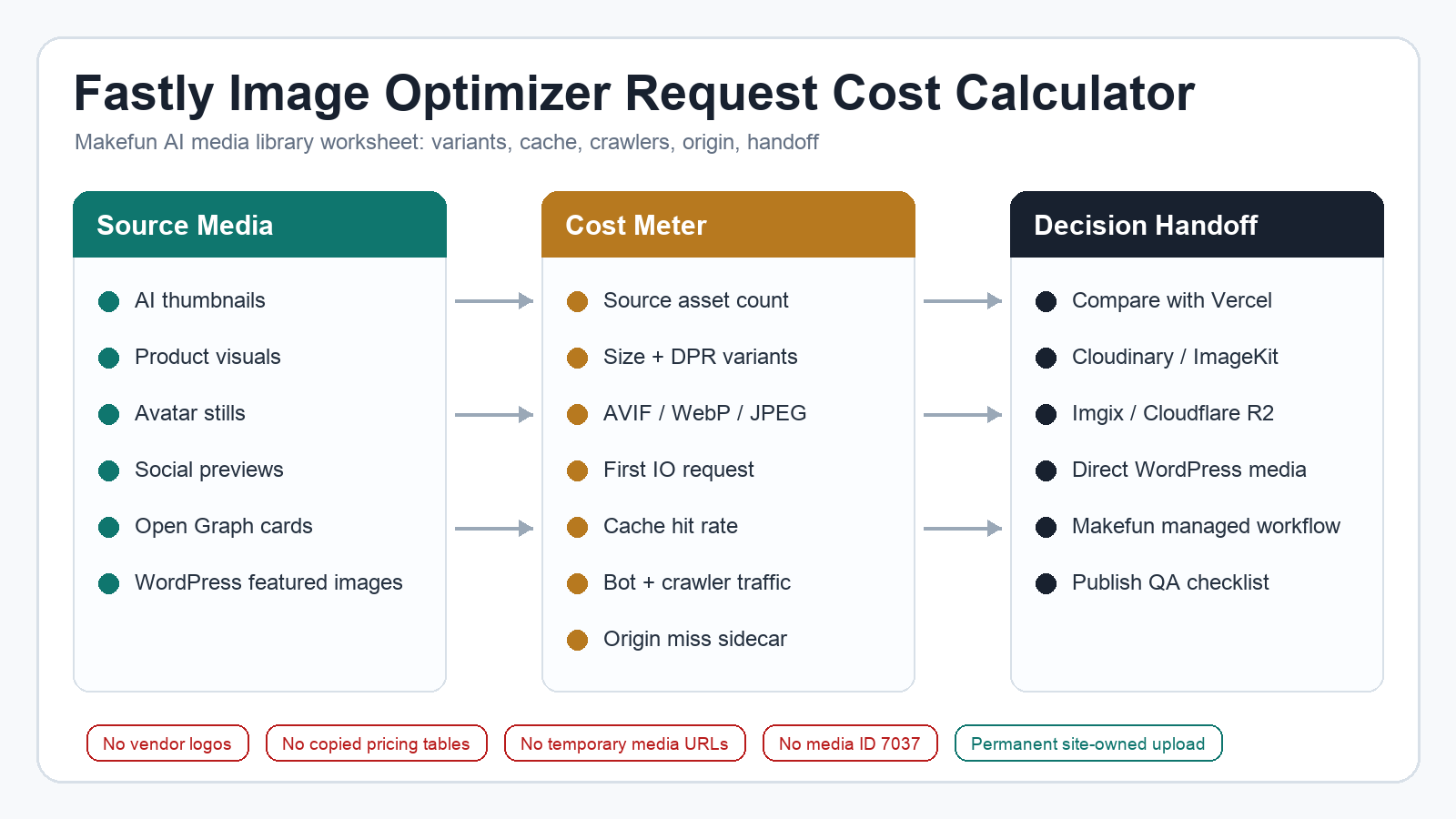
Use the formula as a worksheet, not as a vendor quote. It is designed to keep Cloudinary platform usage, provider generation, cache behavior, WordPress publication, CDN delivery, and editorial QA visible before a team compares options.
Worksheet 1: credits and derived assets
- Start with monthly original assets, derivative count per original, named transformations, responsive sizes, and whether transformations are reused or regenerated.
- Add AI effects only when the workflow actually uses them; do not hide them inside a generic image-CDN row.
- Separate first-generation image or video costs from Cloudinary transformation, storage, backup, delivery, and DAM governance.
- Model cache hit rate and cache-busting behavior because identical cached URLs are different from new derived-asset generation.
- Keep WordPress featured image, Open Graph image, thumbnails, and social crops as explicit derivative rows.
Worksheet 2: same-use media transformation matrix
| Workflow | Cloudinary row to compare | Alternative row to compare |
|---|---|---|
| SEO hero and social images | Original upload, responsive derivatives, optimization, Open Graph crop, storage, and delivery. | WordPress media plus CDN, or R2/custom image pipeline when governance is simple. |
| AI product-avatar batches | Provider output import, AI clean-up, variants, moderation/search metadata, and campaign delivery. | Provider-native storage plus Makefun QA when transformations are deterministic. |
| Video thumbnails and previews | Video transformation, preview generation, storage, delivery, and cache behavior. | Mux, Transloadit, provider-native preview generation, or a custom worker pipeline. |
| Approved-media library cleanup | DAM search, tagging, transformations, backup, and governed reuse. | MediaLayer-style search, R2 metadata, or a simpler WordPress media process. |
Double-processing checklist
- Check whether WordPress is creating thumbnails after Cloudinary already created responsive variants.
- Check whether Next.js, a CDN, or social preview service is re-optimizing a derived Cloudinary URL.
- Check whether cache-busting parameters create new derived assets instead of reusing a stable transformation URL.
- Check whether AI source generation, Cloudinary AI effects, and manual QA are all being counted in the same row.
- Check whether video previews are billed as image-like thumbnails or as video-processing workflows.
Same-use comparison lanes
Use adjacent Makefun pages as workflow lanes, not same-intent duplicates: MediaLayer Match API Search Processing Cost Calculator for approved-media search and DAM governance, fal Video API Cost Router and Runware Video API Cost Router for AI video source assets, Recraft V4.1 API Cost Matrix for generated image provider output routing, Comfy Cloud API Workflow Cost Calculator for custom image pipeline ownership, and FLUX VTO Virtual Try-On Cost Guide for product-avatar derivative scenarios.
ImageKit, Imgix, Cloudflare Images, Vercel Image Optimization, Mux, Transloadit, Cloudflare R2, WordPress media, provider-native output storage, and custom workers should be compared only after normalizing the same workload: originals, derivatives, transformations, AI effects, video minutes, storage, bandwidth, cache behavior, metadata/search, and human review. Avoid cheapest, best, fastest, safest, or most reliable claims unless the same scenario has current evidence.
Publisher checklist and risk controls
- Refresh Cloudinary pricing, plan comparison, billing, transformation counts, image transformations, Cloudinary AI, and DAM search pages before publication.
- Separate Cloudinary credits from provider generation, model API, R2, WordPress, CDN, and human QA rows.
- Name derived transformations, cache behavior, AI effects, video processing, storage, backup, and bandwidth as separate worksheet drivers.
- Use only verified internal links whose canonical public pages return 200.
- Verify duplicate intent, category blog id 2, Yoast fields, sitemap, body links, and unique permanent media before public success notification.
FAQ
Does every Cloudinary transformation request count again? No. The worksheet should separate creating a new derived asset from serving an identical cached transformation URL, then flag workflow choices that regenerate assets or create cache misses.
Should Makefun include AI generation cost in the Cloudinary row? No. Keep MakeFun, model-provider, or native media-generation cost separate from Cloudinary transformation, storage, delivery, DAM, and governance cost.
Is Cloudinary cheaper than ImageKit, Imgix, Cloudflare Images, Vercel, Mux, or Transloadit? This page does not make that claim. Compare same-unit workflow drivers and route by transformation complexity, governance needs, video work, cache reuse, and operational ownership.