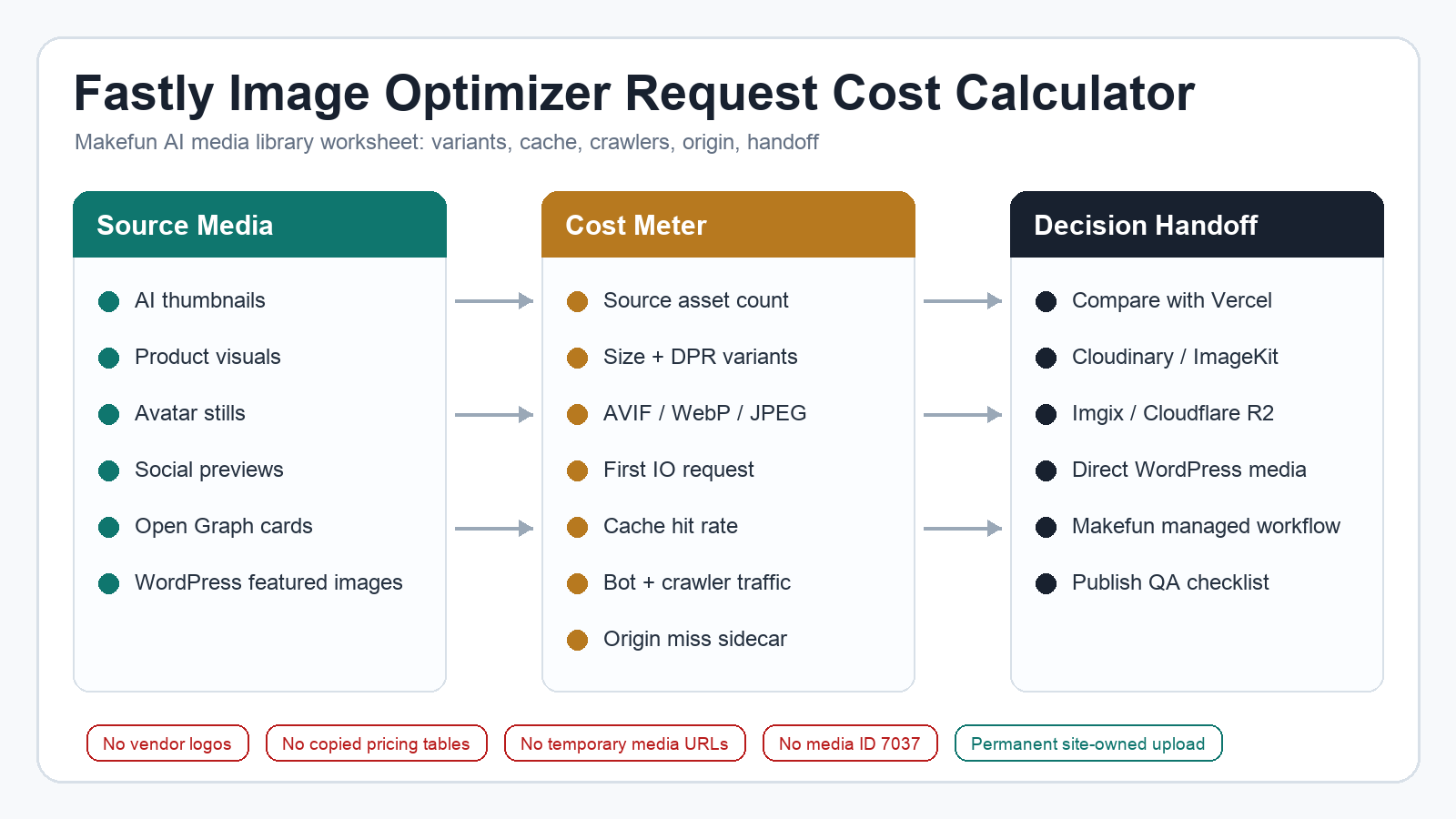
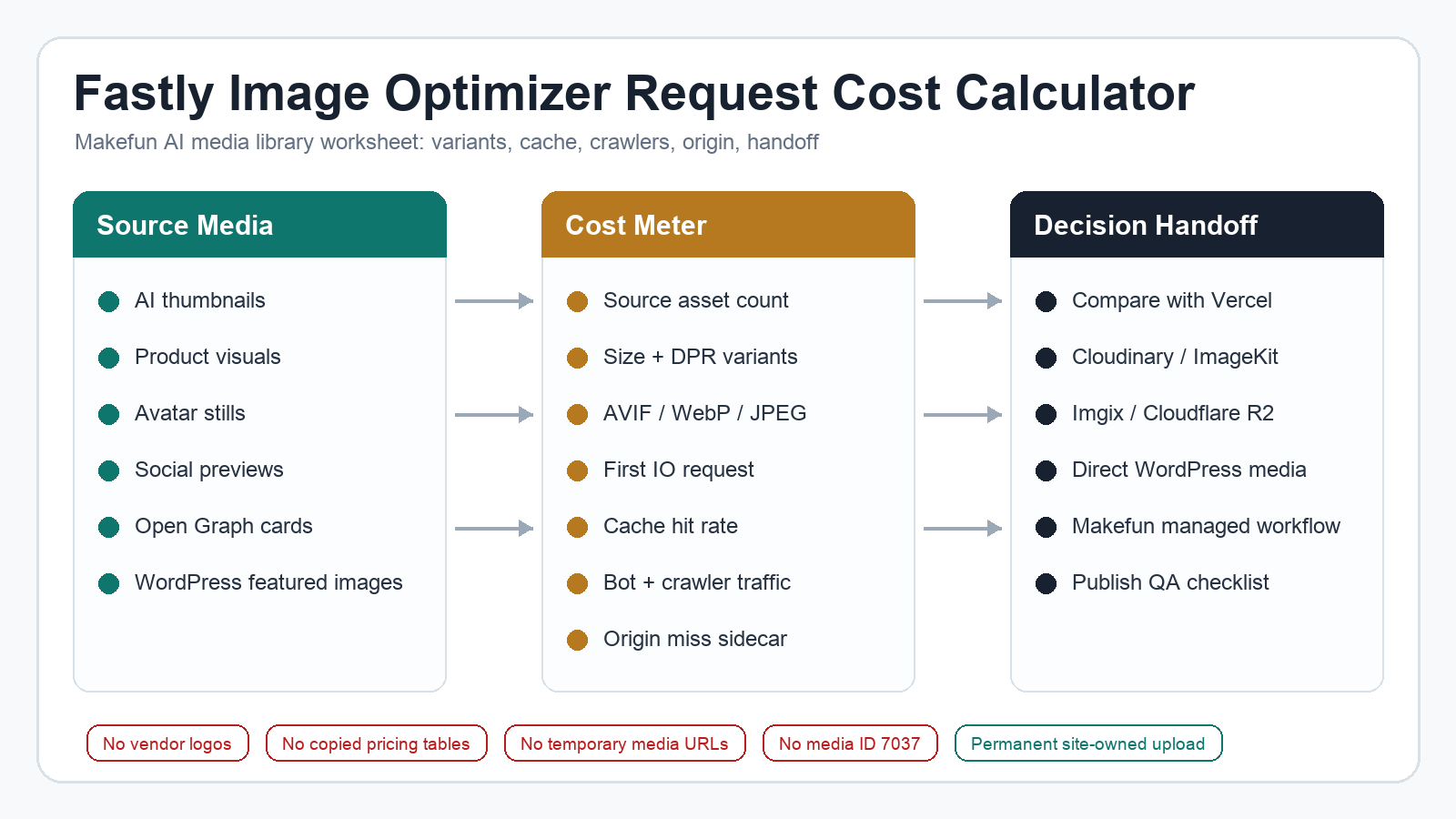
Direct answer: Fastly Image Optimizer cost planning should split one Makefun AI media library into source assets, requested size variants, AVIF/WebP/JPEG fallbacks, transformation parameters, first Image Optimizer requests, cache reuse, origin misses, crawler traffic, CDN request and bandwidth sidecars, optional origin storage, and permanent WordPress media handoff. The useful comparison is not a generic image CDN roundup. It is a same-workload worksheet that normalizes Fastly against Vercel Image Optimization, Cloudinary, ImageKit, Imgix, Cloudflare Images/R2, direct WordPress media, and Makefun managed workflows without making unsupported cheapest or best claims.
Current official source snapshot
Publisher refreshed the official Fastly pricing page, Fastly Image Optimizer documentation, and Fastly Image Optimizer product page on June 25, 2026. The worksheet keeps Image Optimizer requests, CDN requests, bandwidth, storage or origin choices, and human review as separate rows so the article does not overstate one provider meter.
- Fastly pricing
- Fastly Image Optimizer documentation
- Fastly Image Optimizer product page
- Vercel pricing
- Vercel image optimization cost controls
Fastly IO pricing starts with request allowance math
Use Fastly Image Optimizer image requests as the primary row, then keep Full Site Delivery requests, bandwidth, optional origin or object storage, and manual publication QA as separate rows. A single blended number hides the part of the workflow that actually changes with generated image variants.
For Makefun, the source library can include AI thumbnails, product visuals, avatar stills, Open Graph images, social crops, WordPress featured images, and campaign variants. Each group needs its own request and cache assumptions before comparing providers.
This article uses a publication-day source refresh from Fastly pricing, Fastly Image Optimizer docs, and the Fastly product page. Exact tier language should be refreshed again before using this worksheet for a buying decision.
Calculator rows for one Makefun generated-media library
Start with source assets. Count the approved originals that Makefun keeps after generation, review, and cleanup. Then list every requested output size, device-pixel-ratio variant, format fallback, and crop or trim parameter that can create a first optimization request.
Add monthly human views, social preview fetches, search crawler views, ad preview tools, and known bot traffic. Crawler and preview traffic can hit featured images and Open Graph cards before a human visitor sees the page.
Add cache hit rate, origin miss rate, cache TTL, and cache fragmentation notes. The same image library can have very different cost exposure when variants are stable and cached versus when query parameters, remote patterns, or low TTLs fragment the cache.
Worksheet table
| Row | What to count | Why it matters |
|---|---|---|
| Source assets | Approved originals, product visuals, avatar stills, thumbnails, social cards | The source library sets the baseline before variants multiply. |
| Variant bundle | Device sizes, DPR variants, AVIF/WebP/JPEG fallbacks, crop and quality settings | First requests and cache keys grow with every output path. |
| Traffic mix | Human views, search crawlers, social previews, ad previews, bots | Non-human requests can consume allowance before buyers arrive. |
| Cache behavior | TTL, hit rate, fragmented parameters, origin misses | Cache reuse changes how often optimization work repeats. |
| Handoff QA | Permanent WordPress media, alt text, social crop, rollback source, canonical image URL | Publishing work sits outside provider meters but still affects real cost. |
Cache, format, and crawler traps
Variant multiplication is the common hidden driver. One product visual can become desktop, tablet, mobile, retina, square social, landscape social, AVIF, WebP, and JPEG fallback requests. Model the bundle, not only the source image count.
Non-image URLs routed through an optimizer, broad remote allowlists, duplicate format settings, and very low cache TTLs can turn a clean media workflow into noisy request burn. Treat these as QA rows rather than provider faults.
For WordPress handoff, keep a canonical image URL, alt text, social crop, rollback source, and permanent media record. That QA work is not an Image Optimizer charge, but it is part of the real Makefun publishing cost.
Same-use comparison matrix
Compare Fastly with Vercel Image Optimization, Cloudinary transformations, ImageKit extension or DAM units, Imgix rendering credits, Cloudflare Images/R2, R2 plus Sharp, direct WordPress media, and Makefun managed workflows only after normalizing the same workload.
The comparable unit is cost per approved image view bundle or monthly media library. Raw image requests, transformations, cache reads, cache writes, rendering credits, storage, and bandwidth are not interchangeable provider meters.
Avoid claiming Fastly is cheaper, faster, or better than another route unless the worksheet has same-date official pricing and identical workload evidence for every named route.
Makefun publication handoff
Assign ownership for source media retention, the permanent WordPress upload, featured image ID, alt text, social image, internal links, canonical check, cache-busted public check, and sitemap verification.
For small static assets with stable dimensions and low traffic, direct WordPress media can remain simpler. Fastly IO becomes worth modeling when variants, cache behavior, crawler traffic, origin offload, and media-library scale are material.
For AI media articles, connect the cost worksheet back to production workflows such as generated thumbnails, product visuals, social previews, and the Makefun image-to-video workflow instead of leaving the article as an isolated infrastructure note.
Internal links for the same workflow
- Cloudinary AI transformation credit calculator
- ImageKit video extension and DAM unit calculator
- Imgix AI transformation credit delivery calculator
- Cloudflare R2 Images Stream media calculator
- Bunny Stream storage CDN transcribe DRM calculator
- Creatomate video render credit calculator
- Makefun image-to-video workflow
FAQ
What is the main Fastly Image Optimizer cost unit?
Use Image Optimizer image requests as the primary meter, then keep CDN requests, bandwidth, storage or origin, cache behavior, and manual publication work as separate rows.
Do social crawlers and bots matter for Fastly IO costs?
Yes. Social preview fetches, search crawlers, ad preview tools, and bad remote patterns can consume optimization requests before human visitors arrive.
Is Fastly cheaper than Vercel Image Optimization?
Do not answer from raw price rows. Normalize the same workload across IO requests, transformations, cache reads or writes, bandwidth, origin choices, cache TTL, formats, and review labor.
Should Makefun use Fastly IO instead of direct WordPress media?
Only when the worksheet shows enough variant, cache, crawler, and origin-offload value. Direct WordPress media can still be simpler for small static assets with stable dimensions.