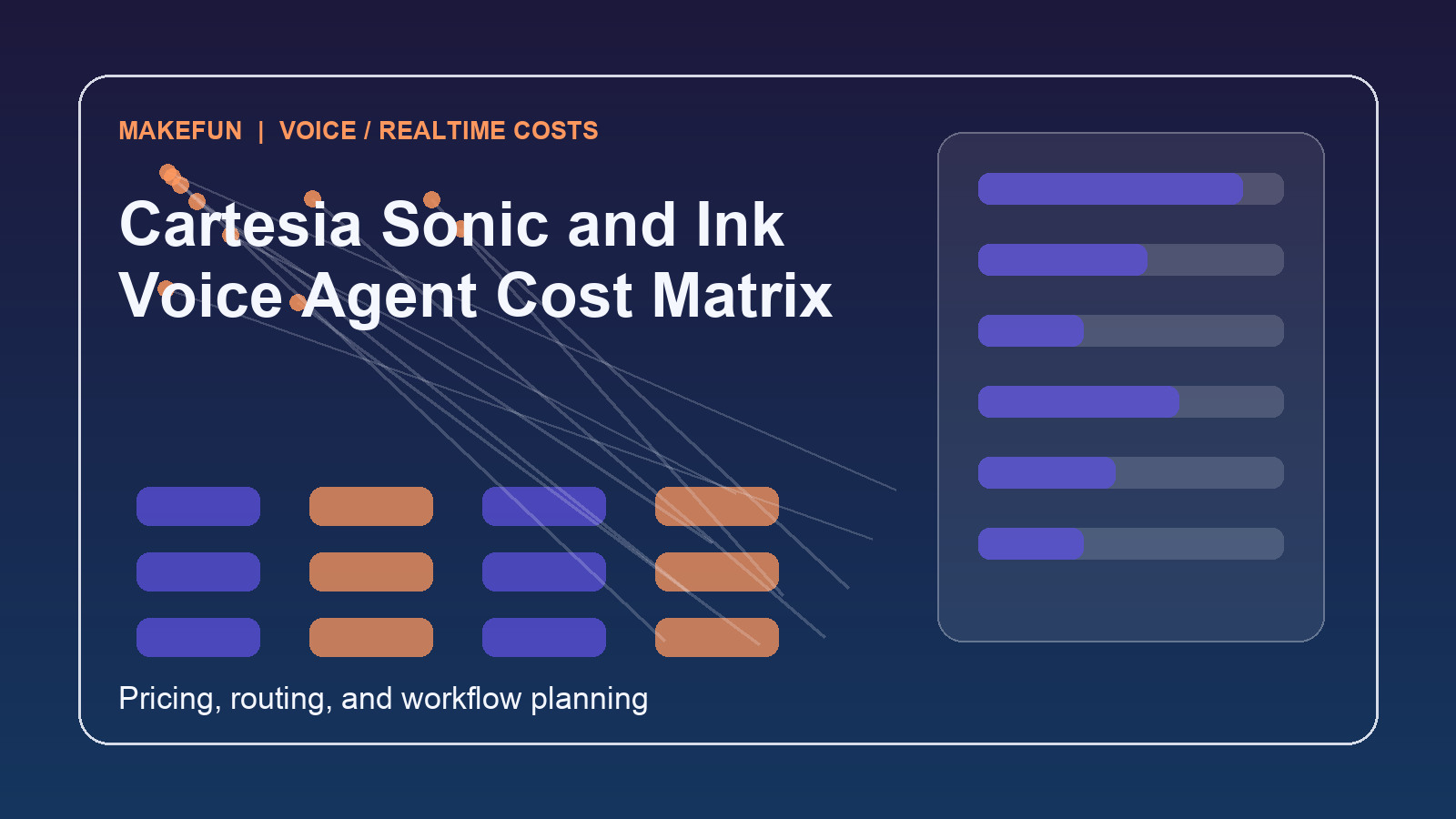
Cartesia Sonic pricing is not a single voice-agent number. A real budget can combine Sonic text-to-speech, Ink speech-to-text, Line voice-agent minutes, telephony, LLM usage during calls, voice cloning, concurrency limits, retries, and migration work. This matrix separates the components so a team can estimate the cost of a support agent, avatar demo, IVR flow, or localization review workflow before usage spikes.
The current official Cartesia pricing page lists plan credits, Sonic usage, Ink usage, Line agent minutes, telephony, text-to-agent creation, evaluations, prepaid agent dollars, and overage paths. Use that page as the source of truth before buying capacity; use this guide as a planning layer for comparing workflows.
Cartesia component cost matrix
| Component | What to estimate | Cost control |
|---|---|---|
| Sonic TTS | Generated speech characters, voice conversion seconds, infilling, and cloning output. | Separate generated speech from cloned-voice training and avoid regenerating full prompts for small copy edits. |
| Ink STT | Incoming audio seconds for each active transcription stream. The Cartesia Ink page positions Ink-Whisper around 1 credit per second and gives Scale-plan hourly context. | Track active audio time, not only completed calls, because open streams still matter. |
| Line voice agents | Call duration, telephony, LLM usage during calls, text-to-agent creation, and evaluations. | Use Line for managed agent workflows; use Sonic plus Ink directly when you need a custom orchestration stack. |
| Concurrency | TTS and STT simultaneous requests, WebSocket behavior, idle sessions, and 429 risk. | Review Cartesia concurrency limits before launch and close idle WebSockets quickly. |
| Migration | Deprecated models, snapshots, languages, and voice-embedding API paths. | Use the Cartesia API changes notes as a checklist before the June 1, 2026 transition. |
Scenario planner
| Workflow | Cartesia path | Main budget risk | Planning move |
|---|---|---|---|
| Support voice agent | Line agent with Sonic, Ink, telephony, and LLM usage. | Long calls, transfer loops, and unresolved intents can multiply minutes. | Cap test-call duration and review agent analytics before raising concurrency. |
| Real-time avatar demo | Sonic TTS plus Ink STT inside a custom avatar or video-agent stack. | Total cost may sit outside Cartesia if rendering, avatar video, or orchestration is separate. | Pair this guide with Makefun’s GPT-Realtime-2 voice agent API and Gemini Live cost calculator benchmarks. |
| Multilingual IVR | Ink for speech recognition, Sonic for localized responses, and Line or custom routing. | Language mix, fallback prompts, and telephony minutes can dominate model credits. | Measure by successful resolution, not just per-minute or per-character unit price. |
| Localization review | Sonic for dubbing-style review audio, Ink for reviewer notes and transcript checks. | Retries and human review time can exceed the first-pass audio cost. | Batch scripts, approve terminology, then regenerate only changed segments. |
Same-use competitor context
Cartesia is easiest to evaluate as a component stack. ElevenLabs exposes API pricing for speech generation and related speech products on its official ElevenLabs API pricing page, while AssemblyAI pricing is useful when a team wants STT and voice-agent packaging from another provider. These are not one-to-one unit conversions, so the comparison should stay workflow-based instead of declaring a universal price winner.
| Option | Best planning lens | Watch for |
|---|---|---|
| Cartesia Sonic plus Ink | Component control across TTS, STT, cloning, and custom orchestration. | Separate credits, concurrency, WebSocket limits, and non-Cartesia runtime costs. |
| Cartesia Line | Managed voice-agent path with call duration, telephony, LLM usage, and analytics. | Call length, agent iterations, prepaid dollars, and overage behavior. |
| ElevenLabs | Speech API and hosted agent context for voice experience teams. | Product-specific billing units, included quotas, overages, and pass-through model costs. |
| AssemblyAI | Speech intelligence and voice-agent packaging for transcription-led workflows. | Bundled versus component costs, concurrency, and audio duration assumptions. |
June 1 migration checklist
- Inventory every Sonic model name, snapshot, language, and voice-embedding API path used in production.
- Map each customer-facing workflow to support, avatar demo, IVR, localization review, or migration-only traffic.
- Test current endpoints against the API-change notes before a launch window, not during a live incident.
- Reserve time for prompt, voice, and transcript quality checks after model or endpoint changes.
- Update routing rules only after measuring latency, transcript quality, completion rate, and total cost per successful outcome.
Hidden cost drivers
- Idle WebSockets: open TTS or STT connections can consume capacity even when useful audio is not flowing.
- Retries and interruptions: failed turns still use model, telephony, and orchestration resources.
- LLM pass-through: the reasoning model behind a voice agent can be a separate bill from speech.
- Telephony: phone minutes, bridge fees, and regional call paths can change the real cost per resolved issue.
- Voice cloning: instant or professional cloning should be planned separately from routine TTS output.
- Human review: regulated, medical, financial, or brand-sensitive workflows may need transcript review and escalation.
For Makefun readers who already work with avatars or generated video, this is why a voice-agent budget should connect back to production goals. Start with a component estimate, then compare it with existing Makefun voice and video workflow references such as MiniMax, ElevenLabs, and Cartesia voice models, Napster OmniAgent API cost planning, voice clone, and agentic video generator.
FAQ
Is Sonic pricing the same as a full voice-agent cost?
No. Sonic text-to-speech can be one component, but a production voice agent may also use Ink, Line, telephony, LLM calls, orchestration, analytics, retries, storage, and human review.
When should a team use Line instead of Sonic plus Ink directly?
Line is better when the team wants a managed voice-agent development path. Sonic plus Ink directly is better when the team already owns the orchestration layer and needs more component-level control.
What is the safest way to compare Cartesia with ElevenLabs or AssemblyAI?
Compare by workflow outcome. A support call, avatar demo, IVR flow, and localization review job have different billing units and hidden drivers, so a single headline rate will usually be misleading.