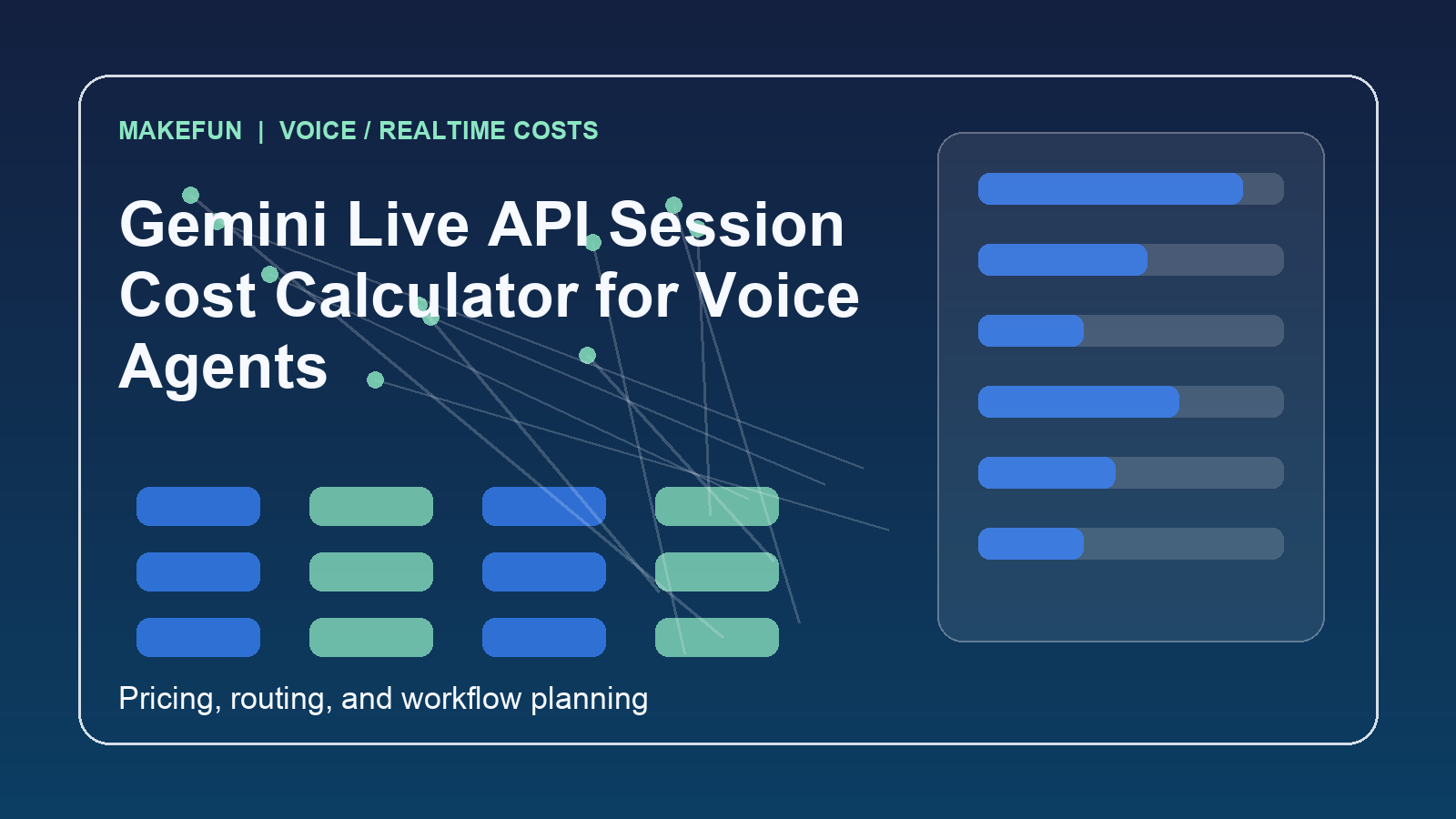
Gemini Live API cost planning is different from a normal chat API estimate because a voice agent is a persistent streaming session. The useful question is not only “what is the token price?” but also how long the call lasts, how much audio the user and assistant produce, whether the session needs video context, and how often the connection resumes or retries.
This guide turns the official Gemini Developer API pricing, Gemini Live API session management, and Deepgram Voice Agent API pricing pages into a practical calculator for support, onboarding, and creator-workflow agents. The numbers below are planning estimates, not invoice guarantees, because audio tokenization, silence handling, retries, grounding, and logging choices can change the final bill.
Gemini Live session rules that affect cost
Google’s Live API documentation says audio-only sessions are limited to 15 minutes without compression, while audio-video sessions are limited to 2 minutes without compression. It also notes that connection lifetime is separate from session lifetime, and session resumption can keep a session active across multiple connections. That means a budget should include session length, compression behavior, and reconnect handling before it assumes a stable per-call cost.
Calculator inputs
- Session minutes: planned call length, plus abandoned calls and retry allowance.
- User audio input: estimated speaking time from the customer or creator.
- Assistant audio output: estimated voice response time from Gemini Live.
- Text side channel: system instructions, tool results, transcript snippets, and summaries.
- Video or image context: add this only when the agent needs visual context, because the session limit and pricing assumptions change.
- Grounding and tools: Google Search grounding, function calls, CRM lookups, and escalation events should be counted separately.
Simple cost formula
Use this planning formula before any pilot:
Estimated session cost =
(audio input tokens / 1,000,000 x Gemini audio input price)
+ (audio output tokens / 1,000,000 x Gemini audio output price)
+ (text input tokens / 1,000,000 x Gemini text input price)
+ (text output tokens / 1,000,000 x Gemini text output price)
+ grounding, tool, retry, logging, and review allowances
For current planning, the official Gemini pricing page lists the Live preview audio model with separate paid-tier text input, audio input, image/video input, text output, and audio output rates. Keep those lines separate in your calculator. Do not convert everything to one blended per-minute price unless you also state the exact audio-token assumptions used.
Example planning scenarios
| Scenario | Gemini Live planning focus | Hidden cost driver | Operational note |
|---|---|---|---|
| 5-minute support call | Audio input/output plus short text summary | Retries, silence, and escalation | Good first pilot profile because it stays below the audio-only session limit. |
| 15-minute coaching call | Audio budget, compression, and resumption | Long assistant output and context growth | Set a warning near the session limit and test reconnect behavior. |
| 2-minute audio-video demo | Audio plus image/video context | Visual context and shorter session limit | Use only when the agent needs to inspect a screen, asset, or product state. |
| High-volume multilingual support | Concurrency, logging, and failover | Human review and transcript QA | Compare token-billed Gemini/OpenAI style pricing with per-minute voice-agent pricing. |
Gemini Live vs GPT-Realtime-2 vs Deepgram
| Route | Best fit | Billing unit to model | What to watch |
|---|---|---|---|
| Gemini Live API | Gemini-specific voice and multimodal agents | Separate text, audio, and image/video token lines | Session limits, compression, resumption, and grounding. |
| GPT-Realtime-2 | Existing OpenAI realtime stacks and Makefun voice-agent comparisons | Realtime audio/text token lines | Do not reuse generic chat-model token estimates for voice calls. |
| Deepgram Voice Agent API | Voice-agent teams that prefer per-minute websocket billing | Per-minute connection time by tier | Connection duration, BYO LLM/TTS options, concurrency, and support tier. |
For Makefun readers comparing realtime voice stacks, the related GPT-Realtime-2 voice agent API cost guide is the closest internal benchmark. Gemini Live should still be evaluated as its own session model, especially if the workflow also touches Gemini Omni video workflows or agentic video generator workflows.
Hidden cost checklist
- Audio input and output token volume can dominate a voice-agent session.
- Long assistant replies often cost more than short user questions.
- Context compression and session resumption need explicit testing before launch.
- Grounding, tool calls, transcript summaries, and CRM writes add separate cost lines.
- Failed calls, abandoned sessions, and reconnects should have a retry cap.
- Human escalation, QA review, and log storage belong in the workflow budget, not only the API budget.
Workflow template for a Gemini Live pilot
- Pick one session profile: 5-minute support, 15-minute coaching, or 2-minute audio-video demo.
- Log user speech, assistant speech, text side-channel tokens, tool calls, and grounding events separately.
- Set reconnect, retry, and escalation caps before adding traffic.
- Compare estimated cost with actual usage after the first 50 calls.
- Use a lower-cost fallback, such as voice-only or chat-only support, when video context is not needed.
FAQ
Is Gemini Live billed exactly per minute?
No. Gemini Live planning should start from the official token and modality pricing lines, then convert to session estimates using measured audio and text usage. Deepgram’s Voice Agent API is the cleaner per-minute comparison because its pricing page lists websocket connection-time rates.
Why does the 15-minute session limit matter?
Without compression, audio-only sessions are limited to 15 minutes. If a support or coaching flow can run longer, you need compression, resumption, or a handoff plan before you treat the agent as production ready.
Should a Gemini Live agent include video context?
Only when the use case needs it. Audio-video sessions have a shorter no-compression limit, and visual context adds another planning dimension. For many onboarding and support workflows, voice plus a text side channel is easier to budget.