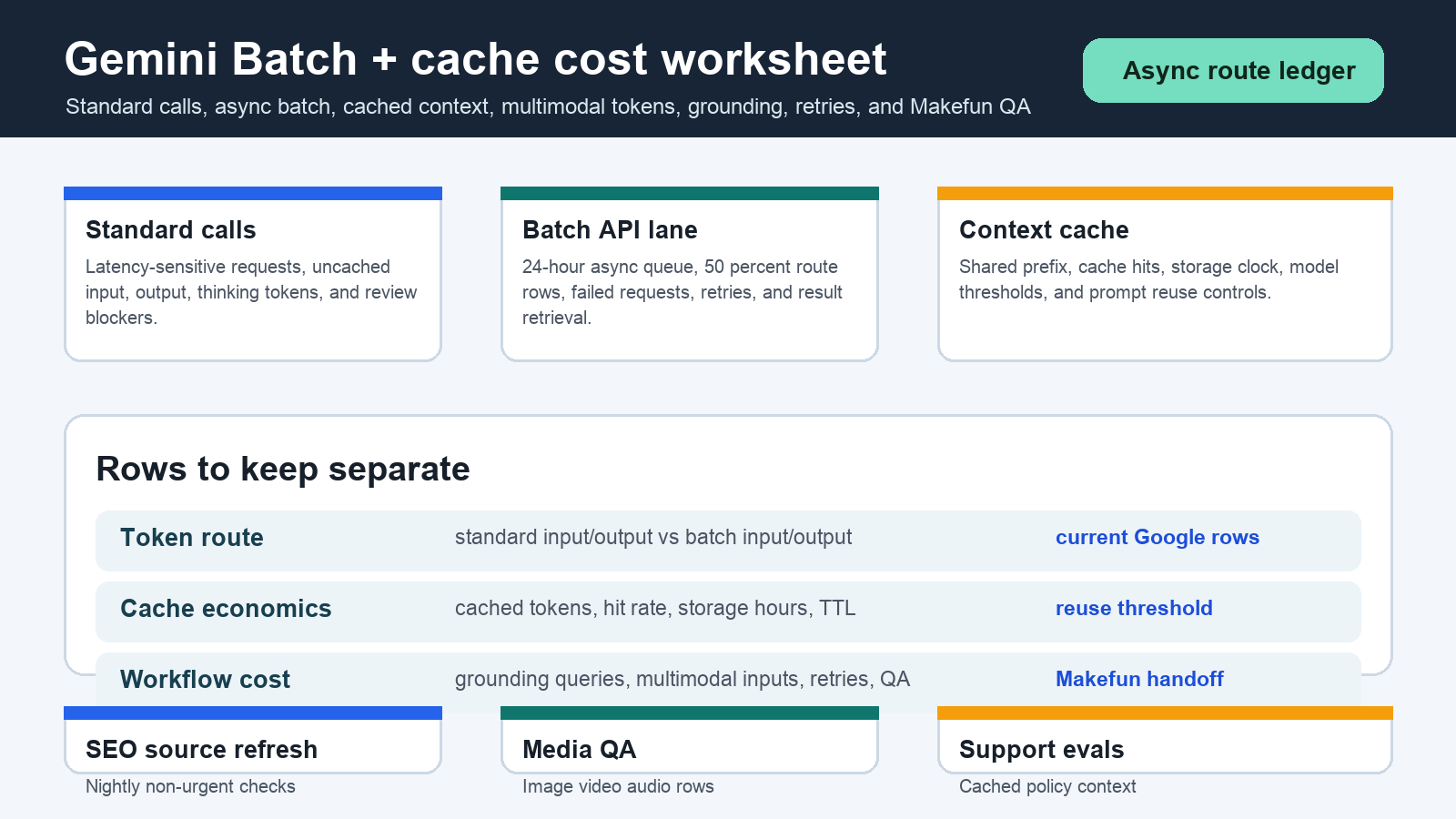
As of June 4, 2026, Gemini Batch API pricing should be modeled as a route decision, not as one blended token price. A useful worksheet separates standard Gemini calls for urgent work, Batch API jobs that can wait for asynchronous processing, context-cache reads and storage hours, multimodal token conversion, grounding search rows, retries, failed rows, result retrieval, and Makefun human QA.
Publication-time checks used the official Google AI Gemini pricing, Batch API, context caching, token-counting, and billing pages, plus current same-use references for OpenAI Batch, Anthropic Message Batches and prompt caching, Fireworks batch inference, Together batch processing, and Vertex AI generative AI pricing. Those official pages remain the source of truth because model rows, cache thresholds, grounding billing, and batch support can change.
Gemini Batch API pricing source snapshot
| Cost row | What to model | Budget caveat |
|---|---|---|
| Standard Gemini calls | Latency-sensitive input, output, thinking tokens, multimodal tokens, and grounding search rows at the current model price. | Use standard calls when a user or publisher is waiting; do not hide urgent review work inside a batch discount. |
| Gemini Batch API | Async jobs, request volume, 24-hour tolerance, batch input/output rows, failedRequestCount, retries, and result retrieval. | Batch can lower eligible API rows, but it does not remove QA, retry, privacy, or delivery work. |
| Context caching | Shared prefix tokens, cache-hit rate, explicit or implicit cache behavior, storage duration, cache minimums, and model support. | Cache rows help only when repeated context is large and reused enough to offset setup and storage assumptions. |
| Multimodal and grounding | Text, image, video, audio conversion, Google Search grounding query counts, and freshness needs. | Media and grounding rows can change the bill even when token-only examples look small. |
| Buyer operations | Prompt packaging, source refresh, failed rows, result review, privacy review, and Makefun workflow handoff. | The article should model cost per approved workflow result, not just model-token spend. |
Standard API versus Batch API route table
Use standard Gemini calls when latency matters, when a publisher needs a blocking source check, or when an operator is reviewing a small number of rows. Use Gemini Batch API for non-urgent source extraction, duplicate checks, transcript tagging, media metadata classification, and eval runs that can wait. Keep the batch row separate from result retrieval, failed jobs, retries, and QA minutes so a lower API row is not mistaken for a complete operating budget.
Context caching and cache storage rows
Context caching belongs in the calculator only when repeated prompts share enough policy, product, style-guide, or source-verification context to meet the current cache threshold and reuse pattern. Add rows for cacheable prefix tokens, cache-hit rate, storage hours, TTL, non-cached input, output, grounding, and cache misses. A Makefun SEO run with a repeated editorial policy prefix can have a different shape from one-off provider checks.
Multimodal token and grounding rows
Gemini workflows often mix text with images, screenshots, video, audio, transcripts, and Google Search grounding. Put those rows into the worksheet explicitly: image token handling, video seconds, audio seconds, text tokens, grounded query counts, and any current model-specific limits. This prevents a text-only example from understating media QA or support-eval spend.
Three scenario calculator
| Scenario | Gemini rows | Decision row |
|---|---|---|
| Makefun SEO source refresh and title/meta QA | Monthly batch jobs, requests per batch, shared editorial context, cache-hit rate, uncached input, output, grounding, failed rows, retries, and reviewer minutes. | Budget cost per verified source packet, not raw prompt count. |
| Media metadata screenshot transcript and video QA | Image token rows, video/audio seconds, text transcript tokens, reusable policy context, batchable share, low-confidence reruns, and human approval. | Separate multimodal conversion, cacheable policy context, and approval labor before comparing providers. |
| Support knowledge eval and retrieval-quality batch | Ticket or eval prompt count, shared product-policy context, candidate document tokens, cache storage, grounding use cases, escalation rate, and privacy review. | Batch when latency can wait; standard calls when users are waiting; cache only when context is reused. |
Same-use comparison rows
Compare Gemini Batch only against the same workload shape. Adjacent Makefun references include Claude Batch API prompt-cache planning, Pinecone Assistant context-token planning, Airtable Field Agents credit automation, Botpress AI spend planning, AWS Bedrock AgentCore governance, and Comfy Cloud API workflow costs. Do not claim Gemini, OpenAI, Claude, Fireworks, Together, Vertex, Pinecone, or local scripts are cheapest, best, faster, safer, or more reliable without current same-scenario evidence.
Makefun async workflow handoff
For Makefun operations, use the calculator as a routing checklist: nightly SEO source refresh, duplicate detection, brief QA, media metadata review, transcript classification, support tagging, retrieval evals, and source freshness checks can use batch rows when latency allows. Publisher blockers, current-source verification, and user-facing support answers stay on standard or manual review paths until evidence is current.
Risks and caveats
- Refresh official Google AI pricing, Batch API, context caching, token-counting, grounding, billing, and model-support rows before quoting exact budgets.
- Keep Batch API savings separate from result retrieval, failed rows, retries, privacy review, and QA labor.
- Do not apply cache rows unless repeated context meets the current threshold, TTL, and reuse assumptions.
- Model text, image, video, audio, and grounding rows separately.
- Avoid cheapest, best, faster, safer, more reliable, or guaranteed-savings claims unless every same-scenario row has current official evidence.
FAQ
When is Gemini Batch API worth the wait?
It is worth modeling when requests are non-urgent, can be packaged safely, and can tolerate asynchronous completion. Keep failed rows, retries, result retrieval, and review minutes in the same worksheet.
When does context caching pay off?
Context caching can help when a large shared prefix repeats across enough requests to meet current cache thresholds and hit-rate assumptions. Add storage hours and cache misses before treating it as a savings row.
How does grounding change the bill?
Grounding adds a separate source-freshness and query-count decision. Use it when current external evidence is required, and keep its query rows separate from model token rows and manual source review.
Can this replace provider-specific pricing pages?
No. Treat this as a worksheet structure. Official Google, OpenAI, Anthropic, Fireworks, Together, and Vertex pages should be refreshed before procurement or publication decisions.