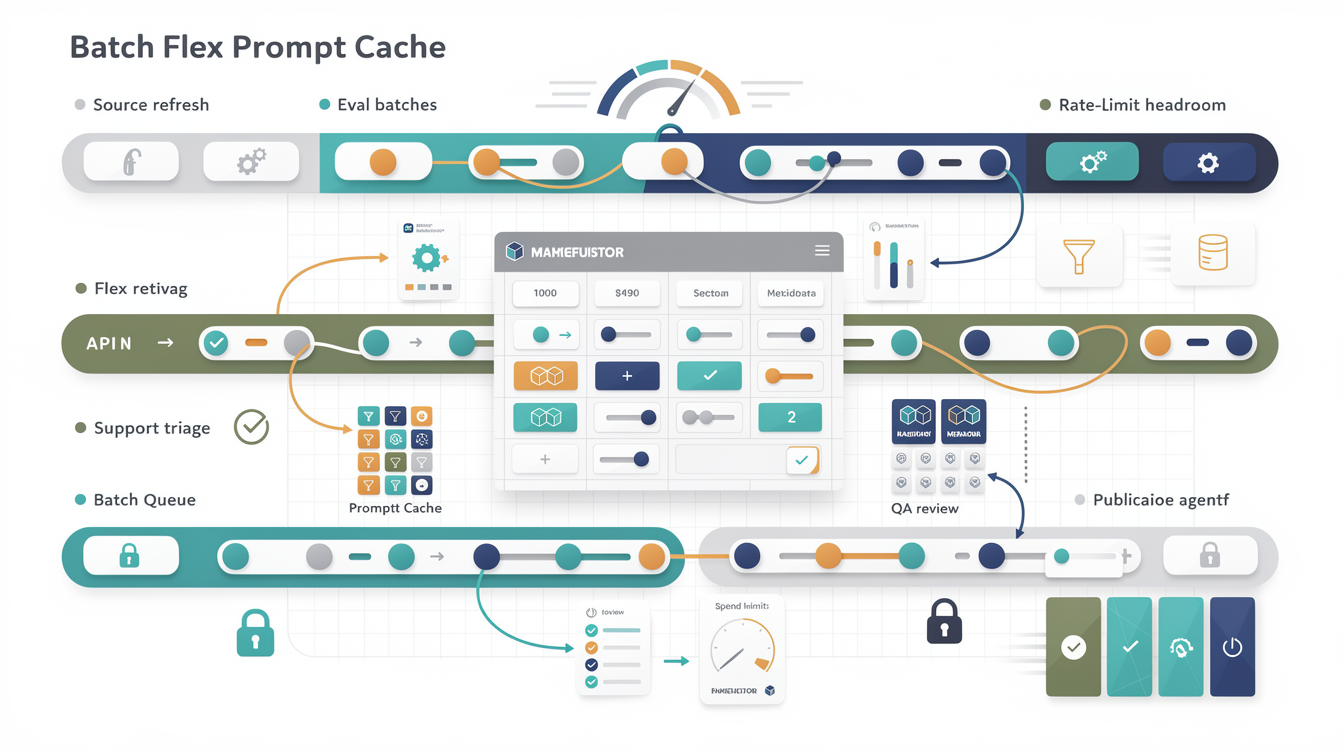
As of June 5, 2026, a Groq Batch API cost calculator should start with routing mode, not just a model-price row. Standard requests, Batch Processing, Flex Processing, Prompt Caching, rate-limit headroom, spend limits, retries, QA, and Makefun publication handoff each belong in separate worksheet rows.
The short answer: use standard Groq calls when latency matters, Batch when the work can wait, Flex when a paid retry-tolerant workload needs more headroom, and Prompt Caching when a stable repeated prefix is reused enough times. Refresh Groq pricing and docs before any numeric claim because model support, discount behavior, cache wording, and limits can change.
Groq pricing and routing source snapshot
Publication-time checks reached the official Groq pricing page, Batch Processing docs, Flex Processing docs, Prompt Caching docs, rate limits docs, and spend limits docs. Treat those pages as the source of truth for current model prices, processing windows, service-tier wording, cache compatibility, and governance controls.
| Route | Use it when | Budget row to keep separate |
|---|---|---|
| Standard requests | The workflow needs low-latency completion or fresh context. | Model input/output tokens, current rate limits, and source-verification labor. |
| Batch Processing | SEO extraction, eval, or metadata work can wait for asynchronous completion. | Batchable token share, result retrieval, failed rows, and delayed review. |
| Flex Processing | A paid workload can tolerate rapid 503 failures and retry/backoff logic. | Retry tokens, worker runtime, idempotency, monitoring, and escalation. |
| Prompt Caching | Stable system prompts, rubrics, source bundles, or style guides repeat across many calls. | Repeated-prefix tokens, cache-hit share, cache misses, prompt churn, and QA. |
| Governance | Teams share keys across source refresh, media metadata, support, and eval workers. | Rate-limit headroom, spend caps, key/project boundaries, alerts, and manual approval. |
Cost formula for Groq routing
monthly_cost = standard_tokens * standard_model_rate + batch_tokens * batch_rate + cached_prefix_tokens * cached_input_rate + flex_retry_tokens * selected_model_rate + worker_retry_runtime + monitoring + QA + Makefun_publication_handoff
The formula deliberately separates vendor token spend from operational work. That prevents a cheaper token row from hiding cache misses, retry loops, source refresh, duplicate checks, media production, body-link verification, and editorial approval.
Worksheet 1: Makefun async source refresh and eval batches
A Makefun SEO worker sends pricing-page extraction, changelog summarization, evaluation prompts, and metadata enrichment through Groq while separating latency-sensitive checks from delayed batch work.
- Use 10 million monthly input tokens and 2 million output tokens as the same-unit row.
- Split the workload into 45% delayed batch jobs, 25% cacheable repeated-prefix jobs, 20% standard requests, and 10% Flex-eligible retry-tolerant requests.
- Keep Batch separate from Prompt Caching because current source wording must support any stacking claim before the article can say those discounts combine.
- Add result retrieval, failed-row handling, duplicate checks, and editor sample review to the same worksheet.
Worksheet 2: Flex support triage and non-critical agent steps
A support or editorial automation classifies tickets, tags source issues, drafts internal summaries, and retries non-critical agent steps where occasional rapid failures do not block a customer-facing flow.
- Use 250,000 monthly classification requests, 900 average input tokens, 120 average output tokens, and retry sensitivity rows at 2%, 5%, and 8%.
- Flex belongs only where retries, backoff, idempotency, and delayed completion are acceptable.
- Do not use Flex for payment, legal, safety-critical, or user-blocking realtime steps unless a fallback path is explicit.
- Track rate-limit headroom and spend caps separately from model price.
Worksheet 3: Prompt Cache repeated-prefix media and editorial work
A media metadata or editorial assistant reuses stable system prompts, source bundles, style guides, schema instructions, and Makefun formatting rules while processing many prompts, alt-text rows, and outline variants.
- Use 4 million monthly repeated-prefix input tokens, 1.5 million fresh input tokens, 1 million output tokens, and cache-hit rows at 30%, 60%, and 85%.
- Apply cache savings only to stable repeated prefixes, not fresh source facts.
- Model prompt-version churn, cache misses, source refresh changes, and reviewer rework as explicit QA rows.
- Avoid claiming cache hits are guaranteed unless the current official docs support that wording.
Same-use comparison rows
Use adjacent Makefun calculators as comparison lanes, not same-intent duplicates: Claude Batch API prompt cache cost calculator, Gemini Batch API context cache cost calculator, Nebius Token Factory batch inference cost calculator, Hugging Face Inference Providers routed request cost calculator, and Requesty AI gateway cache routing cost calculator.
Claude Batch, Gemini Batch, Nebius, Hugging Face, Cerebras, Fireworks, Together, OpenRouter, Requesty, Vercel AI Gateway, and self-hosted inference should be compared only when the same latency, model class, token mix, cache behavior, retry policy, and review work are refreshed from current sources.
Cost-control checklist
- Pick the latency route before comparing token prices.
- Separate batchable share from cacheable prefix share.
- Record retry and 503 handling before using Flex for throughput-sensitive work.
- Set spend limits by project or key for SEO refresh, media metadata, support, and eval workers.
- Refresh official pricing, supported models, processing windows, rate limits, and cache caveats before publication or procurement.
- Keep source verification, internal links, media generation, WordPress publishing, and human QA outside the Groq token row.
Publisher checklist and caveats
The Publisher gate checked target URL, WordPress search, sitemap overlap, official Groq source reachability, five live internal links, and a unique permanent featured image before creating this post. The article avoids cheapest, fastest, most reliable, compliance, privacy, quality, and winner claims because those need current same-scenario evidence and customer-specific testing.
FAQ
Is Groq Batch always the cheapest route? No. Batch only helps work that can wait and fit the current supported constraints. Add result retrieval, failed rows, stale source checks, and editor review before choosing it.
When should Flex Processing be used? Use Flex only for paid, retry-tolerant workloads where rapid failures and delayed completion are acceptable. Model retry tokens, worker runtime, and monitoring beside the token row.
What makes Prompt Caching pay off? Stable repeated prefixes, high cache-hit share, and low prompt churn. Cache misses and changed source bundles can erase expected savings.