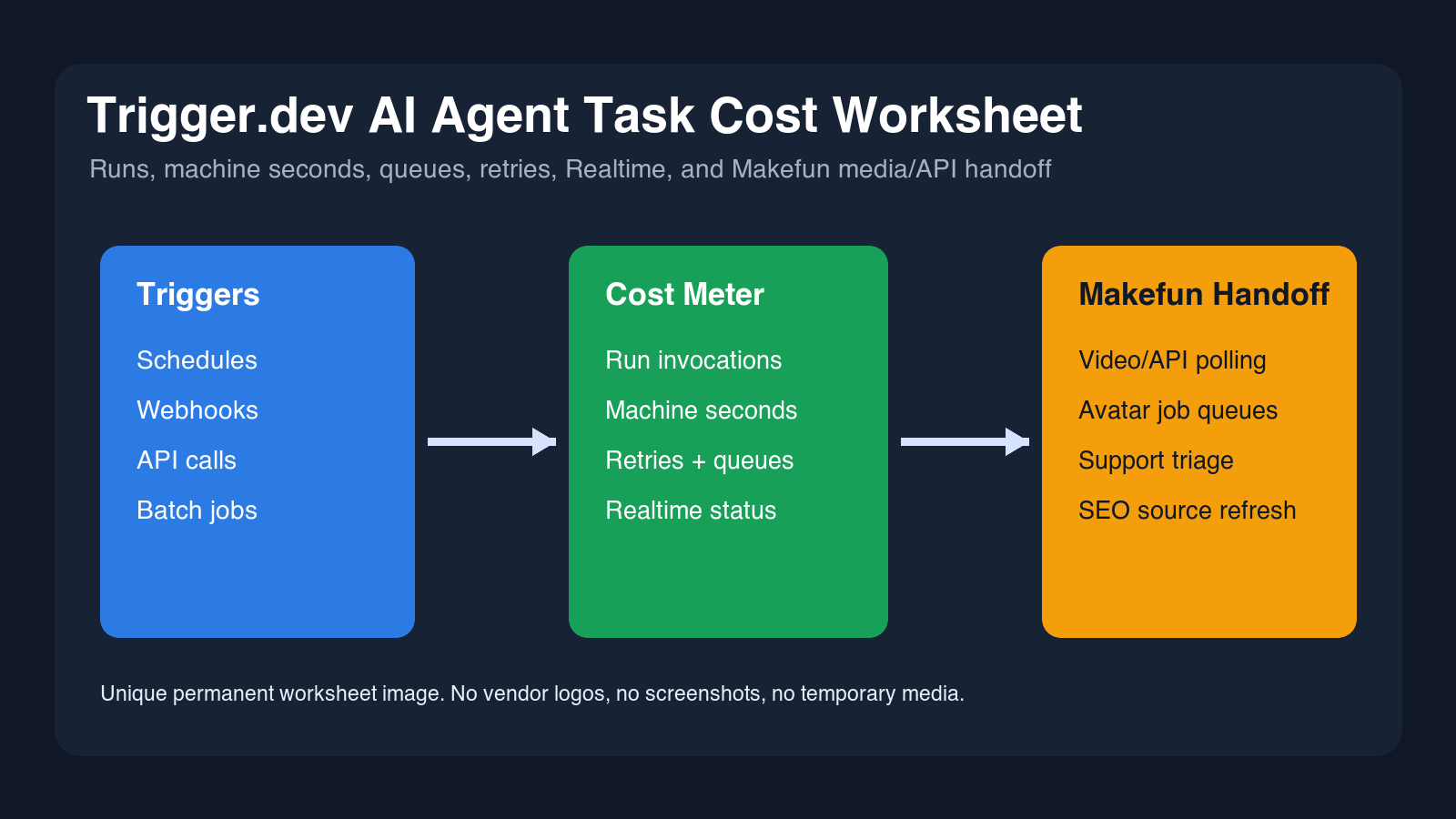
As of June 5, 2026, a Helicone pricing calculator should separate the Helicone plan and usage rows from provider token spend. The useful buyer question is not whether Helicone is another LLM dashboard; it is whether gateway routing, request logging, cache controls, sessions, rate limits, alerts, and reports reduce enough Makefun workflow cost to justify adding the layer.
The short answer: start with the selected Helicone plan, included monthly requests, included storage, retention window, ingestion and API limits, provider pass-through token spend, cache hit rate, cache TTL, session headers, and implementation review time. Refresh official pricing before reusing any number because usage rows, discounts, Enterprise terms, and provider costs can change.

Helicone official source snapshot
Publisher refreshed the official Helicone pricing page, platform overview, Gateway integration docs, LLM caching docs, prompt caching docs, sessions docs, and custom rate-limit docs. Treat those pages as the source of truth at publication time.
| Worksheet row | What to model | Makefun caveat |
|---|---|---|
| Plan and platform row | Hobby, Pro, Team, or Enterprise floor; included requests and storage; retention; ingestion; API access; alerts and reports. | Do not publish a precise usage-rate formula unless the current official pricing calculator exposes it during refresh. |
| Provider pass-through row | OpenAI, Anthropic, Google, Groq, Mistral, DeepInfra, or other provider token spend routed through or observed by Helicone. | Keep provider tokens separate from Helicone subscription and usage costs. |
| Cache row | Hit rate, TTL, seed, ignored keys, bucket size, cache response review, and provider-native prompt cache behavior. | Bypass or segment cache for publication-time pricing, fresh source checks, and user-specific evidence. |
| Session row | Session ID, path, name, user properties, workflow labels, alert review, report review, and dashboard API checks. | Headers and labels need implementation QA before the attribution is trustworthy. |
Request and storage worksheet
monthly_platform_cost = selected_plan_floor + visible_request_usage_rows + visible_storage_usage_rows + retention_or_enterprise_terms + review_time
- Use current official Helicone pricing for plan floors, free request allowance, included storage, retention, ingestion, and API access limits.
- Record the monthly request count for SEO source refresh, support triage, media metadata QA, transcript cleanup, classification, and eval jobs.
- Keep storage and retention as their own row because request logs can become a separate cost driver from token spend.
- Use Enterprise, self-host, on-prem, compliance, and discount language only with the current official page or a sales-source caveat.
Provider pass-through token worksheet
total_workflow_cost = helicone_platform_cost + provider_token_spend + cache_miss_spend + QA_and_investigation_time
- Model provider tokens by route and model instead of hiding them inside the Helicone row.
- Separate gateway credits or pass-through billing language from direct provider invoices.
- Add retries, failed source extraction, false positives, and editor review because Makefun publication work is not just an API bill.
- Avoid cheapest, fastest, best, safest, reliability, or compliance claims without current same-scenario evidence.
Cache-hit TTL seed and ignored-key worksheet
cache_value = repeatable_prompt_spend * validated_hit_rate - stale_answer_risk - cache_policy_QA
- Cache stable support macros, classification prompts, and repeated media metadata checks before caching publication-time source claims.
- Model TTL, cache seed, ignored keys, bucket size, and cache response headers as controls, not guaranteed savings.
- Use separate cache keys when user-specific context, timestamps, source URLs, or pricing versions change the answer.
- For current pricing and source verification, make the worksheet force a cache bypass or a source-versioned cache key.
Session attribution template
Use sessions when the buyer needs to know which user, account, queue item, automation owner, or workflow created the cost. A Makefun support or SEO run can group LLM calls, vector checks, tool calls, and review events under stable session headers, then compare that view with raw provider dashboards.
| Makefun workflow | Session label | Decision row |
|---|---|---|
| SEO source refresh | topic slug plus source-refresh run | Do cache controls reduce repeated provider calls without stale pricing risk? |
| Support triage | ticket or customer account | Does session attribution expose costly macros or noisy routing? |
| Media metadata QA | asset ID plus review queue | Does gateway logging reduce manual investigation and rejected-media review? |
| Eval sampling | experiment or prompt version | Does Helicone observability suffice, or does the workflow need a heavier eval stack? |
Same-use comparison rows
Compare Helicone with adjacent Makefun pages by job type, not by generic category. Use Requesty AI Gateway Cache Routing Cost Calculator and Portkey AI Gateway Guardrails Log Overage Cost Calculator for gateway routing, cache, guardrail, and log rows; Vellum Workflow Evaluation Release Review Cost Calculator and OpenPipe Fine-Tuning Deployment CU Cost Calculator for workflow evaluation and model-operation rows; Groq Batch Flex Prompt Cache Cost Calculator, Claude Batch API Prompt Cache Cost Calculator, and Gemini Batch API Context Cache Cost Calculator when prompt cache or provider-native batch economics are the real alternative.
- Direct provider dashboards can be cheaper to buy but more expensive to debug if teams need session-level investigation.
- Open-source or self-hosted gateways can reduce SaaS dependence but add infrastructure, uptime, dashboard, and incident-response work.
- Eval platforms can be better when scored testing and release governance matter more than gateway observability.
- Do not turn the comparison into a ranking unless every row uses the same workload and current official evidence.
Publisher checklist
- Target URL is absent before publish and WordPress search has no Helicone-specific same-intent page.
- Official Helicone pricing, Gateway, platform, caching, prompt caching, sessions, and rate-limit docs are refreshed on publication day.
- Final body links return 200 and exclude local blocked or cache-pending pages.
- Featured media is a unique site-owned worksheet PNG, not media ID 7037, a temporary MakeFun URL, a hotlink, copied UI, or a Helicone logo.
- Post-publish checks verify REST publish status, blog category id 2, Yoast fields, canonical URL, cache-busted URL, sitemap, body links, and absence of temporary-media markers before any public success notice.
FAQ
What should a Helicone pricing calculator include? Include the selected plan, included requests, included storage, retention, ingestion, API access, provider token spend, cache hit rate, TTL, cache seed, ignored keys, sessions, alerts, reports, and implementation review time.
Does Helicone replace provider token pricing? No. Keep Helicone platform and usage rows separate from OpenAI, Anthropic, Google, Groq, Mistral, DeepInfra, or other provider token spend.
When should Makefun model Helicone cache savings? Model cache savings for stable repeated prompts, support macros, media metadata QA, classification, and retry loops. Bypass or segment cache for live pricing, fresh source checks, user-specific context, timestamps, and request-specific evidence.