LiveKit Agents pricing is easiest to misunderstand when teams treat the agent session minute as the whole voice-agent bill. For Makefun-style voice agents, avatar demos, support assistants, and realtime video workflows, the useful question is different: what layers are you paying for after a user starts talking?
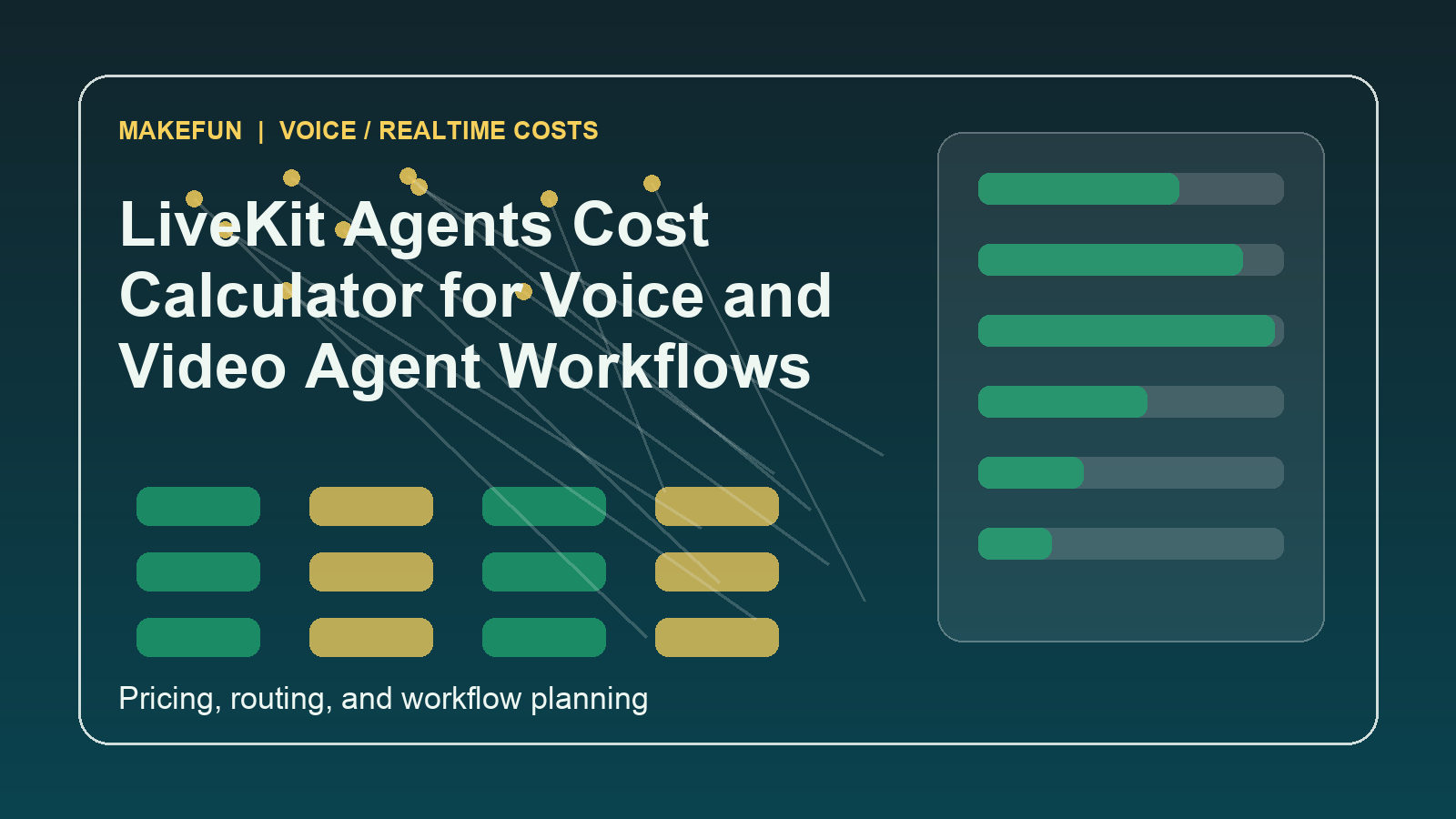
This LiveKit Agents cost calculator separates the bill into session minutes, WebRTC connection time, telephony, STT, LLM, TTS, inference credits, recordings, observability, deployment limits, and self-hosting operations. It uses the current LiveKit pricing page, LiveKit Agents model docs, LiveKit voice AI quickstart, Telnyx LiveKit pricing docs, and Agora Conversational AI Engine pricing as planning anchors. Prices and plan limits can change, so use this as a workflow checklist before you lock a production budget.
Quick Answer
LiveKit Cloud can be a strong fit when you want an open-source-friendly realtime media stack with managed agent deployments, observability, WebRTC transport, telephony options, and model-provider flexibility. But the agent session price is not the full call price. A production bill can also include model inference, STT, LLM, TTS, phone minutes, WebRTC participant minutes, recordings, observability events, data transfer, fallback routes, and the operational cost of running your own LiveKit deployment.
LiveKit Agents Cost Calculator
| Cost layer | What to estimate | Why it matters |
|---|---|---|
| Agent session minutes | Minutes spent by an agent deployed on LiveKit Cloud. | This is the visible starting point, not the complete voice-agent bill. |
| Concurrent agent sessions | Peak simultaneous sessions across deployed agents. | Limits decide when a support or avatar workflow needs a higher plan. |
| Agent deployments | Number of hosted agent backends, prompts, model stacks, and function-call variants. | Separate demo, staging, and production agents can consume deployment capacity. |
| LiveKit Inference | LLM, STT, and TTS model usage through LiveKit Inference. | Voice pipelines often combine providers instead of using one flat per-call rate. |
| Telephony | Inbound calling, phone numbers, SIP, and carrier usage. | Phone-based support agents add costs that web-only demos may not have. |
| WebRTC minutes | End-user connection time on LiveKit’s realtime network. | Self-hosted agents can still use participant minutes when users connect through LiveKit Cloud. |
| Recordings and observability | Recorded sessions, transcripts, trace spans, logs, and events. | QA, compliance, and debugging can become meaningful at scale. |
| Voice isolation and noise handling | Background-noise suppression and primary-speaker isolation. | Call quality improvements may be worth paying for, but they should be explicit in the model. |
| Self-hosted operations | Compute, bandwidth, region routing, monitoring, upgrades, and on-call work. | Open source does not mean zero cost; it moves spend into infrastructure and operations. |
Scenario Worksheet
| Scenario | Best first estimate | Extra line items to add |
|---|---|---|
| Prototype voice assistant | Agent session minutes plus LiveKit Inference. | Small observability allowance, test recordings, and a few deployment variants. |
| Support pilot by phone | Agent sessions plus telephony minutes. | STT, LLM, TTS, call transfers, recordings, and fallback-to-human thresholds. |
| Avatar video agent | Agent sessions plus WebRTC participant minutes. | Realtime model or STT-LLM-TTS stack, video transport, recording, and avatar provider cost. |
| Production call workflow | Peak concurrency, included minutes, and overage assumptions. | Observability events, compliance tier, region needs, retry logic, and QA sampling. |
| Self-hosted LiveKit | Infrastructure and operations instead of only cloud session minutes. | Compute, bandwidth, storage, monitoring, upgrades, incident response, and cloud transport. |
| LiveKit on Telnyx route | Partner-hosted LiveKit assumptions from Telnyx docs. | Beta terms, telephony rates, model-provider costs, and migration risk. |
Same-Use Comparison
Agora’s Conversational AI Engine gives a useful comparison because it prices an audio task model for conversational AI infrastructure, while LiveKit exposes a more layered stack across agent sessions, WebRTC, telephony, and model inference. That does not make either route universally cheaper. The better comparison is by workflow: web demo, phone support pilot, avatar agent, or production call center.
- Use LiveKit when you want realtime media control, open-source portability, and provider flexibility.
- Use a bundled voice-agent platform when you want more application-layer call-center features managed for you.
- Use OpenAI Realtime or Gemini Live style APIs when direct speech-to-speech model behavior is the core product and media infrastructure is secondary.
- Use a Makefun-style media workflow when the voice agent is part of an avatar, AI video, or creator support experience rather than a standalone phone bot.
Hosted, Self-Hosted, Or Partner-Hosted?
LiveKit Cloud is the cleanest route when a team wants managed deployments, dashboards, global media transport, and an agent-hosting path. Self-hosted LiveKit can make sense when infrastructure control, custom networking, or deployment ownership is more important than managed convenience. Telnyx’s LiveKit path adds a partner-hosted voice-AI infrastructure option, but treat beta terms and provider claims as a planning input, not a universal cost conclusion.
Hidden Cost Drivers
- Long conversations where silence, retries, or unresolved loops keep a session open.
- LLM output length, tool calls, context retention, and fallback prompts.
- STT and TTS provider choice, voice quality, language coverage, and custom voices.
- Phone numbers, SIP, carrier minutes, transfers, and regional calling routes.
- Recordings, transcripts, trace spans, logs, observability events, and storage export.
- Cold-start prevention, deployment variants, concurrency spikes, and rollback needs.
- Compliance, region pinning, data residency, and dedicated support requirements.
- Self-hosting labor, media egress, monitoring, upgrades, and incident response.
Internal Planning Links
If your stack is more model-cost-heavy than infrastructure-heavy, compare this guide with the Cartesia Sonic and Ink voice-agent cost matrix, Gemini Live API session cost calculator, and GPT-Realtime-2 voice agent API guide. If your voice workflow is tied to realtime avatars, also review the Runway Characters real-time avatar cost guide.
FAQ
Is LiveKit’s agent session minute the total call cost?
No. It is one layer. Add model inference, STT, LLM, TTS, telephony, WebRTC, recordings, observability, deployment, and operational costs before comparing vendors.
Can self-hosted LiveKit be cheaper?
Sometimes, but only if the infrastructure and operations tradeoff is real. Self-hosting can reduce some managed-cloud line items while adding compute, bandwidth, maintenance, monitoring, and incident-response costs.
Should avatar teams use LiveKit or direct realtime model APIs?
Use LiveKit when realtime media routing, WebRTC, telephony, and provider composition matter. Use direct realtime model APIs when the speech-to-speech model itself is the main product surface and you can keep the rest of the media stack simple.
What should Makefun teams measure first?
Normalize by completed conversation: total spend divided by successful support call, avatar demo, or creator workflow handoff. That is usually more useful than comparing only per-minute or per-token headline rates.