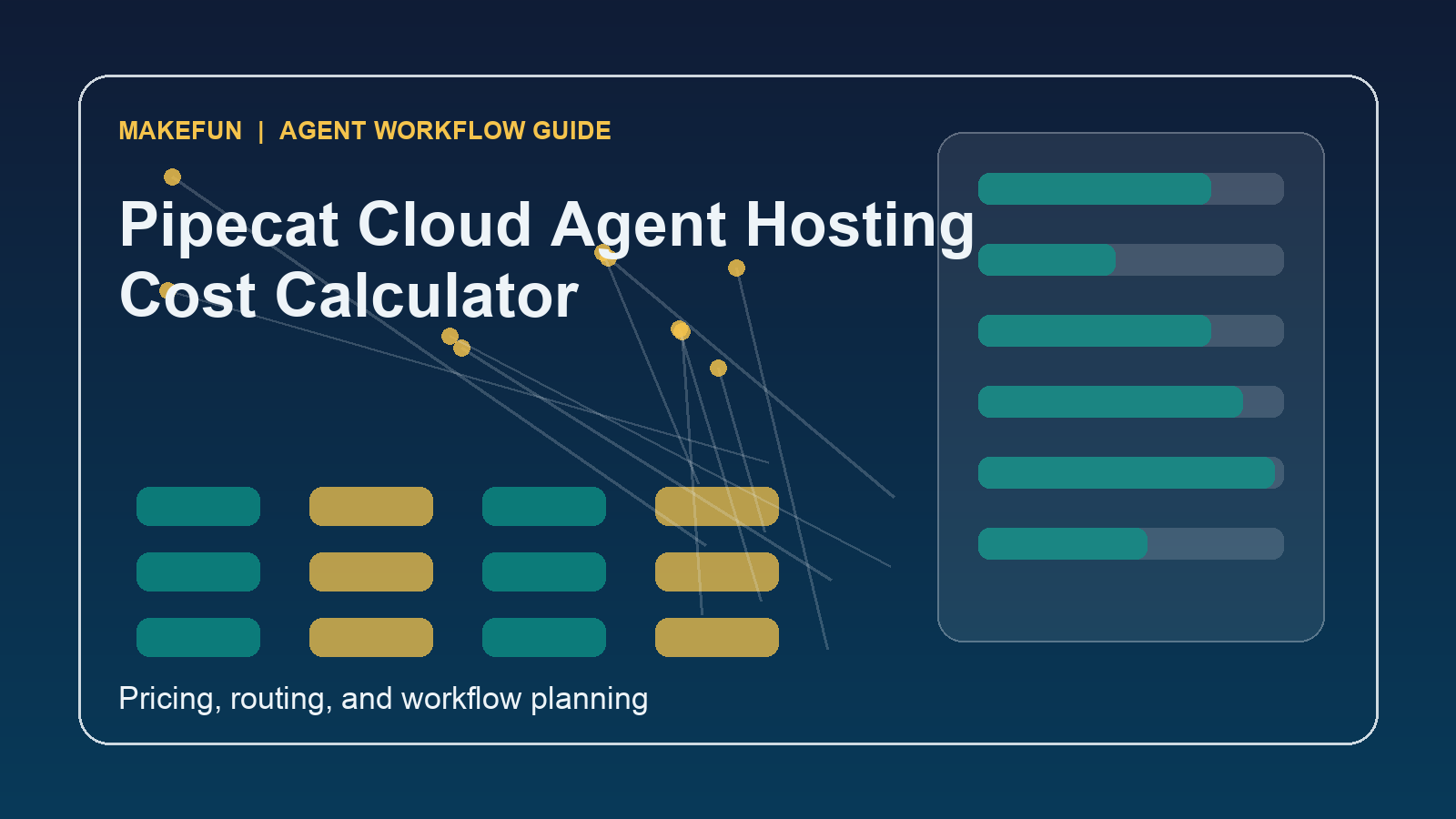
Pipecat Cloud pricing is not just a per-minute model bill. A production voice or video agent can include Pipecat agent hosting, Daily WebRTC transport, SIP or PSTN phone minutes, Krisp VIVA noise suppression, recording, storage, and externally billed LLM, STT, and TTS providers. This calculator separates those layers so teams can compare Pipecat Cloud with LiveKit, Vapi, and a managed Makefun avatar workflow on the same unit: the cost of a completed session.
The official Daily Pipecat Cloud pricing page was checked during this publication run on 2026-05-30. Use Daily as the source of truth before buying capacity; this article is a planning worksheet for support, avatar, browser video-agent, and appointment-call teams.
Pipecat Cloud billing map
| Layer | Official rate checked | What it covers | Planning note |
|---|---|---|---|
| agent-1x active hosting | $0.01/min | Voice-agent container with 0.5 vCPU and 1 GB memory. | Use for browser or phone voice agents that do not need heavier video processing. |
| agent-2x active hosting | $0.02/min | Voice and video-agent container with 1 vCPU and 2 GB memory. | Use when video, heavier tools, or more processing headroom is needed. |
| agent-3x active hosting | $0.03/min | Voice/video plus additional processing with 1.5 vCPU and 3 GB memory. | Reserve for more complex pipelines instead of defaulting every pilot to it. |
| reserved hosting | $0.0005, $0.0010, or $0.0015/min by profile | Warm reserved agents controlled by deployment capacity settings. | Useful for low-latency launches, but it creates idle-time spend. |
| Daily WebRTC voice | $0.001/min, free for 1:1 voice sessions on Pipecat Cloud | Integrated browser voice transport. | Confirm whether the current workflow qualifies for the free 1:1 Pipecat Cloud treatment. |
| Daily WebRTC voice and video | $0.004 per participant minute | Multimodal browser sessions. | Video-agent cost grows with participants and duration, not only agent minutes. |
| SIP / PSTN | $0.005/min for SIP, $0.018/min for PSTN | Dial-in and dial-out phone transport. | Transfers can keep the original call anchored, so budget post-transfer minutes. |
| SIP REFER | $0.20 per event | Transfer to a third-party SIP number. | Compare event fees with anchored transfer minutes. |
| Krisp VIVA | Free through 10k active session minutes; then $0.0015/min | Noise and false-interruption reduction. | Important for phone support and noisy creator environments. |
| Recording and storage | $0.005/min audio, $0.01349/min audio/video, $0.003/min storage | Cloud recording and retention. | Only record sessions that need QA, compliance, or training review. |
Scenario calculator
| Scenario | Pipecat/Daily line items to estimate | External line items | Decision rule |
|---|---|---|---|
| 100 two-minute support calls | agent-1x active minutes, WebRTC voice or SIP/PSTN minutes, VIVA if above the free tier. | LLM tokens, STT minutes, TTS characters or minutes, CRM handoff. | Use the smallest agent profile and compare browser voice against phone transport. |
| 50 five-minute browser video-agent sessions | agent-2x or agent-3x minutes plus WebRTC video participant minutes. | Vision/model cost, STT/TTS, moderation, and support review. | Estimate participant minutes separately from agent container minutes. |
| 25 PSTN appointment calls | agent-1x hosting, PSTN minutes, SIP REFER or anchored transfer minutes. | Calendar API, LLM, STT/TTS, human escalation. | Transfer behavior can be the hidden cost driver. |
| 20 recorded QA calls | agent hosting, transport, audio or audio/video recording, and storage. | Transcript analysis, evaluator model calls, retention review. | Record a controlled sample instead of every low-risk session. |
Pipecat Cloud versus LiveKit and Vapi
Pipecat Cloud is attractive when a team wants an open-source Pipecat stack with managed deployment and Daily transport. LiveKit pricing is a same-use comparison for real-time agent sessions, WebRTC, telephony, inference, and observability. Vapi pricing is a same-use comparison for managed voice-agent operations. Do not compare headline rates alone; normalize by the same call length, participant count, phone path, recording policy, model provider, and support handoff.
The Daily GA announcement supports the managed-deployment angle, while Pipecat’s Pipecat Cloud docs and Daily WebRTC guide explain deployment and transport boundaries. Treat those docs as architecture evidence, not a replacement for the live pricing page.
Hidden cost drivers
- Active versus reserved minutes: active sessions bill when agents are handling users; reserved agents reduce cold starts but add idle spend.
- Profile size: moving from agent-1x to agent-3x can triple hosting cost before transport or model spend.
- Transport path: browser voice, browser video, SIP, PSTN, and Twilio bring different billing units.
- Transfers: anchored calls can keep minutes running after handoff, while SIP REFER adds an event fee.
- Recording: QA and compliance recording add per-minute processing and storage costs.
- Provider keys: LLM, STT, TTS, and telephony providers may be billed outside Pipecat Cloud.
- Retry and escalation: failed starts, long troubleshooting calls, and human fallback change cost per resolved issue.
Workflow template
- Classify the session as browser voice, browser video, SIP/PSTN, or recorded QA.
- Choose the smallest Pipecat profile that can run the pipeline reliably.
- Estimate active minutes, reserved minutes, participants, phone minutes, transfer behavior, and recording retention.
- Add externally billed LLM, STT, TTS, observability, and support-escalation costs.
- Run a pilot, export actual durations and retry rates, then compare Pipecat Cloud against LiveKit, Vapi, and Makefun workflow routing.
Makefun workflow fit
Makefun readers usually care about final workflow cost, not only infrastructure cost. Use this worksheet beside adjacent Makefun planning pages for LiveKit agent costs, GPT-Realtime voice agents, Gemini Live session costs, Cartesia Sonic and Ink, Runway Characters avatars, and the Makefun AI Avatar API. The best route depends on whether the team needs direct infrastructure control, integrated avatar/video workflow, or managed production handoff.
FAQ
Is Pipecat Cloud pricing the full cost of a voice agent?
No. Pipecat Cloud can cover hosting and selected Daily transport or service lines, but LLM, STT, TTS, telephony-provider, monitoring, and human-escalation costs may sit outside that bill.
When should a team reserve Pipecat agents?
Reserve agents when low-latency starts matter enough to justify idle warm-capacity spend. For uncertain pilots, start with active-minute planning and add reserves after real traffic data.
Can Pipecat Cloud be compared directly with LiveKit or Vapi?
Yes, but only with matched assumptions. Compare the same session count, call length, transport path, recording policy, model stack, and support handoff. A headline per-minute rate is not enough.