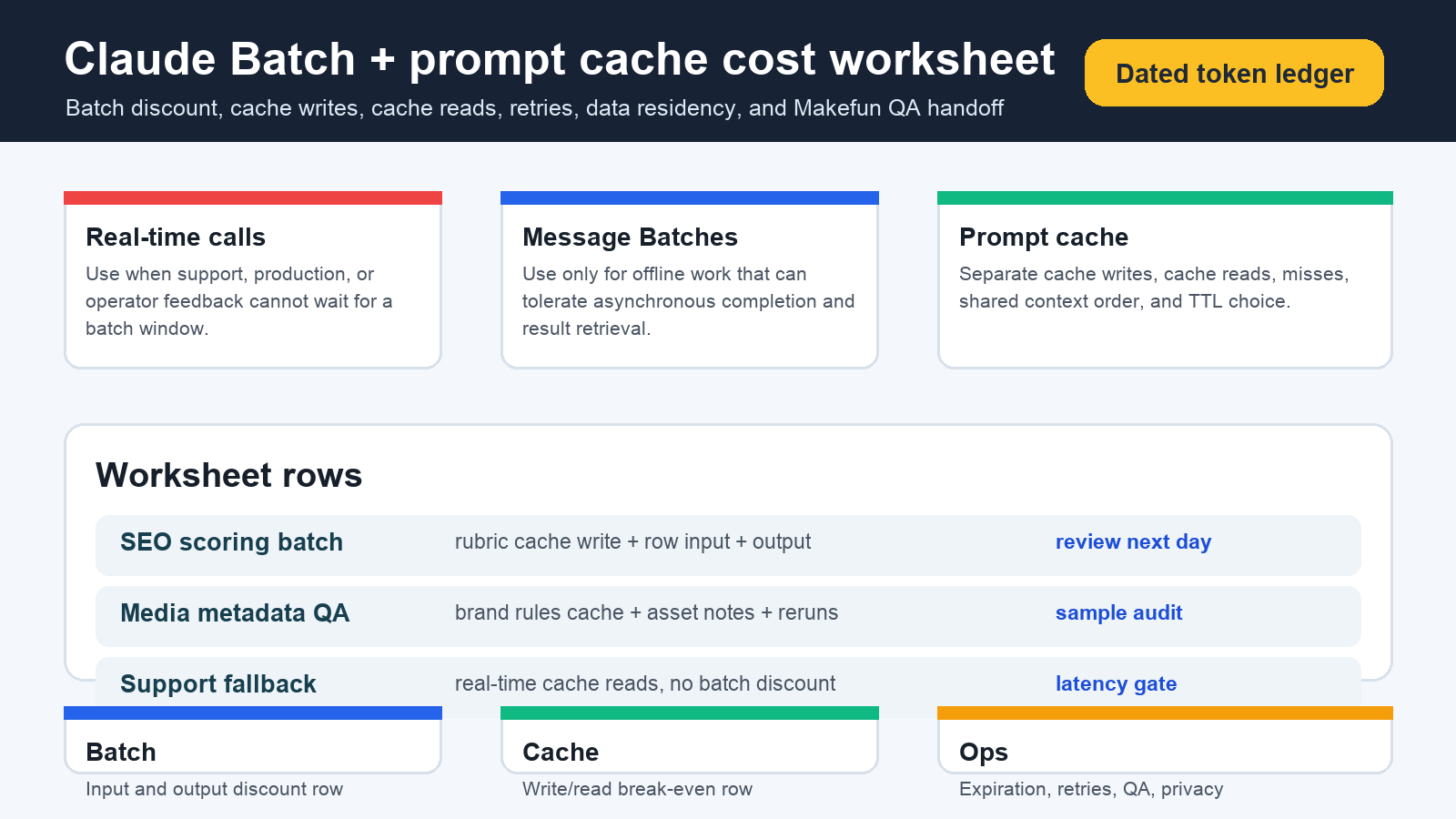
As of June 4, 2026, Claude Batch API pricing should be modeled as a dated token ledger plus a latency gate. The useful worksheet separates batch input, batch output, prompt-cache writes, prompt-cache reads, uncached row-level input, output tokens, retries, expired rows, result retrieval, data residency, tool or search charges, and human QA. Refresh Anthropic pricing before using this for procurement.
Publication-time source refresh used the official Claude API pricing, Batch processing, Prompt caching, and Message Batches API announcement pages. The current pricing docs are the controlling source for rates and eligibility; the launch post is historical context where current docs differ.
Claude Batch API pricing source snapshot
| Cost row | What to model | Budget caveat |
|---|---|---|
| Base model tokens | Selected Claude model input and output token rates from the current pricing page. | Model names, rates, and availability can change; keep a source date in the worksheet. |
| Batch API | Input and output tokens for work that can wait for asynchronous completion. | The Batch API discount applies to eligible batch input and output, not to every surrounding operational cost. |
| Prompt cache write | Shared context written to cache, including 5-minute and 1-hour cache duration choices. | Write cost can outweigh savings if the shared context is reused too few times. |
| Prompt cache read | Repeated shared context read from cache across rows or repeated requests. | Cache hits are best-effort in batch jobs and depend on stable prefixes, ordering, and cache lifetime. |
| Operations | Retries, failures, cancellations, expired batches, polling, JSONL parsing, reviewer time, and privacy review. | These rows often decide cost per approved output more than nominal token price. |
Batch versus real-time latency gate
Start with latency. If a support, production, or operator-facing workflow needs immediate output, the Batch API is the wrong route even when the nominal token discount looks attractive. Use real-time Claude calls and model prompt-cache write/read economics instead. If the job can wait for asynchronous completion, batch input and output rows become relevant, and result retrieval plus review labor should be added to the same worksheet.
Prompt cache break-even rows
Prompt caching changes the input ledger. Count the shared rubric, examples, policy text, or source bundle as a cache-write row. Count each reused prefix as a cache-read row. Then add uncached per-row input and output tokens. The break-even point depends on cache duration, cache-hit count, changed tools or documents, request ordering, and whether the same context is reused enough before it expires.
Three scenario calculator
| Scenario | Claude route | Rows to keep separate |
|---|---|---|
| Makefun SEO scoring batch | Message Batches API plus prompt caching when next-day review is acceptable. | Shared rubric cache write, cache reads per candidate, source snippets, output tokens, failed rows, reviewer sample rate, and duplicate-check handoff. |
| Media metadata and alt-text QA | Batch for offline image or transcript metadata QA; real-time calls for interactive media work. | Brand-rule cache write, asset notes, output tokens, reruns, human sample review, rights review, and Makefun media handoff. |
| Support or production fallback | Real-time Messages API with prompt caching; no Batch API discount when latency is mandatory. | Shared policy cache write, cache read hits, ticket tokens, output tokens, tool/search usage, data residency, escalation, and privacy review. |
Same-use comparison rows
Compare Claude Batch only against the same task mix and latency requirement. For adjacent Makefun planning, use current 200-status internal references such as Claude Agent SDK pricing, GitHub Copilot AI Credits, AWS Bedrock AgentCore cost governance, Comfy Cloud API workflow costs, Pinecone Assistant context token planning, and Hugging Face Inference Providers routing. Do not claim Claude Batch is cheaper, faster, safer, or better than OpenAI Batch, Gemini Batch, Fireworks, Together, Bedrock, Vertex, real-time Claude calls, or Makefun-owned scripts without fresh same-scenario evidence.
Makefun workflow handoff
For Makefun-style operations, add rows for candidate scoring, duplicate checks, source-refresh extraction, prompt tests, media metadata, support tagging, transcript classification, eval QA, and reviewer handoff. Batch and caching can reduce token waste for repeated offline work, but the final budget still needs source verification, failed-row handling, privacy review, and human approval before publication or customer-facing output.
Risks and caveats
- Refresh Anthropic pricing, Batch processing, Prompt caching, data residency, fast mode, and tool/search details before quoting a budget.
- Keep batch discount rows separate from cache write/read rows.
- Count cache misses, changed document order, invalidated prefixes, partial failures, expiration, retries, polling, and result parsing.
- Keep Bedrock and Vertex Claude routes in separate comparison rows because partner cloud behavior and billing can differ.
- Avoid cheapest, fastest, best, safer, or better claims unless each same-scenario row has current source evidence.
FAQ
When does Claude Batch API pricing beat real-time Claude calls?
Only when the workload can wait for asynchronous completion and the batch discount still wins after retries, result retrieval, review labor, and any missed cache savings are included.
When does prompt caching pay off?
Prompt caching pays off when the same shared context is reused enough times before the cache expires. A one-off large prompt can be more expensive after a cache write if there are too few reads.
Why use a 1-hour cache row for batch jobs?
Anthropic’s batch-processing docs recommend considering the 1-hour cache duration for batch jobs because asynchronous processing can exceed five minutes. Model that as a separate write-cost row, not as a free setting.