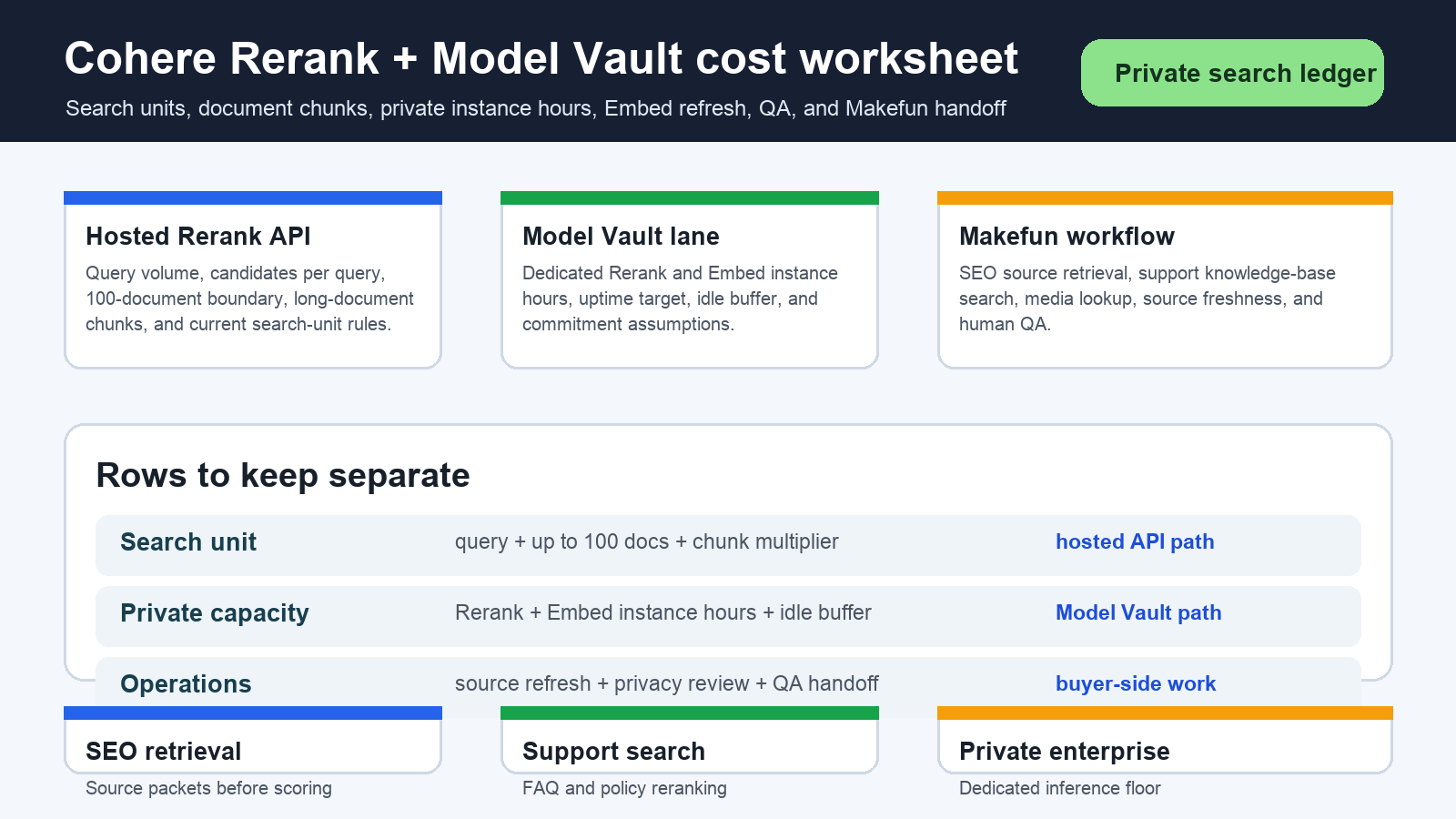
As of June 4, 2026, Cohere Rerank pricing should be modeled as a search-unit and document-chunking problem for hosted API usage, then as a private instance-hour capacity problem when Model Vault is selected for dedicated Rerank and Embed deployment. A useful worksheet separates monthly queries, candidate documents, long-document chunks, rerank depth, Embed indexing or refresh, Model Vault Rerank and Embed hours, idle capacity, privacy review, source freshness, and human QA.
Publication-time source refresh used official Cohere pricing, Model Vault, Rerank overview, Embeddings, and pricing-explainer docs. Cohere’s current pricing and docs remain the source of truth because search-unit definitions, document chunking, model availability, Model Vault examples, and commitment terms can change.
Cohere Rerank pricing source snapshot
| Cost row | What to model | Budget caveat |
|---|---|---|
| Hosted Rerank search unit | Monthly queries, up to 100 candidate documents per query, selected current Rerank model, and long-document chunks. | Do not treat every user query as one simple unit if long documents are split or candidate depth grows. |
| Embed indexing and refresh | Document indexing, query embeddings, refresh frequency, stale source cleanup, and input type choices for retrieval. | Embedding refresh and deduplication can dominate private search operations even when rerank calls look small. |
| Model Vault Rerank | Dedicated Rerank instance hours, model tier, uptime target, idle buffer, and monthly or annual commitment assumptions. | Private capacity creates a fixed floor, so low traffic still needs an instance-hour row. |
| Model Vault Embed | Dedicated Embed Small or Medium instance hours when private embeddings are required. | Keep Embed capacity separate from Rerank capacity so the worksheet does not hide indexing spend. |
| Buyer operations | Privacy review, source verification, monitoring, incident response, human QA, and Makefun workflow handoff. | These are not solved by the model price and should be counted before making an economics claim. |
Hosted API versus Model Vault break-even
Start with the hosted Rerank API when search volume is moderate, data-handling policy allows hosted inference, and the team wants usage to track query volume. Move the worksheet to Model Vault only when privacy, predictable volume, latency, dedicated capacity, or procurement requirements justify a private deployment row. Model Vault can be the right control choice, but it should not be presented as automatically cheaper, safer, more private, or more accurate without current same-scenario evidence.
Search-unit and document-chunking rows
The first hosted row is query count. The second row is candidate documents per query. The third is chunking: long documents can become multiple countable pieces, so policy pages, product docs, changelogs, and long help-center articles need a multiplier. The fourth row is rerank depth after first-stage retrieval. Those rows make a small support search workflow look different from a large internal retrieval system.
Three scenario calculator
| Scenario | Cohere rows | Decision row |
|---|---|---|
| Makefun SEO source retrieval | Monthly source-retrieval queries, official docs per query, chunk multiplier, current Rerank model, Embed refresh if used, duplicate cleanup, and reviewer minutes. | Budget cost per verified source packet, not just API calls. |
| Support knowledge-base reranking | FAQ and billing-policy queries, candidate depth, long policy chunks, Embed indexing, escalation rate, latency target, and answer QA. | Hosted Rerank often fits moderate volume; Model Vault belongs in the worksheet when dedicated inference is a hard requirement. |
| Private enterprise search | Model Vault Rerank instance hours, Embed instance hours, uptime target, idle capacity, peak traffic, access review, monitoring, and incident response. | Show the fixed private-capacity floor before comparing against hosted APIs or self-hosted rerankers. |
Same-use comparison rows
Compare Cohere only against the same workload shape. For adjacent Makefun planning, use currently live references such as Cohere Command A+ workflow coverage, Pinecone Assistant context-token planning, Hugging Face Inference Providers routing, Airtable Field Agents credit automation, Runpod Serverless worker cost planning, and AWS Bedrock AgentCore governance. Do not claim Cohere is cheapest, best, safer, more compliant, or more accurate than Pinecone, Cloudflare AI Search, Algolia, Elastic, Voyage, Jina, OpenAI embeddings, local rerankers, or Makefun-owned workflows without fresh same-scenario evidence.
Makefun handoff worksheet
For Makefun-style operations, add rows for SEO source discovery, support answer routing, template lookup, media-asset search, internal knowledge-base QA, source freshness, duplicate detection, and agent escalation. Cohere can supply reranking or private inference capacity, but the final operating budget still needs retrieval policy, failed-source cleanup, privacy review, and human approval before content or support answers become customer-facing.
Risks and caveats
- Refresh official Cohere pricing, Rerank docs, Embed docs, Model Vault docs, model availability, search-unit rules, chunking behavior, and commitment terms before quoting a budget.
- Keep hosted search-unit rows separate from Model Vault instance-hour rows.
- Count long-document chunks, index refreshes, stale-source cleanup, duplicate removal, failed searches, and reviewer time.
- Treat privacy, compliance, uptime, and data-handling language as requirements to verify, not as unsupported promises.
- Avoid cheapest, best, safer, more private, more compliant, or guaranteed-accuracy claims unless every same-scenario row has current source evidence.
FAQ
What is a Cohere Rerank search unit?
Use Cohere’s current pricing page as the source of truth. The worksheet should model the query, candidate documents, and long-document chunking instead of assuming every request has the same cost shape.
When does Model Vault change the math?
Model Vault changes the math when dedicated private inference, predictable capacity, latency planning, or procurement controls matter enough to justify instance-hour rows for Rerank and possibly Embed.
Should Embed be in the same calculator?
Yes, when the workflow uses Cohere embeddings for first-stage retrieval, indexing, or refresh. Keep Embed indexing and refresh separate from Rerank so the search budget does not hide private capacity or maintenance work.