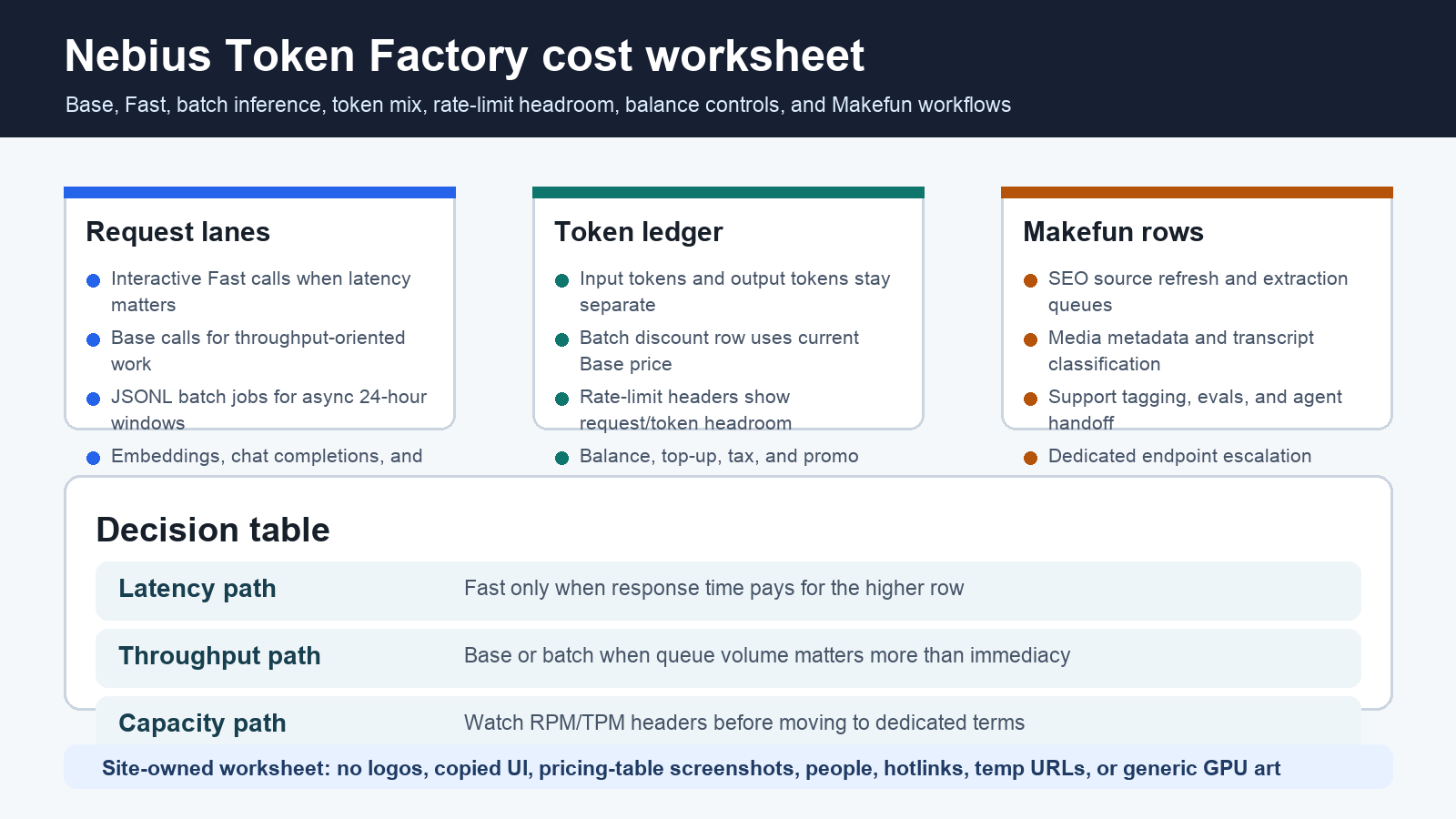
As of June 4, 2026, Nebius Token Factory cost planning starts by separating interactive and batch workloads. Use Fast only when latency matters, Base for throughput-oriented requests, and batch inference for async jobs that can wait up to the 24-hour window; then check rate-limit headers, balance and top-up rules, and downstream Makefun media or support costs before comparing providers.
Publication-time checks used the official Nebius Token Factory pricing page, batch inference docs, rate-limit docs, inference overview, billing docs, and Token Factory service page. Refresh those pages before procurement because model availability, Fast/Base rows, batch terms, rate limits, and billing controls can change.
Nebius Token Factory pricing source snapshot
| Row | June 4, 2026 source value | How to use it |
|---|---|---|
| Base and Fast flavors | The official overview says Base and Fast produce the same outputs but differ in pricing, latency, and optimizations; Fast is selected by appending -fast to the model name when that flavor is available. | Use Fast for latency-sensitive paths only when the current model row supports it; do not infer a Fast price from a Base row. |
| gpt-oss-120b Base anchor | The rendered pricing page showed openai/gpt-oss-120b Base at $0.15 input and $0.60 output per 1M tokens during the publication refresh. | Use as one same-model worksheet anchor, not as a universal Nebius price. |
| Batch inference | Official docs describe async JSONL batch inference for chat completions and embeddings, normally within a 24-hour window, billed at 50% of Base real-time model pricing and rounded up to the nearest cent. | Use batch only for jobs that tolerate async completion; keep retries, source fetch, QA, storage, and media/API work outside token pricing. |
| Rate limits | Nebius docs describe dynamic request and token limits, rolling 15-minute scale windows, hard ceilings, response headers, and enterprise or dedicated-capacity paths. | Model RPM/TPM headroom before promising throughput. |
| Billing controls | Billing docs describe balance requirements, bank-card top-ups, automatic top-ups, tax handling, promo-code credits, and negative-balance stop risk. | Use balance and top-up thresholds as operating rows, not only finance rows. |
Cost formula
A practical worksheet is: monthly_cost = input_tokens_m * current_input_rate + output_tokens_m * current_output_rate + flavor_or_batch_multiplier + retry_tokens + source_fetch + media_API_storage + human_QA. Keep input and output tokens separate, split Fast from Base, and split interactive calls from batch-eligible work.
Worksheet 1: SEO source-refresh batch
For 250,000 source or URL classifications that can finish asynchronously, start with average input tokens, average output tokens, selected model, batch eligibility, and retry rate. A gpt-oss-120b Base planning row uses $0.15 input and $0.60 output per 1M tokens from the refresh, while a batch planning row applies the documented 50% Base-price rule. The article should still count crawler fetches, storage, evidence capture, and reviewer time outside the Nebius token bill.
Worksheet 2: media metadata pipeline
For media metadata and transcript classification, split interactive previews from nightly tagging. Fast can belong in the preview lane when user-facing latency matters. Base or batch belongs in the nightly lane when throughput and reviewability matter. The useful decision is not Nebius versus every provider; it is which workflow lane can tolerate latency, which lane needs response-time guarantees, and which lane is limited by token or request headers.
Worksheet 3: support tagging and evals
For support transcripts, creator tickets, and eval runs, model monthly transcript count, input/output token mix, burst windows, current request and token headroom, 429 rate, balance threshold, auto top-up amount, and dedicated endpoint trigger. A low token row does not help if the workflow hits negative balance, a hard rate ceiling, or an unsupported model flavor.
Same-unit alternatives
Compare by workload unit rather than by generic winner claims. Hugging Face Inference Providers routed request cost calculator is useful for marketplace routing; Claude Batch API prompt cache cost calculator and Gemini Batch API context cache cost calculator cover provider-owned batch rows; Runpod Serverless GPU worker idle timeout cost calculator and Cerebrium serverless GPU cold start cost calculator cover GPU/serverless control; Brave Search API LLM Context Answers cost calculator covers source-refresh context spend.
Cost-control checklist
- Refresh the rendered Nebius price table before using exact model rows.
- Do not infer Fast prices where a Fast model row is unavailable.
- Use batch only for jobs that can wait for the async completion window.
- Track request and token rate-limit headers before scaling production queues.
- Set balance and auto top-up thresholds before high-volume runs.
- Keep source-fetch, media storage, retries, QA, and human review outside token pricing.
Risks and caveats
Avoid claims that Nebius is cheapest, best, fastest, safer, more reliable, or more secure than Fireworks, Together AI, OpenRouter, Hugging Face, Gemini Batch, Claude Batch, Runpod, Cerebrium, or Makefun/MakeFun routes unless current same-scenario evidence supports the exact wording. Treat pricing, model availability, Fast rows, rate limits, billing rules, enterprise terms, and dedicated endpoints as volatile.
FAQ
What is the first row in a Nebius Token Factory calculator?
Start with model ID, Base or Fast flavor, input tokens, output tokens, interactive request count, batch-eligible request count, completion-window tolerance, and rate-limit headroom.
When does batch inference fit?
Batch fits async jobs such as source refresh, metadata tagging, transcript classification, and eval runs that can wait for the documented completion window. It should not be used for user-facing latency paths.
Should Fast be the default?
No. Fast belongs where latency changes the product outcome. Base or batch can be better for throughput-oriented work, but only after refreshing current model rows and checking workflow constraints.