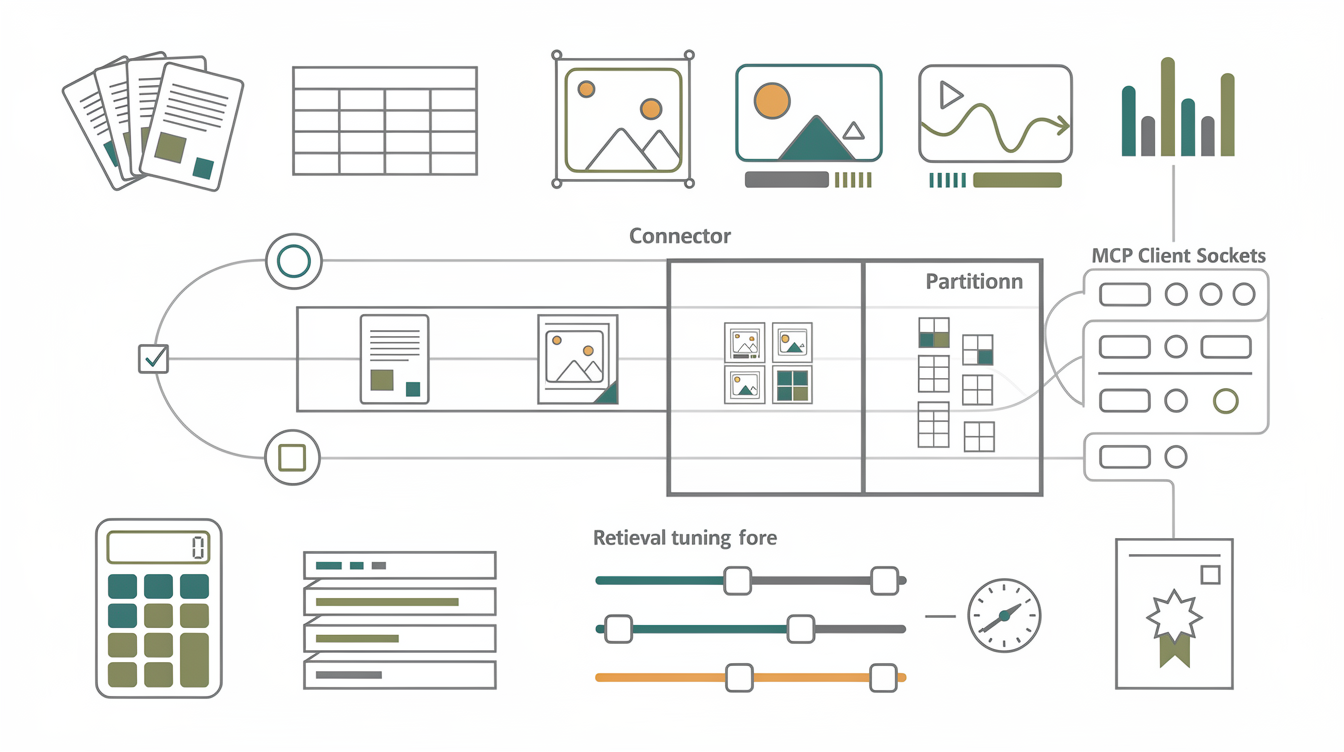
As of June 5, 2026, a Ragie pricing calculator should separate the monthly plan floor from page processing, page storage, audio and video processing, connector add-ons, retrieval tuning, partitioned MCP access, and downstream Makefun review. This article uses publication-time checks of official Ragie pricing and docs, then keeps source refresh, support knowledge-base retrieval, media transcript indexing, and human QA as separate worksheet rows.
The short answer: do not treat managed RAG as one token price. Model included pages, fast pages, hi-res pages, stored pages, audio minutes, video minutes, streaming or media storage, embedded connectors, retrieval settings, MCP clients, webhook handling, and editor verification separately before choosing Ragie over a crawler, vector database, assistant file store, or self-hosted RAG pipeline.
Ragie pricing source snapshot
Publication-time checks used the official Ragie pricing page, connections docs, retrieval guide, Retrieve API reference, MCP overview, and import mode docs. Pricing, included allowances, connector language, streaming units, and feature availability can change, so refresh those pages before turning the worksheet into a quote.
| Row | Current planning input | Makefun caveat |
|---|---|---|
| Plans | Developer free, Starter listed at $100/month, Pro listed at $500/month, and Enterprise custom on the checked pricing page. | Use the public rows only for self-serve planning; Enterprise and custom contracts need direct confirmation. |
| Page processing | Starter includes 10,000 total page processing and Pro includes 60,000 total page processing; additional fast pages are listed at $0.02/page and hi-res pages at $0.05/page. | Keep fast and hi-res ingest separate, especially for documents with tables, forms, charts, screenshots, or images. |
| Search and storage | Paid self-serve rows list search and storage at $0.002 per page per month. | Separate one-time processing from monthly storage so old source libraries do not hide recurring cost. |
| Media rows | The checked page lists audio processing at $0.0067/min, video processing at $0.025/min, and media storage at $0.12/GB/month. | Keep transcript creation, downstream LLM summaries, review, and CDN/storage outside the Ragie media processing row. |
| Connectors | The checked pricing page states the first embedded connector is free and additional embedded connectors are $250/connector/month. | Connector fees do not remove permission review, sync delay, retry, webhook, stale-source, or support escalation work. |
| Retrieval and MCP | Docs describe retrieval controls such as top_k, filters, rerank, max_chunks_per_document, partition, recency_bias, plus partition-scoped MCP retrieval. | Do not turn retrieval settings into quality, security, privacy, or compliance guarantees. Test per corpus and sample outputs. |
Cost formula for managed RAG planning
monthly_cost = plan_base_fee + page_processing_overage + stored_pages * page_storage_rate + audio_minutes * audio_processing_rate + video_minutes * video_processing_rate + media_storage_gb_month + connector_addons + webhook_retry_ops + retrieval_QA + downstream_LLM_tokens + editor_source_verification_time
The formula deliberately mixes vendor billing rows with Makefun labor rows. That is useful because a Ragie corpus can look inexpensive at the ingest line while still creating manual review, stale-page cleanup, permission mapping, and source-licensing work before an article or support answer can rely on it.
Worksheet 1: Makefun official-source library worksheet
A Makefun SEO team keeps provider pricing pages, docs, changelogs, screenshots-to-text notes, and publication evidence searchable for source refresh before publishing calculator pages.
Formula: monthly_cost = plan_base_fee + max(total_pages - included_pages, 0) * selected_page_processing_rate + stored_pages * page_storage_rate + retrieval_quality_QA + downstream_llm_tokens + editor_source_verification_time
- Use 25,000 source pages as the same-unit document library row: official docs, pricing pages, changelogs, support snippets, and older publication evidence.
- Current Ragie pricing shows Developer free, Starter at $100/month, Pro at $500/month, and Enterprise custom; Publisher must refresh the pricing page immediately before publication.
- Current Ragie pricing shows Starter includes 10,000 total page processing and Pro includes 60,000 total page processing; additional fast pages are listed at $0.02/page and hi-res pages at $0.05/page on paid self-serve tiers.
- Current Ragie pricing shows search and storage at $0.002 per page per month on paid self-serve tiers; keep storage separate from one-time processing.
- Hi-res should be used only for documents/images that need OCR/layout extraction, tables, charts, forms, or images; do not average fast and hi-res rows into one headline price.
- Downstream LLM summaries, editorial verification, source licensing review, stale-page cleanup, and WordPress publication handoff remain outside Ragie billing.
Takeaway: The article should show that managed RAG cost is not one token price: plan floor, page processing mode, page storage, retrieval tuning, and editorial verification all need separate rows.
Worksheet 2: Support knowledge base and connector sync worksheet
A support team ingests Notion, Google Drive, Slack, Intercom, Freshdesk, Jira, HubSpot, product docs, and internal policy pages, then exposes scoped retrieval to support and editorial agents.
Formula: workflow_cost = plan_base_fee + connector_addons + page_processing_overage + page_storage + sync_retry_webhook_ops + permission_review + support_QA + downstream_answer_llm_cost
- Use 8 connected knowledge sources and 40,000 processed pages as the same-unit connector row.
- Current Ragie pricing states the first embedded connector is free and additional embedded connectors are $250 per connector per month; Publisher must refresh the exact add-on wording before publication.
- Ragie connections docs describe external connectors, connection limits, metadata overlays, and behavior when a connection reaches a limit; model webhook/retry handling separately from billing rows.
- Connector sync delay, deleted documents, permission drift, stale synced copies, and PII review are operational costs even when the connector fee is clear.
- Partition and metadata design should limit support-agent scope instead of exposing every document to every MCP client.
- Manual QA should sample retrieved answers before publishing pricing, compliance, support, or refund language from a managed corpus.
Takeaway: Connector economics are as much governance as ingestion cost: one free connector does not remove sync, permission, webhook, and QA work.
Worksheet 3: Audio video transcript retrieval and MCP agent worksheet
A creator-support or product team indexes webinars, product demos, support recordings, and tutorial clips, then gives Claude, IDE, support, and Makefun editorial agents partition-scoped MCP retrieval.
Formula: media_rag_cost = audio_minutes * audio_processing_rate + video_minutes * video_processing_rate + streaming_usage + media_storage_gb_month * media_storage_rate + retrieval_top_k_llm_tokens + mcp_partition_QA
- Use 600 audio minutes, 240 video minutes, 20 GB media storage, and 4 partitioned MCP clients as the same-unit media row.
- Current Ragie pricing shows audio processing at $0.0067/min, video processing at $0.025/min, media storage at $0.12/GB/month, and streaming rows that must be refreshed because the page exposes both MB and minute wording in different places.
- Current Ragie retrieval docs call out top_k and rerank as tuning choices that can increase latency and downstream LLM token usage; keep retrieval settings separate from ingest cost.
- Current Retrieve API reference includes query, top_k, filters, rerank, max_chunks_per_document, partition, and recency_bias parameters; article claims should stay at workflow level unless Publisher rechecks exact API fields.
- Current Ragie MCP docs describe scoped Retrieve access through partition-specific MCP servers; model setup, key handling, and access review as governance rows.
- Human review is mandatory before using retrieved media transcripts as factual source evidence in Makefun posts.
Takeaway: Ragie can turn media into retrievable context, but the durable Makefun table must split processing minutes, storage, streaming, retrieval settings, MCP scope, and human verification.
Decision table: Ragie versus adjacent options
| Alternative | Use it when | Do not claim |
|---|---|---|
| Pinecone Assistant | You want assistant-style file ingestion, context token, chat, and evaluation-token planning. | That it is a direct page-processing replacement for every Ragie connector or media workflow. |
| Cohere Rerank plus vector database | You already own parsing, embeddings, storage, access control, and retrieval orchestration. | That rerank pricing alone represents the full managed RAG bill. |
| Brave Search, Firecrawl, Tavily, Parallel, or MediaLayer | You need source discovery, crawl, search, or media/search acquisition before building a corpus. | That source acquisition is the same as persistent retrieval storage and MCP governance. |
| LlamaIndex Cloud, Mem0, Mastra, LangSmith, or self-hosted RAG | You need a different managed RAG, memory, tracing, workflow, or internal-infrastructure route. | That any alternative is cheaper, better, more accurate, more private, or more secure without same-scenario current evidence. |
Internal comparisons for Makefun readers
Use these Makefun pages as adjacent cost lanes, not as same-intent duplicates: Pinecone Assistant context token RAG cost calculator, Cohere Rerank Model Vault private search cost calculator, Brave Search API LLM context answers cost calculator, MediaLayer Match API search processing cost calculator, Mistral Search Toolkit AI retrieval workflow.
Cost-control checklist
- Cap connector scope before the first sync and document which systems feed each partition.
- Split fast and hi-res page processing instead of averaging them into one headline page rate.
- Keep stored pages, media storage, audio minutes, video minutes, and streaming rows separate.
- Tune top_k, rerank, filters, max_chunks_per_document, recency_bias, and partitions against latency and downstream LLM context cost.
- Use MCP partitioning as an access-boundary workflow, then review keys, clients, and sampled retrieved answers.
- Refresh official pricing and docs before publishing any numeric claim or comparing a paid provider row.
Publisher checklist and caveats
The Publisher gate checked target URL, WordPress search, sitemap overlap, official Ragie source reachability, five live internal links, and a unique permanent featured image before creating this post. The article avoids cheapest, best, accuracy, security, privacy, reliability, and compliance winner claims because those require current same-scenario evidence and customer-specific testing.
Official source links used in this publication: Ragie Pricing, Ragie Connections Overview, Ragie Retrievals Guide, Ragie Retrieve API Reference, Ragie MCP Overview, Ragie Import Mode, Pinecone Assistant Pricing and Limits, Cohere Pricing.
FAQ
Is Ragie priced only by pages? No. Page processing matters, but storage, media minutes, connector add-ons, retrieval tuning, MCP governance, downstream LLM tokens, and human review can change the real monthly budget.
Can the first free connector make a support knowledge base free? No. Even if one connector is included, sync delay, permission drift, stale documents, webhook retries, and QA remain operational costs.
Should Makefun use Ragie for pricing-source refresh? It can be a useful managed corpus when official pages, docs, changelogs, and media transcripts need retrieval, but publication-time verification still has to check the current source page before any claim goes live.