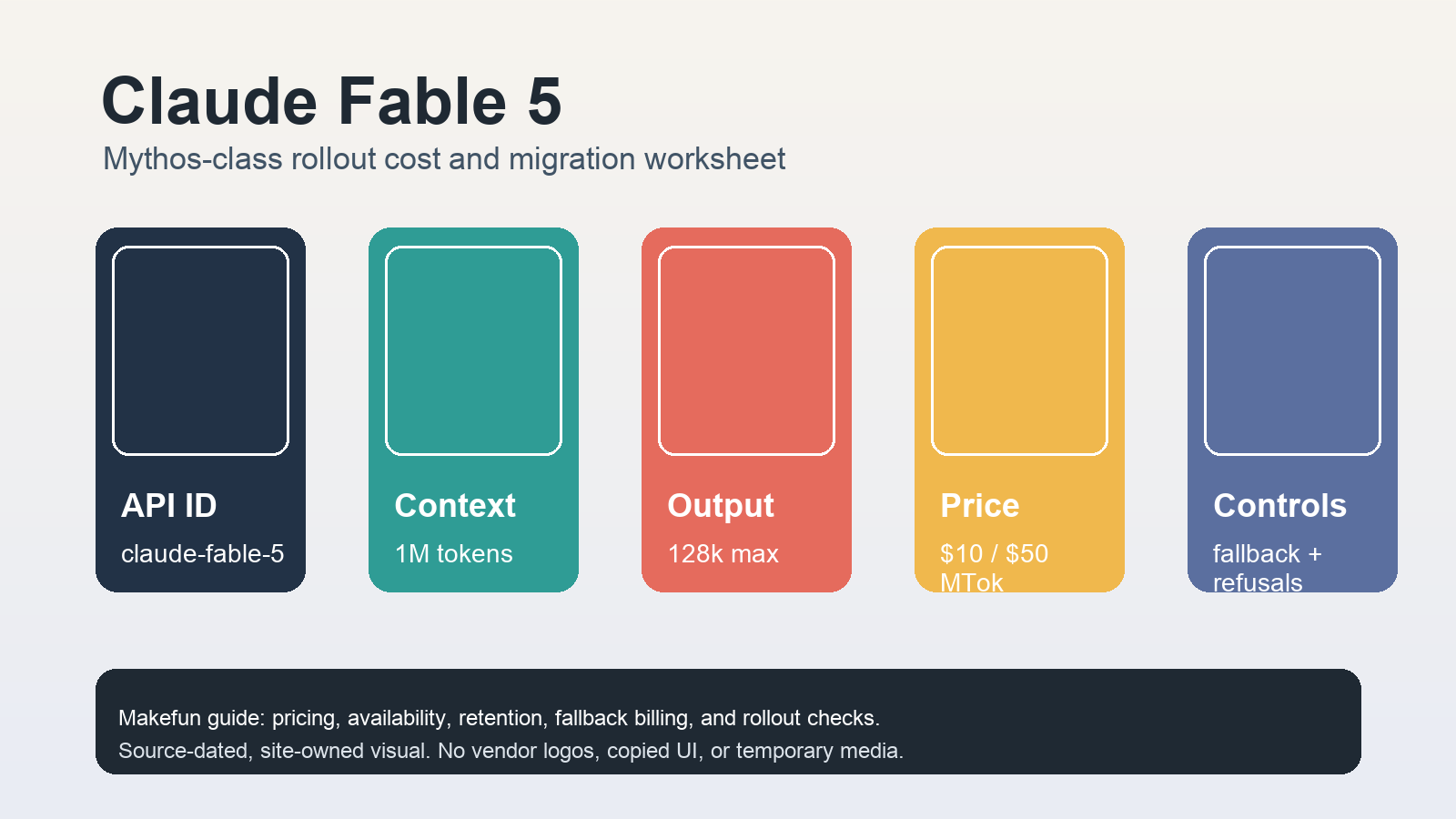
Claude Fable 5 is now a real Anthropic model, not just a Mythos rumor. Anthropic lists claude-fable-5 as its most capable widely released Claude model, available beginning June 9, 2026, with a 1M-token context window, up to 128k output tokens, adaptive thinking always on, and pricing at $10 per million input tokens and $50 per million output tokens.
For Makefun teams, the immediate question is not whether to switch every workflow. The practical question is where a Mythos-class model changes the budget: long-horizon coding, multi-step research, visual QA, source-refresh extraction, and high-value agent reviews. This guide gives a source-dated checklist for deciding when Fable 5 belongs in the workflow and when Opus, Sonnet, Haiku, batch processing, or a lower-cost route is still the better control point.
What changed on June 9, 2026
Anthropic introduced two related models. Claude Fable 5 is the generally available model for demanding reasoning and long-horizon agentic work. Claude Mythos 5 shares the same capability class but is limited to approved Project Glasswing customers. That distinction matters: most product teams should plan around Fable 5 availability and treat Mythos 5 as a controlled-access security program, not a normal API migration target.
| Planning row | Claude Fable 5 detail | Makefun action |
|---|---|---|
| API model ID | claude-fable-5 |
Pin it explicitly in experiments; do not rely on old Opus aliases. |
| Cloud routes | Claude API, Claude Platform on AWS, Bedrock, Vertex AI, Microsoft Foundry | Check which account route has approval, quota, data-retention terms, and region fit. |
| Context and output | 1M context, 128k max output | Use for workflows where long context changes the result, not for short routine prompts. |
| API price | $10 input / $50 output per million tokens | Budget output tokens first; output-heavy reviews can become expensive quickly. |
| Safety behavior | Refusals can return HTTP 200 with stop_reason: "refusal" |
Handle refusal as a response state, not as a transport error. |
| Fallback billing | Fallback credit can avoid paying prompt-cache switching cost twice | Model fallback paths before production, especially for restricted or dual-use tasks. |
| Data retention | Covered Model; 30-day retention and no zero data retention | Route sensitive workloads only after legal, privacy, and customer-contract review. |
When Fable 5 is worth testing
Start with high-leverage workflows where context, planning depth, or visual reasoning is the bottleneck. Good candidates include large codebase modernization, multi-file PR analysis, complex pricing-source extraction, long document comparison, adversarial brief review, and visual QA over screenshots or generated media.
Do not use Fable 5 as the default for every Makefun SEO or media operation. Short metadata tasks, repeated alt-text generation, simple extraction, and routine queue classification should still be tested against cheaper models or batch routes. For example, the existing Claude Batch API prompt cache calculator remains the better starting point when the workload can wait and shared prompt context can be cached across many rows.
Cost worksheet for Makefun workflows
| Workflow | Why Fable 5 may help | Cost fields to record | Exit rule |
|---|---|---|---|
| Source-refresh extraction | Long official docs, pricing pages, and migration notes can fit in one model pass. | Input MTok, output MTok, cache writes, fallback retries, reviewer minutes. | Downgrade if Sonnet or batch gives the same source table with lower review time. |
| Code and agent workflow review | Long-context reasoning can inspect more files and preserve more constraints. | Repo context size, tool calls, output review length, refusal/fallback count. | Use Fable only for high-risk merges, migrations, and architecture reviews. |
| Visual QA and media review | Fable supports vision and can reason over screenshots, layout, and copy states. | Image inputs, transcript tokens, output tokens, human QA minutes. | Keep simple image captioning on lower-cost models. |
| Security-sensitive analysis | Capability may be useful, but safety classifiers and retention rules are central. | Refusal rate, fallback route, retention approval, customer data classification. | Do not bypass refusals; escalate sensitive work through approved security review. |
Migration checklist
- Pin the model ID. Use
claude-fable-5in experiments and record the cloud route separately. - Budget output tokens. The output price is the largest visible line item for long reviews and generated plans.
- Handle refusals. A refusal can be a successful HTTP response; your application must branch on
stop_reason. - Design fallback. Decide whether to use server-side fallback, SDK middleware, or a manual retry path.
- Review data retention. Fable 5 is covered by 30-day retention and is not a zero-retention model.
- Compare same-unit workloads. Test Fable 5 against Opus, Sonnet, Haiku, batch, and provider-specific routes with the same prompts and acceptance criteria.
Same-use alternatives to compare
For long-context API work, compare Fable 5 with the existing Makefun rows for Gemini batch and context caching, Groq batch and prompt caching, OpenPipe fine-tuning deployments, and Hugging Face routed inference. The right comparison is cost per accepted workflow result, not headline model intelligence.
Source snapshot
- Anthropic models overview – refreshed June 10, 2026 Beijing time.
- Introducing Claude Fable 5 and Claude Mythos 5 – refreshed June 10, 2026 Beijing time.
- Claude API pricing – refreshed June 10, 2026 Beijing time.
- Project Glasswing – refreshed June 10, 2026 Beijing time.
Bottom line
Claude Fable 5 belongs in the Makefun stack when one larger, better-reasoned pass can replace several brittle smaller passes. It does not replace normal cost controls. Treat it as a premium long-horizon model: source-date every assumption, track fallback and refusal behavior, and run the same workload through cheaper routes before moving recurring production jobs.